Showing posts with label Conferences. Show all posts

18 May, 2009

This is the dawning of the age of Bavaria...

The Bilderberg Group met last weekend. This lot take their name after the hotel where they first met. As anyone who has read books like Jon Ronson's Them will know, the Bilderbergers are seen by some as the secret rulers of the world. Certainly they seem to include some very influential world figures, and they seem also to be surprisingly secretive. There was no live blogging or Twitter feed coming from Bilderberg attendees. The likelihood is that no public figure will admit to having attended the Bilderberg meeting.

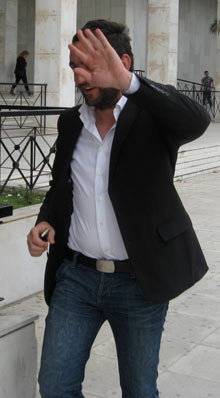
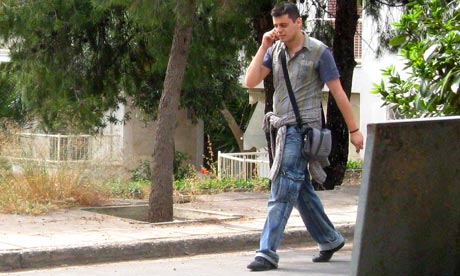
Charlie Skelton has been writing about trying to cover Bilderberg for the Guardian. Getting wind that the event was taking place in Greece, near Athens, he flew out to check it out. He then spent the next few days being followed by undercover policemen (pictured) and having his hotel room repeatedly broken into. Skelton comes across as primarily a humour writer, and his unsuccessful attempts to take photographs of Bilderberg attendees and to shake off his obvious tails are pretty funny, as is his increasingly frazzled mental state. But his writing begs some obvious questions. Like, why are Bilderberg meetings so secret? I know that these days it is impossible for two important people to meet for a cup of coffee without a load of crusties showing up to protest against them, but, even so, the veil of total secrecy that surrounds Bilderberg seems a bit obsessive. The fear of protesters is all very well, but it does not even explain the retrospective secrecy about Bilderberg meetings – the non-disclosure by attendees that they were even at this obviously important gathering. This goes a bit further – if Skelton could find out about this event then so could the media generally, so why were there not loads of proper journalists in Greece to cover this meeting of the great and the good?

One thing you hear about Bilderberg meetings is that they only take place in hotels with golf courses. I wonder if any have ever been held in Ireland?

27 April, 2008

Conference on Democracy in Africa

Given current events in Zimbabwe, there is a certain topicality to a conference taking place on 21st May next in the Royal Marine Hotel, in Dun Laoghaire. Organised by The African Voice, its title is When Will Democracy Work in Africa. You can read all about it here: Africa Conference. They seem only to have a PDF version of the conference programme, so here, pasted in, are the descriptions of the promised speakers:

"- Mr Phakiso Mochochoko, Senior Legal Advisor (Registry) at the International Criminal Court (ICC) the Hague, Holland on whether there can be lasting peace (democracy) without justice


"- Dr. Petros B. Ogbazghi (PhD)on social exclusion of Africans


"- Mr.Aki Stavrou, Director Integrating Ireland on conflict and peace

- Her Excellency Mannete Ramaili Ambassador-Kingdom of Lesotho on 'Women in Africa: where are they; where should they be?'


"- Maurice Manning, Irish Human Rights commission, will deliver closing remarks"

My old classmate Mark Little is MCing (word), and they are also promising a free lunch and an exhibit on tourism in Africa.

01 October, 2007

Conference on Russia

If you live in Ireland, have ninety quid to throw away, and are interested in Russia then you could do worse than go the Royal Irish Academy's Committee for International Affairs conference on the 23rd November. The full title of the conference is Russia's Global Perspective: Defining a New Relationship with Europe and America, and if you follow the link you can see the impressive list of speakers they have. Well, the ones I have heard of are very impressive, so I assume the others are too.

21 November, 2006

I love conferences

I love conferences. You get to hang out with important people and feel like you are part of some great scholarly community, even if you are a just a master student who lurks at the back and says nothing. And you get to go to receptions with free bouze - it's like being an undergraduate again.

I am going to the Royal Irish Academy conference on The Rise of Asia in International Affairs this coming friday. Spy school have not really covered this area so much, so I am looking forward to the RIA filling in the gaps.

The RIA are also hosting the annual Graduate Research Seminar in International Relations on thursday. This event features people talking about the exciting research they have undertaken in the field. My hope is that it will help to trigger research ideas in my own mind.

Look forward to write-ups of these events, hopefully less interminable than the account of my last conference attended.

02 November, 2006

Nice work if you can get it

I have a new hero: Stephen McVeigh of the University of Swansea, who is delivering a paper on The Galactic Way of War: Warfare in the ‘Star Wars’ Universeon the wednesday at the annual British International Studies Association conference, taking place next month in Cork*. Christ, I could write that in my sleep, talking about pre-Westphalian models of political organisation coexisting with oddly modern ideas of ideology. I must get my act together and submit them a paper on the International Relations of Star Trek: The Next Generation for next year.

You are probably too late to book for this event, as they are being a bit Realist about reservation deadlines. And it costs a fortune as well.

*Cork is not actually in Britain.

02 October, 2006

Conference: Palestine as 'State of Exception': a Global Paradigm (part three)

You may recall part one and part two.

Gargi Bhattacharyya talked about how the Palestinian issue has become an emblematic one for anti-globalisation and anti-capitalist people, with it often being said that it is the defining struggle of our time. While this has obvious benefits, it has the downside that the Palestinians themselves get reduced to ciphers, with their actual struggle rendered almost invisible by its appropriation by the opponents of the current world system. There is also the problem that although the Palestinian struggle is currently chic, it may soon go out of fashion, leaving the Palestinians high and dry. As someone with a sceptical view of the anti-globalisation movement, I found myself wondering if the Palestinians conscription by the that lot alienates support from middle-of-the-road people; the dispossession of the Palestinians has little or nothing to do with neo-liberalism, so bundling the two things together produces unlikely bedfellows.

Dr. Bhattacharyya also talked about race, and about how the West has in the context of the War on Terror moved towards seeing Muslims as an existential threat to Our Way Of Life; this is akin to how the Israeli establishment paints the Palestinians. The UK authorities, meanwhile, has moved away from multicultural models of integration for immigrants, seeing these as promoting self-segregation, and instead have moved towards a new model of authoritarian assimilation, with those clinging to other ways of life seen as hating freedom.

Bobby Sayyid talked about the resonance Palestine has for Muslims throughout the world. He finds this resonance interesting and not readily explainable – Muslims who have never been to Palestine or met anyone who was there still feel a great personal attachment to the issue. Dr. Sayyid also talked about how this general Muslim engagement with the Palestinian struggle can be somewhat abstracted and removed from the real-life experience of that people. Instead, the Palestinian issue becomes a metaphor for all Muslims who are struggling against oppression. Sayyid felt that without the engagement of Muslims world-wide with Palestine, the issue would have lost its salience.

I did find myself wondering how the Palestinian issue would resonate with people who are themselves being colonised by Muslims – the good folk of West Papua, say. If the struggle of the Palestinians has become a metaphor not of resistance against oppression but of Muslim resistance against repression of Islam then maybe the Palestinian struggle could lose its cachet with the kind of anti-globalisation people Dr. Bhattacharyya was talking about, if bolshy Muslims and anti-globalisation ever become decoupled.

Conor McCarthy was the last speaker, talking about Edward Said and his theories of the state. A lot of this was situated in a world of literary critical theory with which I am not that familiar, so I struggled a bit, with the lateness of the hour not helping. The paper name-checked such exciting characters as Gramsci, Foucault, and Poulantzas. Dr. McCarthy talked about how Said looked at the Zionist project from the point of view of those on whom it impacted, and on how he looked at the genealogy of Zionism as a concept. Beyond that, Said was perturbed by the disconnection between Israeli and Palestinian self-narratives.

General Points on the Conference

One thing that really struck me about this conference was the absence of any real Palestinian voice or any sense of Palestinian agency. Dr. Lentin had in her opening remarks to the conference discussed how this was going to be a conference about Palestinians in which their voices would be articulate. In practice, though the papers seemed to be all about things being done to the Palestinians or things other people were doing purportedly on their behalf.

Another feature was the absence of Israeli voices. Dr Lentin pointed out in her closing remarks that three of the academics who scheduled to speak were Israeli citizens, but these were either Palestinian Israelis or dissidents like Ilan Pappe whose opinions are completely beyond the pale of normal Israeli opinion. If the conference had lived up to its billing as a vehicle for articulating and analysing Palestinian viewpoints, then the marginalisation of any kind of Israeli voice would make more sense. In practice, though, large parts of the conference were devoted to things the Israelis are doing to the Palestinians, and the lack of any attempt to see things from their point of view made them seem disembodied and ahistorical, a decontextualised and inhuman force rather than the human citizens of a country.

In some ways, though, the above is just nitpicking on my part, and should not be taken as indicating any overall lack of satisfaction with the conference proceedings.

(ends)

01 October, 2006

Conference: Palestine as 'State of Exception': a Global Paradigm (part two)

Remember part one?

On the second day, Raef Zreik opened by talking about the constitutional setup in Israel. Legal theory imagines other countries as moving from a chaotic revolutionary situation where all metaphorical gloves are off to one bound by constitutional niceties, while in Israel the revolutionary state of emergency has remained in being while the forms of constitutionality have been adopted. He also mentioned an odd feature of the country – that the state notionally exists not just for the benefit of its actual inhabitants, but also for all Jews everywhere, giving Israel a notional constituency several times larger than its actual citizenry.

Honaida Ghanim began with an account of a named Palestinian woman who found herself giving birth at an Israeli army checkpoint, losing the child. She discussed the incident in terms of it being almost the perfect atrocity, and then went on to talk about the Palestinians living in a situation of endlessly terminable bare life, subject to total biological control by the Israeli powers that be. More sociology.

Laleh Khalili discussed the relationship of Hezbollah with the Palestinian issue. This was for me one of the most interesting of all the papers delivered at the conference, perhaps because it was more to do with politics than sociology. Dr. Khalili talked about how Hezbollah have painted themselves as the champions of the Palestinians, taking numerous symbolic and actual acts in their favour. However, she cast the relationship as being not entirely symbiotic, with Hezbollah being prepared to subordinate Palestinian concerns to the party’s own interests. Thus, Hezbollah organised commemorations of the Sabra & Shatila massacres that focussed on the small number of Lebanese Shia Muslims killed, obscuring the far greater number of Palestinians killed. For Lebanese political reasons, Hezbollah invited speakers from the Amal party to speak at the commemorations, despite its role in killing numerous Palestinians during the camps war of the mid-1980s. Dr. Khalili went on to talk about how Hezbollah’s symbolic attachment to Jerusalem obscures the city’s status as an actually existing place in which real people struggle to maintain their lives, echoing themes covered in my beloved’s unpublished MA thesis.

Ronit Lentin then talked about Zochrot, this being an Israeli Jewish organisation which seeks to commemorate the Palestinian Nakba (the Nakba being the Arab language term for catastrophe used to denote the founding of the state of Israel and the associated dispossession and exiling of numerous Palestinians). Zochrot organises trips for Israeli Jews to places that were once Palestinian towns or villages. They place signs in Arabic and Hebrew showing the localities’ old names and arrange for the places’ former inhabitants to talk of their dispossession. Lentin was somewhat critical of this fascinating organisation, partly because their trips can often traumatise Palestinians who must re-experience the Nakba for them, and partly because Zochrot proletarianises the Palestinian victims of the Nakba by making them performers of misery recreation for Zochrot tourists. More crucial, however, was Lentin’s disdain for Zochrot’s politics, or Zochrot’s de facto lack of politics. They commemorate the Nakba, but they are a bit vague on whether they are calling for the Nakba’s victims (and descendants) to be able to return to the country in which they used to live. Meh, that seems like ultra-leftism to me – what Zochrot does is more important than what they call for.

During lunch, they showed two short films by Tamar Goldschmidt, apparently downloadable from http://www.mahsanmilim.com - Abu Dis Report and Qalandiya Report. These are both about crossings through the Wall that Palestinians use if they are coming to Jerusalem. Abu Dis is a surreal spot – it is a section of wall standing on its own, with fencing on either side of it, fencing that has had holes knocked through it so that people can climb through it and enter Jerusalem without showing papers to Israeli soldiers. The film is an endless succession of people climbing through the gap, carrying an endless variety of stuff to or from Jerusalem. The surrealism of the whole thing is accentuated by the musical accompaniment – an early Zionist song about the wonderful country they were going to build in Palestine. Qalandiya Report showed people moving through the checkpoint at Qalandiya, the entry point to Jerusalem from Ramallah and the northern West Bank. The passage looked amazingly chaotic, with enormous numbers of people having to crowd through a handful of turnstiles as they waved their papers at Israel conscripts. However, the piece lost some of its power with me because it was filmed about a year before I was in Palestine. The Qalandiya checkpoint had changed greatly by then (and has probably changed even more since), becoming much less chaotic and more efficient, though still somewhere that anyone interested in the Palestinian-Israeli conflict should visit.

One odd thing for me with both these films and the earlier use by Professor Goldberg of an image of an Israeli settlement on a West Bank hilltop was the nostalgia they evoked – while intended as images of oppression, they reminded me of places I had been to on holidays.

24 September, 2006

Conference: Palestine as ‘State of Exception’: a Global Paradigm (part one)

I went to this conference recently in Trinity College Dublin’s Institute for International Integration Studies. In her introductory comments, Ronit Lentin of IIIS and TCD talked about Edward Said’s ideas regarding the distinctness of Palestinian history as distinct to that of the Arab world generally – the Palestinian experience of oppression and rolling dispossession has created a uniquely Palestinian identity. The idea behind this conference was to discuss the Palestinian experience in the context of ideas around state security regimes developed by Carl Schmitt, Michel Foucault, and Giorgio Agamben. The term ‘state of exception’ is a literal translation of the German Ausnahmezustand, or state of emergency; the Palestinian identity has been shaped by near continuous experience of such a state of exception. However, the rest of us are seeing states of emergency becoming institutionalised as part of the War on Terror – as rights are taken away, the state of exception becomes increasingly unexceptional.

Usual caveats apply – my description of what the speakers had to say relies on my scratchy notes and what my faulty memory recalls about the event. I therefore apologise in advance to any of the speakers who stumble across what I have written and find that I have completely misrepresented them.

The conference’s first proper speaker was David Theo Goldberg. He talked about how Palestinian racial identities have been constructed, more in terms of how Zionist settlers and later Israelis defined “Palestinians” rather than how the locals defined themselves. Early ideas of the Arabs of Palestine as people over whom a benign hegemony could be asserted evaporated in the face of determined (if ineffectual) resistance to the Zionist project, leading to a switch in which the Palestinians were recast as an endlessly demonized and bestial Other. That leads to the Palestinians being in practice stripped of any rights they might expect to have in a normal liberal democratic polity, reduced to the status of what Agamben would call homo sacer, a state of bare life where one exists merely at the whim of the dominant party. This was all pretty interesting, but a bit heavy on the sociology for me. And I did think that maybe Professor Goldberg was going a bit overboard when he said that in the current War on Terror, with the continuous erosion of civil liberties, we are all Palestinians, or potential Palestinians; I don’t think there is any real likelihood of some cockfarmer putting a wall and a load of checkpoints between me and where my parents live.

Ilan Pappe spoke next. While not exactly a household name, he is one of the most important of the Israeli “New Historians”. He talked about the ongoing campaign of ethnic cleansing that the Palestinians have had to contend with since the fighting that erupted in the last months of the Mandate. In the past, such things were swept under the carpet within Israel, but more recently the past expulsion of Palestinians has come to be seen as a necessary part of the creation of the Israeli state. More recently, some Israelis have become exercised by the fear that Palestinians will outbreed them and become a majority in the territory west of the Jordan river – the so-called “demographic problem”. Dr. Pappe ties this fear to the essentially unquestioned idea with Israel – that the less Palestinians there are within the country’s borders, the better; Right and Left differ only in how they propose to advance this goal – by expulsion or by redrawing borders.

Dr. Pappe then went on to talk about how the Palestinians have responded to their rolling dispossession. The first strategy was based on nationalism and attempting to cast their struggle as one of anti-colonialism. This was the approach of Yasser Arafat, Fatah, and the mainstream of the PLO. It led to the creation of the Palestinian Authority and the limited self-rule of pockets of Palestinian territory, but it has proved to be a failure. Dr. Pappe sees its failure as being intrinsic to its status as a nationalist discourse – the world, seeing a conflict between a Palestinian nationalism and an Israeli nationalism attempted to broker a kind of compromise between them, but one based on partition that had no viability (I am not entirely clear whether Dr Pappe is talking of the non-viability of partition based on creating a Palestinian state on all of the territory in Mandate Palestine beyond Israel’s pre-1967 borders, of if he means the attempts by Clinton et al. to railroad Arafat into an agreement that sees Israel gobble up all of Jerusalem and large swathes of the West Bank. Dr Pappe would probably feel that the problem with either of these is that they do nothing for the victims of past expulsions – those rotting in refugee camps in Lebanon are not going to be returning).

The second strategy of the Palestinians has been to rely on Islamism as mobilising strategy. While this is still ongoing, Dr Pappe does not see it as having any great likelihood of bringing about an improvement in the situation. He therefore turns to the third strategy, one only now emerging – one of post-nationalism where human rights rather than religious zeal or national rights would be the focus of demands for a halt to the dispossession of Palestinians and a reversal of past expulsions. Dr Pappe talks of campaigning for the emergence of a single state west of the Jordan River, where no religious, national, or ethnic group enjoys any kind of ascendancy over any other.

Now, this might sound utopian, but Dr Pappe sees this as a more credible goal to strive for than something based on national or religious particularism. I do not know if I agree with him on this, but the failure of the other strategies to yield any positive results is striking. Dr Pappe notes how ethnic cleansing is now widely seen as an unacceptable act. The US State Department’s own mission statement stating an uncompromising commitment to the absolute right of refugees to return to their countries of origin, so it’s not like advocating the right of return for Palestinian refugees should be seen as some kind of ultra-leftist madness.

(part two to follow shortly)
30 August, 2006

Edge of Darkness

My old college pal David Landy is organising a conference: PALESTINE AS ‘STATE OF EXCEPTION ': A GLOBAL PARADIGM.

One amusing feature of this is that it stars Ilan Pappe, an Israeli academic. Pappe has played a leading role in advocating a boycott of Israeli academia similar to that which apartheid era South Africa was subjected. So I should really boycott any talk he delivers, but instead I am signing up to hear him speak. Here is a great short article by Pappe on the Israeli legal system: 'In Court'.

I think the conference title draws on the ideas of political and social scientists like Giorgio Agamben, who talk about how it is the ability of states to suspend the normal niceties of constutional rule that defines them. Malcolm Bull reviewed Agamben's States of Exception in the LRB earlier this year: 'States don’t really mind their citizens dying (provided they don’t all do it at once): they just don’t like anyone else to kill them'.

(You'll need to be a subscriber of the London Review of Books to read those linked to articles in full)