Final Episode
In the short term, the successful ouster of Mubarak is likely to lead to more protests in other Arab countries. There has already been unrest in Yemen and Libya, two countries with long-serving leaders who have, like Mubarak, considerably outstayed their welcome; it will be interesting to see whether this intensifies. There are also reports of emerging unrest in Algeria, where a thuggish military clique has been in power since not long after independence, and also in Sudan.
Whether the reformist wave spreads to the monarchies will be interesting. I suspect that the Gulf oil plutocracies may well prove immune to serious pressures for democratisation, but the likes of Jordan and Morocco may find their regimes under serious threat if a wind of change blows through the rest of the Arab world. Whether unrest spreads to Syria will also be interesting to see. Syria has been ruled by the same family since the early 1970s and has the usual underperforming economy of Arab countries, but it is a bit of an outlier in other respects, being perhaps the most rigidly authoritarian country in the region but also the one Arab country that is still an enemy of the West* and Israel. The latter maybe gives the Syrian regime a credibility that the various US-backed kings and dictators elsewhere lack.
The really interesting possible contagion effect of the Egyptian protests could be in Iran. The Iranian regime announced a while ago that it supported the Egyptian protests because they were akin to the 1978-1979 protests that brought down the Shah and brought the Islamic Republic into being. However, opposition figures in Iran have drawn similarities between the Egyptian protests and Iran's own protests against last year's rigged presidential election. There is talk of Iranians taking to the streets to support Egypt's revolution and then implicitly or explicitly demand democratic change at home, something the country's power elite do not want to happen.
In the longer term, the country with most to lose from the transition in Egypt is Israel. Even if a new government in Egypt does not go to war with Israel or start arming Palestinian militants, any government in a more democratic Egypt is going to be less accommodating of Israeli interests than Mubarak was. Israeli leaders will therefore be watching developments in Egypt with some nervousness. In particular, it will be interesting to see whether Egypt continues to assist Egypt in maintaining the siege of Gaza (up to now Mubarak had been keeping the Gazan-Egyptian frontier largely closed). I find it hard to see how any democratically based Egyptian government can continue doing Israel's work for it, so some opening of Gaza's southern border is to be expected. I am not sure what the Israeli government would do in response, though I note their tendency to respond with extreme violence whenever a problem presents itself.
At the moment, Egypt receives an enormous amount of aid from the United States of America. If Egypt moves to a more confrontational relationship with Israel then this aid is likely to dry up. I am not sure how much of a loss this would actually be to Egypt, as much of it comes in the form of tanks, airplanes, and other toys for the Egyptian armed forces – does anyone know if a significant proportion of it comes in more socially useful forms? Either way the loss of this aid would hurt Egypt, so a less confrontational line towards Israel may be pursued in the hope of hanging onto at least some of it.
*The extent to which Syria is actually an enemy of the West is a bit arguable; it is more that successive American regimes are hostile to it, for all that they are happy to subcontract torture and intelligence gathering to the Syrian security services. American hostility stems from Syria's support of Hezbollah in Lebanon and its reluctance to accept a one-sided peace deal with Israel. Syria's attempts to run Lebanon as a client state, meanwhile, cause problems in its relations with other western countries, notably France.
From Hunting Monsters
Showing posts with label Egypt. Show all posts
Showing posts with label Egypt. Show all posts


13 February, 2011
After Mubarak: Part 2 - The Spectre of the Muslim Brotherhood
One fear consistently expressed about a transition in Egypt is that it would lead to a takeover by the Muslim Brotherhood and the institution of an Iranian-style Islamic Republic. This apocalyptic scenario was implicitly or explicitly evoked by Mubarak and his defenders, with the old man painted as the only thing stopping the mad mullahs from going on a maniacal rampage. A takeover by the Muslim Brothers and an Islamic Republic is not particularly likely in Egypt, however. One thing seen elsewhere is that while Islamist parties have considerable appeal in Muslim and Arab countries, they never seem to really command majority support from voters. So long as Egypt adopts some kind of electoral system with a significant measure of proportional representation then a parliamentary majority for the Muslim Brothers is unlikely. Of course, if Egypt ends up with a non-proportional electoral system, particularly one that gives significant rewards to the largest party, then the country could find itself with an accidental parliamentary majority of the Muslim Brothers.
However, it seems that the Brotherhood is already taking steps to ensure that it does not end up having to rule Egypt. Its leaders have said that they will not be fielding a candidate in presidential elections, an indication that they seem happy enough to remain in opposition. In parliamentary elections they may well follow the example of their fellow in Jordan, where the Islamists fielded sufficiently few candidates that it would have been impossible for them to win a majority. It seems, oddly, that Islamists like being in opposition. This may be because they have spent so long there that they do not have any kind of realistic government programme (the Muslim Brothers in Egypt have a tendency to say "Islam is the answer" when asked any awkward question).
The other reason why the Muslim Brotherhood may choose to lose is the example of what happened elsewhere when Arab Islamists won elections. In 1992 in Algeria an Islamist party looked like winning that country's first ever free elections. The military responded with a coup that plunged the country into a horrific civil war, receiving the full backing of western powers in this attack on democracy. In 2006, when Islamists unexpectedly won elections to the parliament of the Palestinian Authority and formed a government there, the international community responded by cutting off its financial support of the PA and, in the USA's case, attempting to subvert it. It is easy for Islamist parties to conclude, therefore, that political power is a prize that internal and external actors will prevent them from exercising, so it is better just to be a big opposition party rather than the party of government.
One other factor making an Islamic Republic on the Iranian model unlikely is the differing nature of Islam in Egypt and Iran. Iranian Muslims are mostly Shia, while in Egypt Sunnis predominate. Sunni Islam does not feature the kind of hierarchical clergy found in Shia Iran, so there is no monolithic clerical caste to assume the kind of leadership role the ayatollahs in Iran did. It is also noticeable that the Muslim Brotherhood is a mostly lay organisation, with relatively little involvement by Muslim clergy. That is not to say that it could not theoretically impose its vision on society, but it would not be putting Iranian-style Ayatollahs in the driving seat.
In any case, it seems like the Muslim Brothers look more to Turkey, hoping to be like that country's government of friendly Islamists who are no more threatening than European Christian Democrats or the various God Botherers who infest American politics. You may not like these people, but your not liking them does not make their participation in politics illegitimate.
From Hunting Monsters
However, it seems that the Brotherhood is already taking steps to ensure that it does not end up having to rule Egypt. Its leaders have said that they will not be fielding a candidate in presidential elections, an indication that they seem happy enough to remain in opposition. In parliamentary elections they may well follow the example of their fellow in Jordan, where the Islamists fielded sufficiently few candidates that it would have been impossible for them to win a majority. It seems, oddly, that Islamists like being in opposition. This may be because they have spent so long there that they do not have any kind of realistic government programme (the Muslim Brothers in Egypt have a tendency to say "Islam is the answer" when asked any awkward question).
The other reason why the Muslim Brotherhood may choose to lose is the example of what happened elsewhere when Arab Islamists won elections. In 1992 in Algeria an Islamist party looked like winning that country's first ever free elections. The military responded with a coup that plunged the country into a horrific civil war, receiving the full backing of western powers in this attack on democracy. In 2006, when Islamists unexpectedly won elections to the parliament of the Palestinian Authority and formed a government there, the international community responded by cutting off its financial support of the PA and, in the USA's case, attempting to subvert it. It is easy for Islamist parties to conclude, therefore, that political power is a prize that internal and external actors will prevent them from exercising, so it is better just to be a big opposition party rather than the party of government.
One other factor making an Islamic Republic on the Iranian model unlikely is the differing nature of Islam in Egypt and Iran. Iranian Muslims are mostly Shia, while in Egypt Sunnis predominate. Sunni Islam does not feature the kind of hierarchical clergy found in Shia Iran, so there is no monolithic clerical caste to assume the kind of leadership role the ayatollahs in Iran did. It is also noticeable that the Muslim Brotherhood is a mostly lay organisation, with relatively little involvement by Muslim clergy. That is not to say that it could not theoretically impose its vision on society, but it would not be putting Iranian-style Ayatollahs in the driving seat.
In any case, it seems like the Muslim Brothers look more to Turkey, hoping to be like that country's government of friendly Islamists who are no more threatening than European Christian Democrats or the various God Botherers who infest American politics. You may not like these people, but your not liking them does not make their participation in politics illegitimate.
From Hunting Monsters
12 February, 2011
After Mubarak: Part 1
I am writing on the day after Egypt's vice president, Omar Suleiman, announced that President Hosni Mubarak had resigned and handed power to what is basically a military junta. The situation in the country remains fluid, but I will nevertheless now attempt to sketch some likely future developments.
Mubarak's resignation does not represent a full democratic transition. The regime he headed basically remains in place. His former colleagues may be hoping that in throwing him to the wolves they can preserve their own positions of power. My feeling, however, is that they will not be able to succeed in this endeavour. If it becomes too obvious that they are just attempting to perpetuate themselves in power then the pressure for change will rise again. I see things in Egypt as developing a bit like they have been going in Tunisia, with initially mild reforms being followed by more far-reaching changes to the political system. My prediction is that Egypt will move inexorably towards fully competitive elections.
One thing I hope to see in Egypt is the dismantling of the Mukhabarat and thuggish security apparatus that was so in evidence during the period of protests. If the establishment faction remain able to haul in and torture opponents or send in street thugs against their political opponents then a full transition will not take place. It looks to me that the freedom protesters have grasped this point too, with their demands for an end to Egypt's interminable state of emergency marking a desire for a normal kind of politics where the secret police torturer has no place. Again, my feeling is that with the regime in retreat it will have to bow to the popular will in this area.
So, what will a democratic Egypt look like? One thing that will be interesting to see is whether the reform process just adds competitive elections into the existing constitutional setup, or if there is some attempt to sit back and think about what kind of political setup would best suit the country. I reckon the former is more likely, so Egypt will find itself with a directly elected and powerful president, and a prime minister responsible to an elected parliament – a new member of the family of semi-presidential nations. This is probably unfortunate – a purely parliamentary system of government might be more conducive to managing the democratic transition, as it avoids the concentration of power you get with executive presidents and the tiresome turf wars that can erupt between presidents and prime ministers; a parliamentary system would also require a more broadly based coalition government. However, the experience of transitions elsewhere is that people tend not to really think that much about institutional issues until well after a system has embedded itself, so I do not expect a purely parliamentary system to emerge.
Aside from institutional issues, there is the question of what political groupings will be influential in a post-transition Egypt. At the moment, Egypt has two big parties (the ruling National Democratic Party and Muslim Brotherhood) and a load of small parties. I suspect that unless it is forcibly dissolved, the NDP will remain a player in Egyptian politics, largely due to institutional inertia (I am partly basing this prediction on the continued existence of former communist parties in Eastern Europe after the transition there). However, neither the NDP or the Muslim Brotherhood is that well-placed to really dominate politics. The NDP is the old regime institutionalised, so it is hardly going to pick up mass support from a public eager for change. The Muslim Brotherhood, meanwhile, is by its very nature not really in a position to pick up support from outside its core constituency. It also has an odd self-defeating streak that I will return to later. That seems to mean that the general reformist tendency that brought people out onto the streets is up for grabs. In the period before elections take place I expect to see parties and politicians emerging and scrambling to try and capture this elusive constituency.
From Hunting Monsters
Mubarak's resignation does not represent a full democratic transition. The regime he headed basically remains in place. His former colleagues may be hoping that in throwing him to the wolves they can preserve their own positions of power. My feeling, however, is that they will not be able to succeed in this endeavour. If it becomes too obvious that they are just attempting to perpetuate themselves in power then the pressure for change will rise again. I see things in Egypt as developing a bit like they have been going in Tunisia, with initially mild reforms being followed by more far-reaching changes to the political system. My prediction is that Egypt will move inexorably towards fully competitive elections.
One thing I hope to see in Egypt is the dismantling of the Mukhabarat and thuggish security apparatus that was so in evidence during the period of protests. If the establishment faction remain able to haul in and torture opponents or send in street thugs against their political opponents then a full transition will not take place. It looks to me that the freedom protesters have grasped this point too, with their demands for an end to Egypt's interminable state of emergency marking a desire for a normal kind of politics where the secret police torturer has no place. Again, my feeling is that with the regime in retreat it will have to bow to the popular will in this area.
So, what will a democratic Egypt look like? One thing that will be interesting to see is whether the reform process just adds competitive elections into the existing constitutional setup, or if there is some attempt to sit back and think about what kind of political setup would best suit the country. I reckon the former is more likely, so Egypt will find itself with a directly elected and powerful president, and a prime minister responsible to an elected parliament – a new member of the family of semi-presidential nations. This is probably unfortunate – a purely parliamentary system of government might be more conducive to managing the democratic transition, as it avoids the concentration of power you get with executive presidents and the tiresome turf wars that can erupt between presidents and prime ministers; a parliamentary system would also require a more broadly based coalition government. However, the experience of transitions elsewhere is that people tend not to really think that much about institutional issues until well after a system has embedded itself, so I do not expect a purely parliamentary system to emerge.
Aside from institutional issues, there is the question of what political groupings will be influential in a post-transition Egypt. At the moment, Egypt has two big parties (the ruling National Democratic Party and Muslim Brotherhood) and a load of small parties. I suspect that unless it is forcibly dissolved, the NDP will remain a player in Egyptian politics, largely due to institutional inertia (I am partly basing this prediction on the continued existence of former communist parties in Eastern Europe after the transition there). However, neither the NDP or the Muslim Brotherhood is that well-placed to really dominate politics. The NDP is the old regime institutionalised, so it is hardly going to pick up mass support from a public eager for change. The Muslim Brotherhood, meanwhile, is by its very nature not really in a position to pick up support from outside its core constituency. It also has an odd self-defeating streak that I will return to later. That seems to mean that the general reformist tendency that brought people out onto the streets is up for grabs. In the period before elections take place I expect to see parties and politicians emerging and scrambling to try and capture this elusive constituency.
From Hunting Monsters
07 February, 2011
A History of Egypt: Episode 4 – Mubarak
Conluding my brief series introducing the history of modern Egypt
Sadat was succeeded by his vice president, Hosni Mubarak. He has been in power ever since. He largely continued Sadat's policies – maintaining the peace treaty with Israel, the economic liberalisation, and the pro-US orientation of Egyptian foreign policy. More recently, Egypt has been assisting Israel in maintaining the siege of Gaza, merely the latest manifestation of Mubarak's traditional foreign policy.
Mubarak's economic policies (largely continued from the Sadat era) continued to show no obvious benefit to the Egyptian masses. Instead a shifty business elite, often comprising people with close links to Mubarak and his political cronies, seemed to become ever richer.
Politics remained essentially authoritarian, based around Mubarak and his National Democratic Party, with only the merest democratic trimmings around the edges. The Muslim Brotherhood (still technically illegal, but semi-tolerated) continued to be the most prominent opposition grouping. By this stage this group had largely embraced the political process over violence. The regime was too entrenched for it to directly challenge, so the Brothers concentrated on setting up charitable foundations and creating a parallel network to Mubarak's state.
However, the Muslim Brotherhood was not the only Islamist game in town. Seeing the Brotherhood as having gone soft, some were attracted to more hard core groups who carried out a series of unpleasant terrorist attacks on tourists (e.g. the Luxor massacre), regime figures, and Egypt's indigenous Christian community.
On the eve of the current round of protests, the elderly and not particularly healthy Mubarak seemed nevertheless to be secure in power. Few people liked him very much, but he seemed to have ridden out any challenges to his regime and was grooming his idiot son Gamal to succeed him. The Muslim Brotherhood appeared like a spent force, having failed to bring an end to Mubarak and suffering increased state harassment of their charitable and political activities. The headbanger Islamists had largely been crushed or had drifted off to fight the Americans in Iraq or Afghanistan. The secular opposition to Mubarak, while substantial in numbers, was leaderless, disorganised, and ineffective. The Grim Reaper looked like the only serious threat to Mubarak's continued rule.
Sadat was succeeded by his vice president, Hosni Mubarak. He has been in power ever since. He largely continued Sadat's policies – maintaining the peace treaty with Israel, the economic liberalisation, and the pro-US orientation of Egyptian foreign policy. More recently, Egypt has been assisting Israel in maintaining the siege of Gaza, merely the latest manifestation of Mubarak's traditional foreign policy.
Mubarak's economic policies (largely continued from the Sadat era) continued to show no obvious benefit to the Egyptian masses. Instead a shifty business elite, often comprising people with close links to Mubarak and his political cronies, seemed to become ever richer.
Politics remained essentially authoritarian, based around Mubarak and his National Democratic Party, with only the merest democratic trimmings around the edges. The Muslim Brotherhood (still technically illegal, but semi-tolerated) continued to be the most prominent opposition grouping. By this stage this group had largely embraced the political process over violence. The regime was too entrenched for it to directly challenge, so the Brothers concentrated on setting up charitable foundations and creating a parallel network to Mubarak's state.
However, the Muslim Brotherhood was not the only Islamist game in town. Seeing the Brotherhood as having gone soft, some were attracted to more hard core groups who carried out a series of unpleasant terrorist attacks on tourists (e.g. the Luxor massacre), regime figures, and Egypt's indigenous Christian community.
On the eve of the current round of protests, the elderly and not particularly healthy Mubarak seemed nevertheless to be secure in power. Few people liked him very much, but he seemed to have ridden out any challenges to his regime and was grooming his idiot son Gamal to succeed him. The Muslim Brotherhood appeared like a spent force, having failed to bring an end to Mubarak and suffering increased state harassment of their charitable and political activities. The headbanger Islamists had largely been crushed or had drifted off to fight the Americans in Iraq or Afghanistan. The secular opposition to Mubarak, while substantial in numbers, was leaderless, disorganised, and ineffective. The Grim Reaper looked like the only serious threat to Mubarak's continued rule.
06 February, 2011
A History of Egypt: Episode 3 – Sadat
Continuing my exciting series on the History of Egypt
When Nasser died, he was succeeded by his vice president, Anwar Sadat. In 1973, Sadat joined with the Syrians in launching a surprise attack on the Israelis. Although the Israelis ultimately prevailed, Egyptian national pride was restored by their army's creditable performance. Sadat launched a diplomatic offensive that led to a peace treaty with Israel and their withdrawal from the Sinai. This led to a period of Arab World isolation for Egypt.
Sadat also reversed Nasser's orientation towards the Soviet Union, seeking out a new alliance with the United States of America. Nasser's socialist experiments domestically were replaced by a new policy of Infitah (opening), whereby the Egyptian economy was liberalised and foreign investment welcomed. This created an Egyptian business elite without obviously benefiting the country's masses, but they may well have been even worse off if Nasserite socialism had continued.
In 1981 Sadat suffered the unfortunate fate of being murdered by disgruntled army officers at a parade commemorating the 1973 crossing of the Canal by Egyptian forces. His killers were Islamists angered by the peace treaty with Israel. There was a certain irony to Sadat's fate – he had previously encouraged Egyptian Islamists to counter leftist opposition to his Infitah policies.
When Nasser died, he was succeeded by his vice president, Anwar Sadat. In 1973, Sadat joined with the Syrians in launching a surprise attack on the Israelis. Although the Israelis ultimately prevailed, Egyptian national pride was restored by their army's creditable performance. Sadat launched a diplomatic offensive that led to a peace treaty with Israel and their withdrawal from the Sinai. This led to a period of Arab World isolation for Egypt.
Sadat also reversed Nasser's orientation towards the Soviet Union, seeking out a new alliance with the United States of America. Nasser's socialist experiments domestically were replaced by a new policy of Infitah (opening), whereby the Egyptian economy was liberalised and foreign investment welcomed. This created an Egyptian business elite without obviously benefiting the country's masses, but they may well have been even worse off if Nasserite socialism had continued.
In 1981 Sadat suffered the unfortunate fate of being murdered by disgruntled army officers at a parade commemorating the 1973 crossing of the Canal by Egyptian forces. His killers were Islamists angered by the peace treaty with Israel. There was a certain irony to Sadat's fate – he had previously encouraged Egyptian Islamists to counter leftist opposition to his Infitah policies.
05 February, 2011
A History of Egypt: Episode 2 – Nasser
Continuing my exciting series on the History of Egypt
In 1948, Egypt joined other Arab states in sending its armed forces to assist the Palestinians in their struggle against the emerging Israeli state. Egyptian forces performed rather badly in this conflict, undermining support for the monarchy. In 1952, a military coup overthrew the monarchy. After a power struggle, Colonel Gamel Abdel Nasser became Egypt's president. He was the first ethnic Egyptian leader of his country since the pharaohs*.
Nasser negotiated a British withdrawal form the Canal Zone and then embarked on a radical series of reforms. He also shut down the parliamentary system that had existed under the monarchy, setting up a purely authoritarian system of government based on himself. And he began to orient the country towards the Soviet Union. Nasser cut a charismatic dash and became something of a hero across the Arab world. He even achieved a short-lived union of Egypt and Syria, seen as a possible harbinger of a future united Arab state.
When the secular nationalist character of Nasser's programme became clear, he earned himself the enmity of the Muslim Brotherhood. He suppressed their conspiracies against him and executed their chief ideologue, Sayyid Qutb.
When Nasser went and nationalised the Suez Canal, he earned the pathological hostility of the British government. They joined with Israel and France in attacking Egypt, reoccupying part of the Canal Zone. However, the invasion failed when the USA refused to support it. The three invaders withdrew and Nasser's stock soared.
From there, however, it was downhill for him. His economic reforms ran out of steam. In 1967, Egypt found itself at war with Israel again. This time the Israelis destroyed the Egyptian armed forces in an embarrassingly brief and one-sided campaign. The Israelis also occupied the Sinai Peninsula and the east bank of the Suez Canal, closing off this vital source of foreign exchange. Nasser was humiliated, and died a broken man in 1970.
*I have to qualify this statement. The Kings of Egypt had been of Albanian extraction, but by the time of the monarchy's overthrow they had lived in Egypt for around a hundred years, and could arguably be taken to have become naturalised. Nasser was also preceded as Egypt's president by General Muhammed Naguib, an ethnic Egyptian, but during this brief period real power lay with Nasser.
In 1948, Egypt joined other Arab states in sending its armed forces to assist the Palestinians in their struggle against the emerging Israeli state. Egyptian forces performed rather badly in this conflict, undermining support for the monarchy. In 1952, a military coup overthrew the monarchy. After a power struggle, Colonel Gamel Abdel Nasser became Egypt's president. He was the first ethnic Egyptian leader of his country since the pharaohs*.
Nasser negotiated a British withdrawal form the Canal Zone and then embarked on a radical series of reforms. He also shut down the parliamentary system that had existed under the monarchy, setting up a purely authoritarian system of government based on himself. And he began to orient the country towards the Soviet Union. Nasser cut a charismatic dash and became something of a hero across the Arab world. He even achieved a short-lived union of Egypt and Syria, seen as a possible harbinger of a future united Arab state.
When the secular nationalist character of Nasser's programme became clear, he earned himself the enmity of the Muslim Brotherhood. He suppressed their conspiracies against him and executed their chief ideologue, Sayyid Qutb.
When Nasser went and nationalised the Suez Canal, he earned the pathological hostility of the British government. They joined with Israel and France in attacking Egypt, reoccupying part of the Canal Zone. However, the invasion failed when the USA refused to support it. The three invaders withdrew and Nasser's stock soared.
From there, however, it was downhill for him. His economic reforms ran out of steam. In 1967, Egypt found itself at war with Israel again. This time the Israelis destroyed the Egyptian armed forces in an embarrassingly brief and one-sided campaign. The Israelis also occupied the Sinai Peninsula and the east bank of the Suez Canal, closing off this vital source of foreign exchange. Nasser was humiliated, and died a broken man in 1970.
*I have to qualify this statement. The Kings of Egypt had been of Albanian extraction, but by the time of the monarchy's overthrow they had lived in Egypt for around a hundred years, and could arguably be taken to have become naturalised. Nasser was also preceded as Egypt's president by General Muhammed Naguib, an ethnic Egyptian, but during this brief period real power lay with Nasser.
04 February, 2011
A History of Egypt: Episode 1 – the British Protectorate
The current pro-democracy protests in Egypt have put the country at the top of world news reports. For the benefit of readers who know next to nothing about this populous country, I present this brief history.
British commercial penetration of Egypt was followed by British political dominance and military occupation in the late 19th century. Egypt was never formally incorporated into the British Empire, retaining its own hereditary ruler (a Khedive, later a King) and government, but ultimate power lay with the British High Commissioner. Britain's main interest in Egypt stemmed from a desire to protect the Suez Canal, a vital link to India.
British indirect rule situation persisted well into the 20th century, despite a rise in Egyptian nationalism in the 1920s and 1930s. After the Second World War, Britain withdrew its military forces from most of Egypt, remaining only in vicinity of the Canal. The assumption was that the country would remain a firm British ally.
The British period saw the emergence of the Muslim Brotherhood, the Arab world's longest lasting and most influential Islamist movement. The Muslim Brothers staged a sometimes violent campaign against the monarchy and the British occupation, both of which responded in kind.
British commercial penetration of Egypt was followed by British political dominance and military occupation in the late 19th century. Egypt was never formally incorporated into the British Empire, retaining its own hereditary ruler (a Khedive, later a King) and government, but ultimate power lay with the British High Commissioner. Britain's main interest in Egypt stemmed from a desire to protect the Suez Canal, a vital link to India.
British indirect rule situation persisted well into the 20th century, despite a rise in Egyptian nationalism in the 1920s and 1930s. After the Second World War, Britain withdrew its military forces from most of Egypt, remaining only in vicinity of the Canal. The assumption was that the country would remain a firm British ally.
The British period saw the emergence of the Muslim Brotherhood, the Arab world's longest lasting and most influential Islamist movement. The Muslim Brothers staged a sometimes violent campaign against the monarchy and the British occupation, both of which responded in kind.
09 September, 2008
Egypt: Perv Capital of the World?
Egypt is famous for its ancient sites – the Pyramids, temples too numerous to count, plus more recent Islamic sites from the Fatimid Caliphate and the Ayyubids and Mamelukes that followed it. Increasingly, though, Egypt is attracting note for a less savoury reason – the country is increasingly being scene as one of the world capitals for male pervs, where women cannot walk the streets without being harassed and leered at. Over the last few years, there have been some particularly gross incidents, such as the mass groping by pro-government pervs of women opposition activists. There was also the 2006 incident in Cairo where large mobs of pervs used the celebrations of the Eid religious festival as an excuse to assault any woman unlucky enough to cross their path. But these seem not to be isolated incidents, but part of an endemic pattern of male perving. recent article in which some Egyptian women talk about as they go about their daily lives.
Egypt is not the only country in the Arab world (or the world generally) where male pervs are a significant problem, but it does seem a particular centre for sexual harassment and antediluvian gender politics. It is easy for those of us in the West to proffer lazy explanations for this kind of behaviour, with many no doubt saying that Islam is to blame for the ordeal Egyptian women endure. This is, however, simplistic. You would struggle to find anything in the Koran or the sayings of the Prophet and his companions to support the idea that women in public places are fair game to pervs. Likewise, I doubt there are any contemporary religious scholars who would see the assaulting of women on the streets as approved by Islam. In reporting on the Eid incidents, it was noted that both veiled and unveiled women were equally subject to attack, suggesting that the motivation here was not entirely religious. And the oppositional women mentioned above would probably have included devout women supporters of the Muslim Brothers, so the attack on them cannot be seen as some kind of obscurantist religious crackdown.
Some Egyptians quoted by the BBC have suggested that the country's problem with pervs is a product of the country's stagnation and economic dysfunction, with many young men unable to find the financial security they need before they can marry. In this line of thinking, their unmarried status leads to sexual frustration, which boils over into the harassment and assault of women in public places. I think this argument is maybe also simplistic, and it seems to make young Egyptian men into automatons unable to control their urges, but I reckon it does push the argument into a potentially more useful direction. Ultimately, Egypt's problem with sexual harassment is a social problem, and it may well have to be addressed in the context of the country's overall stasis and deep-seated gender inequalities.
Incidentally, it would be wrong to say that all Egyptian men are pervs - reports suggest that many of them are as shocked by the actions of their fellow men as people like us are.
Egypt is not the only country in the Arab world (or the world generally) where male pervs are a significant problem, but it does seem a particular centre for sexual harassment and antediluvian gender politics. It is easy for those of us in the West to proffer lazy explanations for this kind of behaviour, with many no doubt saying that Islam is to blame for the ordeal Egyptian women endure. This is, however, simplistic. You would struggle to find anything in the Koran or the sayings of the Prophet and his companions to support the idea that women in public places are fair game to pervs. Likewise, I doubt there are any contemporary religious scholars who would see the assaulting of women on the streets as approved by Islam. In reporting on the Eid incidents, it was noted that both veiled and unveiled women were equally subject to attack, suggesting that the motivation here was not entirely religious. And the oppositional women mentioned above would probably have included devout women supporters of the Muslim Brothers, so the attack on them cannot be seen as some kind of obscurantist religious crackdown.
Some Egyptians quoted by the BBC have suggested that the country's problem with pervs is a product of the country's stagnation and economic dysfunction, with many young men unable to find the financial security they need before they can marry. In this line of thinking, their unmarried status leads to sexual frustration, which boils over into the harassment and assault of women in public places. I think this argument is maybe also simplistic, and it seems to make young Egyptian men into automatons unable to control their urges, but I reckon it does push the argument into a potentially more useful direction. Ultimately, Egypt's problem with sexual harassment is a social problem, and it may well have to be addressed in the context of the country's overall stasis and deep-seated gender inequalities.
Incidentally, it would be wrong to say that all Egyptian men are pervs - reports suggest that many of them are as shocked by the actions of their fellow men as people like us are.
26 January, 2008
JAILBREAK

Yes, this is another post about the busting down of the southern wall surrounding the Gaza Strip. The Egyptian authorities have responded to pressure from Israel, the USA, and unspecified members of the shadowy "International Community" by making ineffectual attempts to reseal the border. These attempts have failed, not least because some Palestinian scamps have used a bulldozer to knock more holes in the wall surrounding them.
 One interesting thing about this is how the Palestinians have turned the tools of their enemies against them. You can see from the enclosed pictures that the bulldozer used to smash down the wall has been manufactured by Caterpillar. The Caterpillar company is often criticised for supplying the bulldozers used to destroy Palestinian homes or kill American political activists, but on this occasion its products are serving the interests of the oppressed.
Pictures from BBC articles: In pictures: Gaza border breached & Gazans make new border wall hole
23 January, 2008
BORSTAL BREAKOUT!
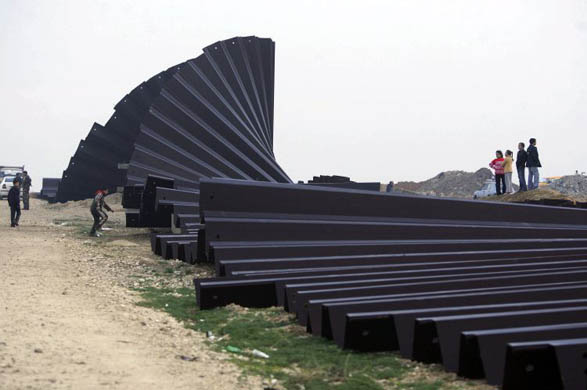
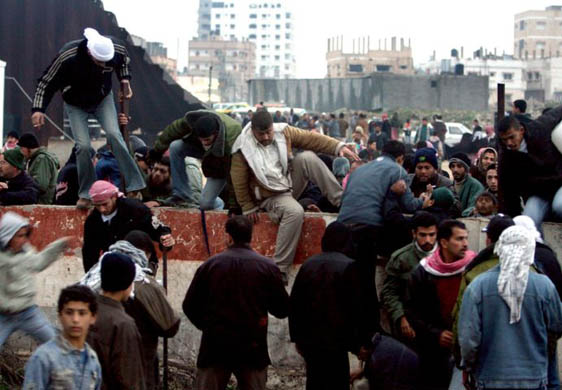 I mentioned recently how Gaza lost electricity as Israel cut off fuel supplies to the area's only power station. But then the Israelis relented, and released some fuel supplies to the Gaza Strip, while maintaining the general siege. Today, however, the people of Gaza were able to freely cross into Egypt, thanks to Hamas' demolition of large chunks of the wall on the Gaza-Egypt border. Palestinians in Gaza with money were able to buy things for the first time in a while.
Aside from the obvious visual symbolism of walls being torn down, the incident is interesting in terms of the pressures it puts on Middle East players. When Israel withdrew its colonists and ground forces from Gaza, they negotiated a deal with the Egyptians, whereby the latter would guard the Egypt-Gaza border. However, the deal was meant to be that the Egyptians would guard the border to orders from Israel, denying entry and exit as the Israeli state directed. This has largely broken down, partly because the Egyptian regime is unwilling to risk the opprobrium that would result from its putting the boot in on behalf of the Israelis. So, late last year, the Egyptian authorities defied Israel by allowing pilgrims from Gaza to return home after the Hajj. In some respects, though, the Egyptian leaders are making a virtue of necessity. Under the terms of their peace agreement with Israel, they can deploy only limited security forces in the Sinai peninsula; thus they would be very stretched were they to try and crack heads to rebuild the wall.
It will be interesting to see whether the Fatah government of Mahmud Abbas comes under pressure to try similar tactics against the Israeli wall on the West Bank. It is likely that the Israelis would respond to any such attempt with maximum force.
Pictures from Palestinians flood into Egypt (Guardian)
05 May, 2007
The Biter Bit
I have been reading about electoral systems in the Middle East. These are typically used by regimes to mimimise the amount of seats won by the opposition in elections (usually in conjunction with other measures, like throwing opposition activists or candidates in jail, banning some of the opposition parties, or straightforwardly rigging the election results). My current favourite regime manoeuvre is one used in Egypt at one point. They had a list system of proportional representation, but with a high threshold of 8% - any party getting less than that proportion of the vote got no seats in the parliament (this at a time when the opposition was rather fragmented). The stroke of genius was a ruling that any votes for parties getting less than the threshold were to be counted as votes for the goverrning party.
Turkey either is or is not in the Middle East, depending on who you talk to. They are having some interesting political stuff at the moment. The Turkish Prime Minister Recep Tayyip Erdogan wants to make Abdullah Gul, one of his party colleagues the country's president. As the president is chosen by the parliament, and as Erdogan's Justice & Development party has a handsome parliamentary majority, there should be no problem here... except that Justice & Development is an Islamist party, and Turkey's army does not like the idea of an Islamist president and prime minister.
Some have apparently taken to complaining that although the governing party has a massive majority in parliament, they achieved this on on something puny like only 30% of the popular vote. Amusingly, they managed this because the country has a comedic electoral system specifically designed to weaken the Islamists.
Turkey either is or is not in the Middle East, depending on who you talk to. They are having some interesting political stuff at the moment. The Turkish Prime Minister Recep Tayyip Erdogan wants to make Abdullah Gul, one of his party colleagues the country's president. As the president is chosen by the parliament, and as Erdogan's Justice & Development party has a handsome parliamentary majority, there should be no problem here... except that Justice & Development is an Islamist party, and Turkey's army does not like the idea of an Islamist president and prime minister.
Some have apparently taken to complaining that although the governing party has a massive majority in parliament, they achieved this on on something puny like only 30% of the popular vote. Amusingly, they managed this because the country has a comedic electoral system specifically designed to weaken the Islamists.
Subscribe to:
Posts (Atom)

