I was at an interesting talk the other night to launch the book Thinking Palestine*, a collection of essays based on papers delivered at that conference on the Palestinian "state of exception" I was at a while back. I will discuss the talk and the book in more detail later, but first an anecdote. Ronit Lentin, the editor of the book, mentioned a piece by Eyal Weizman, in which he discussed how some Israeli army training centre has taken on some crazy post-structuralist academics. The use of post-modernist and post-structuralist ideas in army training is apparently part of a whole new paradigm in urban warfare tactics the Israelis have been developing. After graduating from their course, the Israeli soldiers apply their post-structuralist ideas in a somewhat over-literal manner, deconstructing Palestinian houses by driving tanks through them.
As previously noted, elements of the Bush administration have also evinced a certain fondness for weirdo post-modernist ideas.
*Ronit Lentin (ed) (2008). Thinking Palestine. London: Zed Books
Showing posts with label PostModernism. Show all posts
Showing posts with label PostModernism. Show all posts
22 November, 2008


05 December, 2007
The Postmodern White House
 You may recall that I was discussing theoretical approaches to International Relations. That ran into the ground a bit, sadly before I reached any of the more entertaining theories. One day I will climb back on the wagon.
In the meantime, an entertaining thing to do can be to look at real world political leaders or organisations, and try to work out what is their theoretical perspective. Take George W. Bush (please, take him*). Like most people, he probably does not think of himself as having a theoretical perspective, he just does things he reckons will advance whatever goals he happens to have at hand. Or maybe he just does things (the whole idea of people actually having clearly defined goals that they rationally work to advance is surprisingly problematic when applied to real situations). However, one can still look at what he says and does and attempt to deduce the perspectives that guide him, even if they are subconscious.
The Bush regime is sometimes seen as embodying a realist view of international relations, with all that willingness to project US power wherever they like and tell anyone who doesn't like it to shag off. But the current US administration is also often seen as being driven by liberalism, albeit a kind of crusading bad-ass liberalism far removed from the stereotypes of hand-wringing whingey liberalism. From this point of view, it is Bush's liberalism that drove him to invade loads of countries and threaten bloody war on others - he is trying to make the world a better place, and you can't make an omelette without breaking eggs.
 It might be, though, that in trying to place the White House in terms of the old-school big two of International Relations theory, people are missing the point big time. We live now in the 21st century, and the Enlightenment derived certainties that drove people in the past are looking distinctly frayed around the ages. Realism and liberalism are both approaches from within the tired Enlightenment tradition... could it be that in our post-Enlightenment era, the current US administration is driven by post-modern ideas?
In 2002, some journalist fellow called Ron Suskind talked with a Senior White House Figure. The SWHF took issue with something the journalist had written, and berated him for belonging to a "reality-based community", defined as being people who "believe that solutions emerge from your judicious study of discernible reality". The SWHF went on talk about how the world no longer conforms to this paradigm: ''We're an empire now, and when we act, we create our own reality" (SWHF quotes from this article by Ron Suskind: Faith, Certainty and the Presidency of George W. Bush)
A key feature of the postmodern worldview is to repudiate the idea of objective reality. Instead, people construct a reality for themselves. Ideas and theories become more important than mere facts, and if you can get enough people to believe something you have created your own reality. Suskind's contact suggests that at least some people in the White House buy in to this kind of postmodern perspective.
 The last few days have seen another example of the Bush regime's postmodern view of reality. Over the last while, the Bush administration has been talking a lot about how Iran has a nuclear weapons programme and how something needs to be done about it; that "something" is implicitly war of one sort or another. However, US intelligence officials have released a report that says that there is strong evidence to support the idea that the Iranian regime halted its nuclear weapons programme in 2003. While one could argue that this evidence supports the idea that a tough Western policy forced the Iranians away from nuclear weapons, it severely undermines the idea that Iran needs to be invaded or fucked up to stop it acquiring nuclear weapons in the very near future. President Bush, however, is determined to press ahead with his policy of ramping up sanctions against the Iranian regime, possibly as a way of building tensions that will have the way towards a US strike. Bush's response to the inconvenient, reality-based report of his intelligence community has been to ignore it - instead he has rhetorically urged Iran to come clean about its non-existent nuclear weapons programme. In doing so, he is attempting to conjure such a programme into being, at least in so far as it can be used as pretext for war.
Pictures from, in order: Wikipedia, Wikipedia, and the BBC.
* Thank you, I am here all week
20 August, 2007
Palestine's Post-Modern Future
You may or may not have heard of Professor Alan Dershowitz. When he is not calling for the legalisation of torture, he is doing his bit to help solve the Israeli-Palestinian dispute. He has in mind the emergence of a Palestinian independent state that will be comprised of the Gaza Strip and a number of non-contiguous blocks of territory on the West Bank. This might sound like a recipe for bantustanisation, but Professor Dershowitz thinks otherwise. Rather in this world of instant communications and cheap and fast travel non-contiguity need not be a barrier to the creation of a viable state. Or so a review of Dershowitz's "The Case for Peace" reports that he says.
19 March, 2007
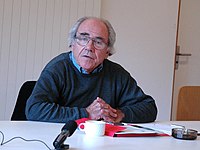
Jean Baudrillard
You may recall that I was working through the world of International Relations theories. This process is currently in hiatus, but eventually I hope to discuss what post-modernists have to say on the subject. Jean Baudrillard was one of the leading figures in this area, and you may have noticed that he died recently. Or maybe, he has not died but ascended into a realm of pure representation, like that Barry O'Blivion guy in Cronenburg's Videodrome (I am surely not the first person to make the comparison).
Momus comments on the difference between English and French language obituaries of Baudrillard, with the francophone world engaging with his ideas and anglophone obituaries focussing on his largely misunderstood claim that the first Gulf War had not taken place and on his apparently being the inspiration for well-known film The Matrix. The latter point is particularly comedic, suggesting that Baudrillard ran around in leather coats wearing wrap around shades and forgetting the obvious point, made by Baudrillard himself, that the film is a rather facile distillation and adaptation of his views. This is life.
On the first point, about the Gulf War not happening: my recollection is that Baudrillard, like many post-modernists, reckoned that in our hypermediated age events are less significant than their representation. Therefore, the endless rolling news reportage of the war becomes what counts, not the war itself. While I see what he is getting at here, I do not quite remember what he means by saying that the War did not happen (as opposed to it being of less significance than its media portrayal). Maybe the point is intended rhetorically. It does though call to mind a very real problem with the writings of Baudrillard (and of post-modernists generally): they are by and large written in a largely impenetrable manner. Baudrillard does at least have the excuse of foreignness - he cannot answer for the opacity of his translations. Having read other English-language post-modernist writers, however, it does appear that there is a post-modern writing style, one that Baudrillard's translators have captured well.
To see what I mean, check out Baudrillard's 'The Mask Of War', a nice short piece that appeared in some book called 1000 Days of Theory. It is a while since I read it closely, but my recollection is that there is an interesting point in there somewhere, but I cannot see it now.
Momus comments on the difference between English and French language obituaries of Baudrillard, with the francophone world engaging with his ideas and anglophone obituaries focussing on his largely misunderstood claim that the first Gulf War had not taken place and on his apparently being the inspiration for well-known film The Matrix. The latter point is particularly comedic, suggesting that Baudrillard ran around in leather coats wearing wrap around shades and forgetting the obvious point, made by Baudrillard himself, that the film is a rather facile distillation and adaptation of his views. This is life.
On the first point, about the Gulf War not happening: my recollection is that Baudrillard, like many post-modernists, reckoned that in our hypermediated age events are less significant than their representation. Therefore, the endless rolling news reportage of the war becomes what counts, not the war itself. While I see what he is getting at here, I do not quite remember what he means by saying that the War did not happen (as opposed to it being of less significance than its media portrayal). Maybe the point is intended rhetorically. It does though call to mind a very real problem with the writings of Baudrillard (and of post-modernists generally): they are by and large written in a largely impenetrable manner. Baudrillard does at least have the excuse of foreignness - he cannot answer for the opacity of his translations. Having read other English-language post-modernist writers, however, it does appear that there is a post-modern writing style, one that Baudrillard's translators have captured well.
To see what I mean, check out Baudrillard's 'The Mask Of War', a nice short piece that appeared in some book called 1000 Days of Theory. It is a while since I read it closely, but my recollection is that there is an interesting point in there somewhere, but I cannot see it now.
12 August, 2006
Virtual War
I hope eventually to trundle along through the magic of IR theory, bringing you eventually to the magic of post-modernism in so far as it relates to my discicpline. In the meantime, ILX brought me to an article by Eyal Weizman called Israeli Military Using Post-Structuralism as “Operational Theory” which originally appeared in the journal Radical Philosophy. I'm not saying this article is brilliant or anything (I've only barely skimmed it myself), but it seems illustrative of the type.
Subscribe to:
Posts (Atom)

