31 October, 2009

Sad Tony's EU Fail

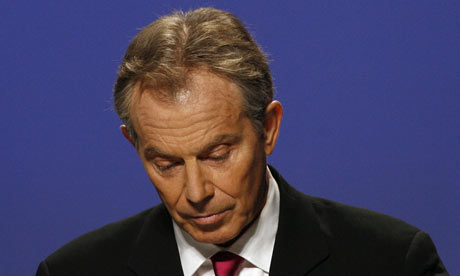
Tony Blair's attempt to become EU President has failed. President Sarkozy of France and Chancellor Merkel of Germany seem to have decided that they were never really in favour of his candidacy, leaving Gordon Brown and Italy's charming Silvio Berlusconi as Blair's only serious backers; Ireland's Brian Cowen had also lent his support. Tony Blair can now go back to his day job of sitting on boards of companies and giving speeches to American neo-cons. In his spare time he will be able to continue his good work bringing the Israel-Palestine conflict to a conclusion.

I am starting to wonder if this President Blair thing was all some kind of complicated joke. In retrospect, how could he ever have been a serious candidate? Aside from his being a cockfarmer, he headed a euro-sceptic government that kept Britain out of the Euro and negotiated opt-outs from everything for his country. This hardly makes him an attractive person to take on the job of being Mr EU.

19 October, 2009

A flawed and one-sided post about Israel's Gaza campaign

Do you remember last January, when the Israeli army was once more blowing up everything they could in the Gaza Strip? At the time, there was a lot of discussion about whether war crimes had been committed. Partly this arose from the Israeli army's indiscriminate shelling and the targeting of Gaza's infrastructure as a way of punishing everyone there for the actions of militants who fired rockets over the border. There were also reports of instances where Gazan civilians were herded into buildings by Israeli soldiers, only for these buildings to then be shelled. It was also suggested that actions by Hamas and other militant groups (firing un-aimed rockets at Israeli towns) were also contrary to the laws of war.

A United Nations fact finding mission, headed by Richard Goldstone, looked into the accusations of war crimes. Goldstone's team found that there had been extensive war crimes committed by Israeli forces, and recommended that the perpetrators be indicted for trial by an international court. The report also mentioned human rights abuses by Hamas and the other militant groups operating in Gaza, but the main thrust dealt with crimes by the Israelis.

Normally, when a UN report identifies people as having committed these kind of crimes, the wheels of international justice start turning, and people who have been accused of doing bad things find themselves on their way to trial in the Hague or before some other international tribunal. That is what happened with previous investigations with which Goldstone was involved. In this case, however, something different happened. The United States of America, and other allies of Israel (notably Germany and the United Kingdom), dismissed the report as flawed and one-sided, and procedural rules were used to prevent the report coming before the UN Security Council.

For many years now it has been the case that whenever some respected body issues a report on human rights abuses have been committed by Israel, the USA leaps in to condemn the report as "flawed" and "one-sided". Only Israel seems to receive this kind of protection, and when the same bodies issue reports on human rights abuses by other actors, the USA is happy to see them trigger an international response. That the new administration of Barack Obama is continuing in this tradition is depressing. It suggests that behind his shiny rhetoric, his government is continuing the same morally bankrupt policies of Bush and Clinton.

One argument that has been expressed for burying the Goldstone report is that it would set back the peace process if Israeli officers (and politicians?) find themselves in danger of arrest for war crimes. The idea here is that it is better to choose peace over justice, and to forget past crimes so that Israelis and Palestinians can move forward to a peaceful and happy future. This kind of argument might have some purchase in other conflict situations. In the Israel-Palestine situation, it is nonsense. There is no credible peace process at the moment. Furthermore, there is unlikely to be one until the USA demonstrates a willingness to rein in Israel. If the USA remains intent on sheltering Israeli criminals then it cannot hope to broker any kind of settlement.


Some more links:

Prospect of war crimes trials in Middle East alarms US diplomats (Irish Times, 30/9/2009)

Goldstone defends UN Gaza report (BBC, 30/9/2009)

Abbas seeks vote on Gaza report (BBC, 12/10/2009) The USA had leaned on Mahmoud Abbas, head of the Palestinian Authority, getting him to support the shelving of the Goldstone Report. As can be imagined, this played very badly within Palestine. In an effort to not look like a complete pawn of the West, he has now called for the UN Human Rights Council to vote on the report.

13 October, 2009

Turkey's Ironic Peace Statue


Here is a more human interest story about the Armenia-Turkey peace process. It is about Naif Alibeyogluin, the former mayor of Kars, in Turkey, who decided to build a monument to peace, showing two stylised figures on the brink of shaking hands. Although Kars is in Turkey, local geography means that when floodlit at night the statue is visible across the Armenian border, 40 kilometres away. The statue is meant to symbolise the Armenian and Turkish peoples overcoming their troubled past and joining together in friendship.

The fact that Mr Alibeyogluin is the former mayor of Kars is significant. Many people in Turkey are unconvinced by the desirability of friendship with Armenia. Local politician Oktay Aktas of the National Action Party asserted that one of the figures has their head bowed – taking this as signifying Turkish guilt over the Armenian genocide, an event that Turkish
law says never happened. Mr Aktas sees the statue as indicating an Armenian desire to take over eastern Turkey, and has vowed to demolish it. In recent elections, Mr Alibeyogluin found himself sidelined by his own Justice and Development party, with someone else taking the mayoral title.

The future of Mr Alibeyogluin's monument to peace remains uncertain.

see also

12 October, 2009

Turkey, Armenia, and the Armenian diaspora

Armenia and Turkey are two countries that have long had a fractious relationship, largely arising over the Armenian genocide of 1915, in which the Ottoman Empire massacred over a million ethnic Armenians. Recently, there have been moves towards some kind of rapprochement between the two countries. I do not know the details of the engagement between them, but it is interesting to note that the Armenian diaspora community (many of whom are descended from survivors of the genocide or of people who were expelled from Anatolia during it) seems to be very against the rapprochement.

Armenia's president, Serzh Sarkisian, has felt obliged to tour the Armenian diaspora, in an effort to head-off opposition to his Turkish policy. His success in this endeavour seems to be a bit mixed – earlier this week he had to be shielded by Lebanese cops from angry Lebanese-Armenian demonstrators. I do not know what exactly in the Armenia-Turkey engagement the diaspora are objecting to, but I find it interesting that the Armenian president finds it worth his while to try to secure the exile community's support for his policy. I am assuming that the Armenian diaspora does not get to vote in Armenian elections, but it still seems to be important for him to engage with them.

I am not sure if there has been any general research done on the role of diasporas in conflict situations. The other obvious one I can think of is the role of the exile Palestinian community in the Israel-Palestine conflict, but I understand that ethnic diasporas have been important factors in the Sri Lankan and Aceh conflicts. Working from first principles, I can imagine a strong diaspora to be a major complicating factor in the search for a settlement. On the one hand, they have relatively little to lose by the continuance of a conflict, while oftentimes they are not going to gain anything by its resolution. Diaspora interests will often diverge from those of the non-exile community, so a settlement that works for one community could not be acceptable to the other.

That is not to see diasporas as "bad", or as groups that have to be marginalised or blocked if a conflict is to be settled. If they are in a position to block settlements, then they should be engaged with as another actor in the conflict. Maybe it would be best to break the fiction of their sharing an identity of interests with the home community, and instead give them some kind of separate representation at negotiations. This might depend on the specifics of any conflict.

Stop press: Armenia and Turkey today signed an accord, though they were unable to agree a statement on it.

some random links:

ARMENIA: KARABAKH TALKS POSES BIG CHALLENGE FOR ARMENIAN-TURKISH RAPPROCHEMENT

Lebanon Armenians angry over planned Turkey deal

Armenians anxious over Turkish plan

07 October, 2009

Europe's Malaise

Ireland voted last Friday to ratify the Lisbon Treaty, having voted last year to reject it. My understanding is that Ireland is the only country that has voted on the Treaty, with tradition and constitutional quirks here meaning that we always get to vote on EU treaties that other countries nod through their national parliaments. One problem, of course, with referendums is that you can never be quite sure that people will vote the right way; this is the second time that the Irish electorate have not played ball, and the second time they were then obliged to troop out and vote on the issue again. Whatever about the substantive issue of whether the Lisbon Treaty is a good idea or not, the whole process leaves a nastily undemocratic taste in the mouth. What is the point of voting on something if only a Yes vote is accepted?

When Ireland voted against Lisbon last year, there was a suggestion in some quarters that we had become a nation of ingrates – trousering the EU cash that had lifted the country out of penury only to stick two fingers up when the organisation tried to streamline its decision-making procedures. There might be something to this, but it ignores one crucial fact – the poor track record of EU treaties at referendums in other countries. Whenever the citizens of EU countries are given the opportunity to vote on any EU treaty, or the EU constitution, they have a marked tendency to vote No. If rejecting EU treaties is a mark of Euro-scepticism then the Irish people are no more Euro-sceptic than anyone else.

Too much can maybe be read into people's willingness to block EU treaties. Oftentimes the public seems to vote on the basis of things that have nothing to do with the treaty at hand – last time round, some Irish people rejected Lisbon out of a false belief that it would institute conscription here, while some French voters reputedly voted down the EU Constitution in 2005 thinking that it would lead to Turkey joining the Union. But still, the willingness of people to vote against EU treaties based on things that are not in them betokens a fundamental lack of trust in EU institutions and their leaders. This is a serious problem, but I am not sure what can be done about it.

One thing that is sometimes thrown out about the EU is its lack of democratic accountability. This argument is somewhat overstated – it is often said or implied that some shadowy Elders of Brussels make all EU decisions, when the main EU decisions are taken by the Council of Ministers or the European Council. These both comprising people who represent the governments that took office in the member states after democratic elections. Many of their decisions have to be approved by the European Parliament, but that body is an interesting example of how a body can be directly elected and yet still have little or no democratic legitimacy. With the European Council and Council of Ministers, we are looking at people who got where they are as a result of elections, but is still a bit remote from the public will.

One example of how remote the EU decision making apparatus is from the public is the case of a new office created by the Lisbon Treaty – the president of the European Council. The actual powers of this office have been left a bit vague, and the president's main role will be to chair Council meetings (as is, the chair of the European Council rotates every six months). It has been reported that the favourite for this new office is none other than Tony Blair. This is, frankly, an astonishing development. It defies all common sense that Bush's warmongering sock puppet should be given any role by the European Union, let alone one that could lead to people calling him the President of Europe. There is, furthermore, Blair's status as the former head of a rejectionist government who refused to join either Schengen or the Euro. Yet, it is not clear at all how concerned European citizens could go about blocking Blair's accession, or how they could vote to prevent it.

Again, it is difficult to see institutional changes would make things better here. A directly elected president of the Council would be a bad idea, and would in any case piss off those people who moan about the EU going all federal on us. If the president of the European Council does nothing more than chair council meetings then arguably the members of the council should be the ones to pick who holds the office, as they are the ones who have to put up with their choice. But it still seems outrageous that Blair could end up with such a prestigious EU post, even if it is not clear what institutional changes could prevent it. This is maybe the problem with EU institutions in a nutshell – their faults are obvious, but what would improve them is less so.

28 September, 2009

Ireland decides, again

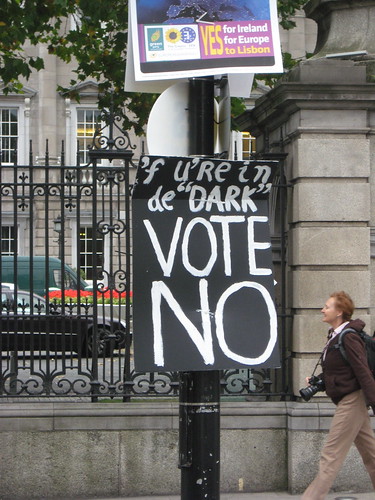
This whole post is basically an excuse to post the lovely picture above. Foreign readers may find it a bit confusing, so here is some context. Last year Ireland held a referendum on the Lisbon Treaty, an agreement reached between European Union heads of government. The Treaty was rejected by Irish voters, causing a sensation throughout Europe.

Next Friday we are going to be voting on the Treaty again. There are a couple of justifications for having another referendum. First of all, many people last year claimed to be confused by the whole Lisbon Treaty business, so maybe with the passage of time they will have made some effort to inform themselves. Secondly, the EU heads of government have made some non-binding guarantees on some of the concerns of the Irish voters. Thirdly, the astonishing deterioration of the Irish economy since the last vote suggests that now might not be the time to piss off our powerful European friends.

The pro-Treaty side in the referendum are basically the entire Irish political establishment, in so far as they are from almost all the parties that people actually vote for in elections. The implicit main plank of their campaign is that the country will go down the plughole if Lisbon is rejected, though they have never been quite so crude as to explicitly state this on election posters.

The anti-Treaty side mine a broad vein of disaffection. There is a tendency in some quarters to divide the antis into right-wingers (typically worried that the EU will force everyone to have abortions) and left-wingers (typically worried that the EU will draft everyone into an EU army or make everyone slaves of large corporations). I think, though, that more unites the antis than this kind of analysis suggests. They all distrust mainstream Irish politicians. They all fear that Lisbon represents a terrible and irrevocable loss of sovereignty, a transfer of power to some sinister and shadowy EU elite; the only difference is in what they think the EU overlords will do with that power.

Cóir are one of the players on the No side. I have heard it said that they spring from the same stream that gave us Republican Sinn Féin (a fringe Republican movement who reject the Good Friday Agreement and almost everything else) and Youth Defence (a hardline anti-abortion movement). I'm not going to link to their website, but if you go there you will get a flavour of their campaign against Lisbon – slogans suggesting that Lisbon would reduce the minimum wage to around two Euro, that Lisbon would eliminate the freedoms for which our country's founding fathers died, or that Lisbon would lead to an inrush of foreigners to this sceptred isle. The above image is a parody of one of their posters*. It is rather like shooting fish in a barrel, as the petty concerns of Cóir are godsends to people who support Lisbon.

A spice burger is a fast food product that bears some mysterious relationship to meat. "Away with you, you wife swapping sodomites!" was the celebrated response of a Catholic conservative to the passing of the referendum that legalised divorce.

Parody posters seem to be quite a thing this time round. Another Cóir parody I have seen points out that 98% of Europeans are foreign. On the other side, a subtly ironic poster has Adolf Hitler urging a Yes vote.

Meanwhile, here is a home-made election poster, probably not a parody:


*I apologise to Irish readers for stating the obvious to an almost Wikipedia-esque extent.

12 September, 2009

Fiji latest

Fiji is a Pacific island nation whose dysfunctional politics keep it in the news. The other day it was a visit by a Commonwealth envoy, who was there to discuss a possible return to democracy with the country's military ruler. It was previously part of the British Empire, and in that period many people from India came to the island, eventually playing a major role in the economic life of the island. After independence, the institutions of the state were initially dominated by ethnic Fijians. Over time, a politics based almost entirely on ethnicity surfaced in the country, with parties for ethnic Fijians squaring up against ones for ethnic Indians. In the 1980s, a coup by the ethnic Fijian dominated army blocked a government of mainly ethnic Indian parties (but to be led by an ethnic Fijian) from taking office.

Mahendra Chaudhry succeeded in taking office as the country's first ethnic Indian prime minister in 1999, but in 2000 he was imprisoned in a bizarre coup attempt by failed local businessman George Speight. Speight's coup failed, but the fall-out from it lives on. One consequence was that many ethnic Indians have given up on Fiji. They had constituted c. 50% of the population, but the manifest unwillingness of many ethnic Fijians to accept a prime minister from their community led many ethnic Indians to take the hint and leave the country.

Another consequence of Speight's coup is that it exposed fissures within the ethnic Fijian community. The 1980s coup against the instatement of an ethnic Indian prime minister was staged by the army, with that body seeming to maintain a formidable degree of cohesion as it acted to advance the interests of ethnic Fijians. Speight's coup, however, was staged by a failed businessman and his cronies. The army performed badly in the coup – its leaders (ethnic Fijians, like the rank and file; ethnic Indians seem to have better things to do than join the armed forces) declared for the constitutional government, but many of the rank and file seem to have sympathised with Speight.

Speight's ability to break the army's cohesion seems to have rankled with Commodore Frank Bainimarama, the army's commander in chief. My impression is that much of Fiji's politics since Speight's coup attempt is explicable by Bainimarama's personal animus towards Speight. To Bainimarama, Speight is responsible for the army's humiliation during his coup. It was moves by Prime Minister Laisenia Qarase to pardon Speight and his pals that saw Bainimarama stage a coup in 2006 that has brought democracy in Fiji to an end.

Bainimarama has promised elections at some stage in the future, but no one is holding their breath. His regime has reputedly become increasingly dictatorial, arresting and harassing its opponents. It nevertheless represents an interesting development – an authoritarian government of ethnic Fijians justifying itself by fears of how a democratic regime would lead to political oppression of ethnic Indians. Bainimarama might simply be paying lip-service to the lofty goals of inter-communal fairness as a way of seizing power for himself. Even so, the army's advancing of its own corporate interest cuts across the ethnic issues that torment Fiji.

Increasing cross-community opposition to Bainimarama is, paradoxically, another positive consequence of his coup. This might be a sign that Fijians are hoping for some kind of more normal politics, one based on constitutions and rules as opposed to poisonous inter-ethnic competition and coups every couple of years.

09 September, 2009

Trouble in Somaliland

Somaliland is the unrecognised country comprising the northern bit of Somalia. Compared to the rest of Somalia, it is an oasis of calm. Unfortunately, the country's tranquillity was on Monday shattered by its parliamentarians. When officials announced that a motion to impeach Dahir Riyale Kahin, the country's president, could be debated, a bar-room brawl erupted, with rival politicians exchanging punches. There are reports of one MP brandishing a fire-arm, though no shots were fired. Police had to enter the chamber to restore order.

Unlike the rest of Somalia, Somaliland has a functioning political system, with a president, an elected parliamentary chamber (where the brawl broke out), and an upper house comprising elders of the country's various clans. Tensions have apparently been rising recently over the timing of a presidential election and a disputed register of electors.

It would probably be premature to see all this as a sign that Somaliland is about to slip into the chaos of the rest of Somalia. Parliamentary fist-fights are always good for a laugh, but they do not necessarily presage democratic collapse. That this was just a fist-fight suggests that things in Somaliland are nothing like as bad as they could be.

The disputes over the presidential election are maybe more worrying. One danger facing Somaliland is a slide into Somalia-style anarchy. Another, though, is a transition to the kind of authoritarianism that bedevils many of its neighbours. If the disputes over the electoral register and the election's timing are symptoms of a power-grab by the president then people should be concerned. As Somaliland's independence is unrecognised, it may well be the case that the international observers who scrutinise elections elsewhere will not engage with the country's electoral process. This is unfortunate; in a potentially shaky situation, external oversight could deter either electoral chicanery by the government or vexatious claims of fraud by bad losers.

more

28 August, 2009

Hebron's dark history

Hebron is an extremely depressing town. Apart from East Jerusalem, it is the only Palestinian town on the West Bank under direct Israeli occupation. The town's centre is partitioned into an Israeli zone and a zone under Palestinian Authority administration. Both of these have substantial Palestinian majorities, but the Israeli sector is blessed by the presence of a couple of hundred Israeli settlers. These settlers are heavily armed, and are in turn protected by a large contingent of Israeli troops. In their sector, they typically occupy the upper stories of buildings, and are famed for their tendency to throw rubbish down on Palestinians making their way through the streets below.

The Israeli settlers in Hebron belong to the most hard-line section of Israeli society. Their most famous scion is perhaps Baruch Goldstein, who in 1994 made his way into a mosque during prayers and massacred 29 Palestinians before being overpowered and killed. Some argued at that stage that the Israeli government should have responded by evacuating his fellow settlers and then handing the entire town over to Palestinian administration. The Israeli government however demurred, leaving the settlers in place. This was perhaps the moment when people should have realised that the Oslo process would lead nowhere.

Israel's West Bank settlers are often religious nutters who claim a divine right to live anywhere in Biblical Israel. This is true of the Hebron settlers, but they also cite another justification for their presence in the town. Before the foundation of the state of Israel, Hebron also had a Jewish presence. In the British mandate period, increasing Jewish immigration to Palestine from those committed to political Zionism led to increasing tension. In 1929 in Hebron, many of the local Palestinians turned on their Jewish fellows. Many were killed (others survived, thanks to being sheltered by Palestinian neighbours and friends). The town remained unsafe for Jews until it was conquered by Israeli troops in 1967. The Hebron settlers claim that they are recreating the Jewish community that lived there before the riots.

One ironic feature of all this is that the actual Jewish survivors of the Hebron riots are far less solidly behind the settlers than one might imagine. It seems as though many of them back then were religiously Jewish but culturally Palestinian, often actively anti-Zionist in political outlook. Many of them and their descendants have retained something of this outlook, identifying more with the Palestinians in Hebron than with the Israeli settlers. While one would think that many would relish the opportunity to return to their ancestral home, a view expressed by many is that they could not return to Hebron until a just settlement with the Palestinians has been reached.

Links:
Long shadow of 1929 Hebron massacre (BBC)

Hebron Jews' offspring divided over city's fate
(Jerusalem Post)

27 August, 2009

Imminent solution of Middle Eastern conflict

The Guardian reported yesterday that the Middle East peace process is on the brink of a breakthrough. This seems to be taking the form of Barack Obama caving in to the demands of Binyamin Netanyahu, the unsavoury prime minister of Israel. Obama had been looking for Israel to announce a freeze of settlement activity on the West Bank, including in East Jerusalem. From what the Guardian is saying, however, it looks like Obama will agree to Netanyahu continuing to evict Palestinians from East Jerusalem; in the rest of the West Bank, Israeli settlement expansion will freeze, except that settlement expansion currently underway will be able to proceed to completion. To sugar the pill of these non-concessions, Obama will cheer Netanyahu up by adopting a new tougher line against Iran and its alleged nuclear ambitions.

It is astonishing that anyone could consider this a breakthrough in the Middle East peace process, or that anyone could take Israel's commitments seriously as confidence building measures. Obama seems to be adopting the usual Clinton-Bush mode of reaching agreements with the Israelis and then presenting these on a take-it-or-leave-it basis to the Palestinians. Obama is currently facing domestic problems, and may have decided to park the Middle East process until the health care issue has reached some kind of resolution. If so then maybe he could spare us the pretence that this is something that is going to effect a just and lasting resolution of the Israel-Palestine conflict.

Even if Obama's "breakthrough" leads to the resumption of negotiations, they are unlikely to lead anywhere. One problem has always been the tendency of US presidents to blow hard about their credentials as an honest broker, but then to simply take an Israeli line during the negotiations. Jonathan Freedland in the Guardian also suggests a more fundamental problem. Recent negotiations have invariably focussed on the post-1967 situation, with talk being about Israel generously giving to a Palestinian state some of the territory it seized that year. Freedland feels that the conflict is more fundamental, and needs to go back to the issues of 1948, when the Israeli was formed. He may be right, though this does sound a bit like one-stater talk.

One other problem making any kind of credible outcome from negotiations unlikely is the question of who speaks for the Palestinians. At the moment, there are two entities purporting to be the government of the Palestinian Authority. One of these was appointed by the PA's president under emergency powers he was not constitutionally entitled to wield; that president's term of office has in any case expired, yet he clings on to office. The other government came into being through the PA's own constitutional features, and is based on the party that won a majority of seats in the last parliamentary election. As is the way of things, it is the more mickey mouse of these two governments that is going to be taking part in any negotiations, making it unlikely that it will be able to make any agreement stick. In any case, neither of these governments can credibly claim to speak for the wider Palestinian refugee community.

I would not, therefore, advise anyone to expect a resolution of the Israel-Palestine conflict any time soon.

Links:

Barack Obama on brink of deal for Middle East peace talks
Peace plans come and go. Obama may have to try a wholly new approach
US peace plan gives Israel too much

25 August, 2009

Lockerbie relatives and their faith in legal systems

As you know, Abdelbaset Ali al-Megrahi was released from prison in Scotland and allowed to return home to Libya. Al-Megrahi had been convicted of causing the Lockerbie bombing, but was released by the Scottish government on compassionate grounds as he is terminally ill and due to die in the near future.

There are any number of interesting things that could be said about this case – the separate roles of the Scottish and UK governments, differing conceptions of what constitutes justice, and so on. One thing I was particularly struck by, though, was the differing attitudes of British and American relatives of those killed at Lockerbie. It was reported that while the US relatives were very angry about al-Megrahi's release, many of those in the UK were more sympathetic. This seemed to be related to doubts that have been raised about the safety of al-Megrahi's conviction (he had been appealing his conviction prior to his release, and still maintains his innocence), with many of the UK victims sharing doubts as to his guilt, doubts not shared by the Americans.

What interests me is why the UK relatives are more open to the idea of al-Megrahi's innocence. There might be deep-rooted cultural factors at play here, but something that must be significant here is the UK's experience over the last few decades with miscarriage of justice cases, where those convicted of high profile crimes (often of a terrorist nature) saw their convictions quashed years after their initial trials. These people were freed because it was shown that they had been convicted on the basis of such things as ludicrous forensic evidence or confessions extracted under torture. These cases must have planted the seeds of doubt in people's minds, establishing the idea that the authorities can get it wrong and can pin the blame for terrible crimes on the wrong people.

My understanding is the US justice system is not so rock solid that people are not sometimes convicted of crimes they did not commit. I have read of some analysis where innocent people were executed for crimes committed by others. However, I do not think that any of these miscarriage cases have become massive causes célèbres in the way that the cases of the Guildford 4, Maguire 7, Birmingham 6, Bridgewater 4, etc. did. This makes it easier for Americans to maintain a naïve confidence in the correctness of the judicial process. Britons, on the other hand, must find it far easier to believe that high-profile cases can produce miscarriages of justice.

This is not, by the way, to say that I believe in al-Megrahi's innocence or guilt, as I have not followed the case that closely. It is more the general idea of how much confidence people have in justice systems that I am interested in.

22 August, 2009

US Health Care Reform

The British media have noted that, in the current debate on Barack Obama's proposed health care reforms, the political right in the US have taken to characterising Britain's National Health Service as being some kind horrific amalgam of Stalin's gulag and the worst excesses of the Third Reich. Setting up anything even remotely similar to the NHS in the United States is being portrayed as an assault on fundamental freedoms, something that will lead to jack-booted Nazi doctors cackling as they deny treatment to your loved ones.

What is amusing about all this is that by any measure, the UK's health care system is better than that of the United States. The NHS costs less per capita than the USA's privatised health care "system", and it provides health care to the entire British population, whereas very large proportions of the US population are without health insurance and so without adequate health care.

So, who are the people in the USA who want to prevent any kind of move towards universal health care provision? I think they can be split into three groups:

1. Libertarians and market fundamentalists – this lot are people who oppose any state involvement in anything as a point of principle, not because they think it will lead to otherwise bad outcomes. I have every respect for the sincerity with which these people hold their beliefs, but their preconceptions are so strange that it is impossible to have any kind of rational discussion with them.

2. The US health insurance companies, and people in their pocket – the health insurers make a lot of money out of the current system, and they have a lot of money to throw around to buy lobbyists, journalists, and politicians. These people have a strong interest in keeping things as they are now, and most likely have no shame in spewing out lies to advance their interests.

3. Nutters who somehow hate universal health care because it would take away their freedom to die young because they can't afford health insurance.

At this stage it is not clear whether Obama's health care reforms will go through. It does seem like the opponents of functioning health care are succeeding in raising doubts in the minds of enough Americans to make the programme's passage far from certain. On the other hand, the people who oppose the health reform plans are adopting the increasingly strident tones that characterised Sarah Palin's supporters in the later stages of the recent presidential election campaign; this could mean that people increasingly see them for the crazies they are.

19 August, 2009

Borders open, regimes fall

It is now twenty years since Communism trundled off to the dustbin of history. This makes for an exciting series of 20th anniversaries. The first partially free elections in an Eastern Bloc state were held in June 1989 in Poland, with Solidarity doing so well that the communists were thrown out of office (though a government was not formed until the 24th August).

Today makes for another interesting anniversary - it marks the day when Hungary began to stop policing its border with Austria. This made the country a conduit for East Germans who fancied heading to the West, setting in motion events that led to the opening of the wall and disappearance of the DDR.

More (all BBC):

How Hungary let East Germans go

Hungary marks 1989 freedom event

1989 - Europe's revolution

18 August, 2009

The Mayor of Mostar

I have been reading a recent International Crisis Group report about the municipal politics of Mostar, the well-known town in Bosnia-Herzegovina. It is very interesting, but I think I need to read more about recent developments in that former Yugoslavian country (fortunately the Crisis Group have another report on just that subject).

Mostar's politics seem to be ethnically based. At the moment, the city has a Croat majority, with a large minority of Bosnian Muslims (or Bosniaks, as people now seem to call them) and a teeny tiny minority of Serbs. The city has been without a mayor or budget since the last local elections in October 2008. The mayor is meant to be elected by the town council, but they have been unable to elect a candidate.

To become Mostar's mayor, a candidate needs the support of two-thirds of the council, something no candidate has been able to obtain. However, the voting rules also state that if two mayoral candidates are tied, then the younger candidate wins. As mayoral elections are done by role-call vote of the councillors, there have been all kinds of disputes over what order the councillors should vote in, as the supporters of the younger candidate could tip the election to him by engineering a tie.

These eccentric mayoral election procedures seem to have been bestowed on Mostar by the Office of the High Representative, the international body that ultimately rules Bosnia-Herzegovina. They strike me, though, as having more in common with a Reiner Knizia boardgame than with anything intended to balance democracy, protection for minorities, and the need to provide a functioning civic government.

above: Mostar's ironic bridge

* * *

More generally, I have been finding anger rising in my heart when I read about Bosnia-Herzegovina, both from details contained in the Crisis Group's report on Mostar and other recent news report's on events in eastern Bosnia during the country's civil war. Before the war, Mostar had a three-way split in its population, albeit with a strong plurality of Bosniaks. Now Croats form a substantial majority, largely by running Bosniaks out of town during the war and forcibly preventing their return thereafter.

Other news reports recently focussed on the reburial of victims of the Srebrenica massacre (in which Serbian forces killed some eight thousand Bosniak men and boys while UN forces stood around ineffectually). I was reminded of how eastern Bosnia was brutally purged of its local majority population, to the extent that it is now a somewhat desolate land of shame and half-remembered horror. Terrible things were done during the war in Bosnia-Herzegovina. I know that some of the monsters who played a leading role in that conflict's horrors have found their way to the Hague, but it does seem like there has not really been a true reckoning or any serious effort to restore the rights of the victims.

image source

16 August, 2009

Phantom Countries: Tamil Eelam

Tamil Eelam is the name Tamil separatists give to the country they want to create on the island of Sri Lanka. The history of Tamil Eelam is an interesting example of just how badly wrong things can go for secessionist regimes. For many years, the Liberation Tigers of Tamil Eelam (better known as the Tamil Tigers) were able to successfully defend the territory of notional Tamil Eelam from the Sri Lankan army. They established a de facto regime, essentially a garrison state, in the liberated territory, but were unable to get any external recognition of their independence. More recently, the Sri Lankan military was able to exploit internal divisions within the Tigers. In a series of bloody offensives, the separatist zones were over-run. The Tamil Tigers' last enclave was eliminated earlier this year, with massive loss of life, including that of the Tigers' leader.

I do not know if any general lessons can be learned from Tamil Eelam's Gotterdammerung, but it does illustrate the precarious situation in which unrecognised countries find themselves.

image source

13 August, 2009

Phantom Countries: Kosovo

Kosovo (capital city: Pristina) was formerly a part of Serbia. Although considered by Serbs to be the cradle of their civilisation (seemingly because in some mediaeval battle there the Serbs were stuffed out of it by the Turks) the area is predominantly inhabited by ethnic Albanians. In the Yugoslav period, the area became an autonomous region within Serbia, but it was never raised to the status of a full constituent republic.

Kosovo's history and the rise and fall of Slobodan Milosevic are closely intertwined. Milosevic shot to prominence by embracing Serbian nationalism and the cause of the Serbian minority in Kosovo. On achieving power in Serbia, he succeeded in closing down the region's autonomous government, shutting the ethnic Albanians out of public life. In the early 1990s, though, armed Kosovar rebels struck against Serbian rule, and Milosevic's attempt to crush them triggered the NATO bombing campaign that effectively forced a Serbian withdrawal from the region, fatally undermining Milosevic's credibility.

Kosovo thereafter assumed a somewhat anomalous status. The international community basically ran Kosovo as protectorate while preserving the fiction that it was still part of Serbia. Eventually, though, Kosovo was allowed to declare independence in 2008. There was much grumpiness about this in Serbia (and among ethnic Serbs in Kosovo), but the Serbs were unable to prevent this development. Because of the general distaste in international law and politics for secessionist regimes, Kosovar independence was justified on the convoluted grounds that Milosevic's 1994 crackdown constituted an effective Serbian repudiation of sovereignty over the province.

Now, one might wonder why I am bothering to list Kosovo as a phantom country. It does, after all, have a lot of international recognition, including by three permanent members of the UN Security Council. Kosovo's status nevertheless remains somewhat anomalous, for a number of reasons. Firstly, its state apparatus is still a bit ramshackle, and the country remains dependent on civil and security support from the international community. One could argue, therefore, that despite the relatively wide recognition afforded to it, Kosovo's independence is actually notional, with the region remaining a protectorate. Another problem is that although Kosovo has received plenty of recognition, many other countries actively reject it as an independent state. The Serbian state continues to maintain that it has jurisdiction over Kosovo. Although the Serbs do not really count for much, they are pals with the Russians, whose Security Council veto stands in the way of Kosovar membership of the United Nations. Spain, meanwhile, bedevilled by its own would-be secessionists, has also declined to recognise Kosovo, and may well block any move towards Kosovar membership of the EU. Kosovo is therefore likely to remain outside the world of key international organisations for some time.

Kosovo also has internal problems. The Serbian minority are not that taken with separation from the rest of Serbia. Serbs in the border areas adjacent to Serbia-proper have effectively seceded from Kosovo, rejecting Pristina's authority in favour of Belgrade. Relations between Serbs and Albanians in the rest of the country remain tense, partly triggered by memories of intercommunal violence during the Milosevic years.

It is hard to know what the future holds for Kosovo. One possibility is that some kind of comprehensive Balkan settlement will see Pristina and Belgrade make friends as they jointly move to EU candidacy and Kosovo becomes fully accepted into the family of nations. For this to happen, though, it will be necessary for Kosovo to build an effective administration and to achieve some kind of rapprochement with its internal Serbian minority. It would not surprise me if the areas abutting Serbia succeed in seceding from Kosovo, or are at least allowed to permanently remain under Serbian administration even if showing up on maps as part of Kosovo.

An aside – there is apparently very little likelihood of Kosovo ever becoming part of Albania. Although Kosovo has a large majority of ethnic Albanians, ethnic Albanians do not seem to have the kind of pan-nationalist sentiment seen in some members of other ethnicities. There seems little or no interest in forming a Greater Albanian state out of Albania, Kosovo, and the bits of surrounding countries that have large Albanian populations.

Another aside – I think that ethnic Albanian Kosovars refer to their country as Kosova, but I am opting for the generally accepted international version of the country's name.

image source

08 August, 2009

"The Priest and the King"

The full title of this book by Desmond Harney is The Priest and the King: An Eyewitness Account of the Iranian Revolution. Mr Harney seems to be some businessman fellow who was a large international bank in Iran at the time of the Shah's fall. The book is a diary of political events he kept during the last months of the Shah's regime. One thing that strikes about it is that by the time he starts writing the Shah's position already seems terminal, even though it was still four months before the fall of the monarchy and the Ayatollah Khomeini's return. The sense of impending doom seems to have driven Harney to start writing. He had been out of Iran on holiday, but while he was away news came in of a massacre of demonstrators by the Shah's soldiers. Sensing that this was going to both trigger further unrest and expose the regime as morally bankrupt, Harney raced back to Iran, and rapidly becomes convinced that the regime, and the Iran he knew, was doomed.

Oddly, the Ayatollah Khomeini takes some time to appear in this book. Although the Shia Muslim clergy played an important part in the agitation against the Shah, Khomeini was not initially that prominent. At the commencement of the unrest, Khomeini was in exile in Iraq, confined to the city of Najaf. Messages smuggled from him there were reaching the disaffected in Iran, and his teachings did have some resonance. In an attempt to reduce his influence, the Shah prevailed upon Saddam Hussein to deport Khomeini, to remove him from the vicinity of Iran. From Iraq the Ayatollah made his way to France, where he was able to speak to the world media, with his message making its way into Iran through the BBC World Service's broadcasts. This seems to have turned Khomeini from being just one of many disaffected clerics to being the face of opposition to the Shah.

Once the unrest got seriously going, it took a while to bring down the Shah's regime, but the outcome (to Harney anyway) was never in doubt – he consistently dismisses as too little too late any attempts to form new governments acceptable to the opposition. He also has no time for the talk, common in the elite circles in which he moves, of a hard-line crackdown by the regime, or even a rightwing coup that would remove the Shah and crush the opposition. To Harney, a crackdown was impossible, as after the initial massacres of demonstrators morale in the army had collapsed, and there was the real likelihood that the army would mutiny or disintegrate if ordered to shoot demonstrators again.

As well as the demonstrations, Harney also mentions the labour unrest that paralysed Iran in 1978. Half the country seems to be either on strike or else showing up to work but not doing any. From his perspective, it is not too clear how much of this is political and how much purely economic – Iran had been going through an inflationary boom, and many workers would have found prices rising faster than their wages.

One thing you hear in retrospect about the Iranian revolution is leftist played a major part in it, only to be crushed after the fact by Khomeini and his allies. You do not really get much of a sense of this from Harney. Leftists are fairly invisible, with the demonstrations appearing to be lead by the clergy. As Khomeini assumes greater prominence, pictures of him are increasingly everywhere. He does mention one demonstration by the Tudeh ("masses"), Iran's communist party. It comes pretty late in the day, and comes across distinctly as a "we're here too!" affair. It sounds almost quaint and, in the light of what came after, rather sad – the demonstration features mass ranks of men and (unveiled) women marching hand in hand, openly repudiating the Khomeini-ist social codes they would soon have to live under.

One factor significant in the Shah's fall that Harney does not mention, because it only came into the public domain afterwards, was how unwell the Shah was at the time. Harney does comment on the unfortunate paralysis of the regime, its inability to act or take any kind of serious decision. We know now, of course, that the Shah was severely unwell in the last years of his rule, and was basically terminally ill at a time when his regime most needed direction. Whether his dynasty could have survived if he had been in a position to provide clearer direction is something we cannot say, but it is often noticeable in history how often monarchical regimes fall when a major crisis coincides with some kind of weakness at the top.

A couple of things in the book seem relevant to current events in Iran. One thing he is struck by is how the Shah has no riot police – so once a demonstration becomes too big for the ordinary cops to deal with, the authorities have to either surrender the streets or call in the army to start shooting people and creating martyrs. In contrast, during the recent unrest in Iran it was noticeable that the Khamenei-Ahmadinejad clique was able to deploy riot police and various paramilitary thugs to crack heads and clear the streets, keeping demonstrator fatalities to a minimum. On the other hand, the role of external broadcasts (indeed, of the BBC) is strikingly similar in both cases. In 1978, the BBC world service was broadcasting to Iran in Farsi*, carrying reports of the unrest that the censored local media was ignoring. In 2009, meanwhile, the BBC was publicising the unrest on the web and in Farsi-language satellite news broadcasts. Memories of the role played by the BBC in the fall of the regime they replaced may well have driven the Khamenei-Ahmadinejad faction's recent vilification of the BBC.

There is one big difference, though, with the fall of the Shah and the current situation in Iran. In 1978, the Shah's regime increasingly had no support whatsoever outside the various placeholders who surrounded him – in society at large it was increasingly isolated. This is not really the case with the Khamenei-Ahmadinejad faction. They may have stolen the recent election, but they do have a significant bloc of public support. Their supporters may well be a minority, but they might well be a minority sufficiently large to keep the regime in place so long as it is willing to crack the heads of anyone who tries to stand against it.


*Farsi is the main language of Iran. I am guessing the word comes from the same root as Persian.
06 August, 2009

Phantom Countries: Nagorno-Karabakh

hey look, it's another in my series of posts about a semi-imaginary countries!

Nagorno-Karabakh just about makes it onto the list of phantom countries, despite being basically a territory other countries fight over rather than a would-be country in its own right. It lies in the southern Caucasus, and in the late Soviet period it was part of Azerbaijan but had a mainly Armenian population. If my memory is correct, the Soviet republics of Armenia and Azerbaijan started fighting each other over Nagorno-Karabakh even before the Soviet Union broke up. The Armenians triumphed in this struggle, overrunning Nagorno-Karabakh and also the Azerbaijani territory lying between it and Armenia proper.

Looking at Wikipedia, it seems like Nagorno-Karabakh's notional independence is a ploy to allow Armenia to escape the censure that comes from invading a neighbouring country and taking some of their territory. Although Nagorno-Karabakh has its own formal government apparatus, in practice it is completely interlinked with Armenia, and it was Armenian troops fought the war that separated it from Azerbaijan. I suspect that its continued existence is dependent on Armenian arms.

A few years ago, there was the suggestion that the Nagorno-Karabakh dispute was about to reignite. Azerbaijan was reputedly engaged in a military build-up. This was funded by oil revenues that allowed Azerbaijan to spend more on arms than Armenia was spending on everything. For now the threat of this war has been averted, perhaps because the more recent collapse in oil prices leaves Azerbaijan less able to support a bloated military.

Nagorno-Karabakh has a semi-presidential political system. It is a member of the Community for Democracy and Rights of Nations, an organisation of various former Soviet would-be states.

image source

05 August, 2009

Yeah I Know

I've been neglecting you. I fear I will need home internet once more before Hunting Monsters rides again.

06 July, 2009

Iran

I have been having problems accessing the Internet. I have also been a bit short of time for any kind of serious analysis of anything. So, in lieu of an actual substantive post, here are a load of links to stuff about Iran's recent travails.

Iran election turnouts exceeded 100% in 30 towns, website reports
There was some suggestion in the immediate aftermath of the election that Ahmadinejad might actually have won it fair and square. This Guardian article discusses a statistical analysis of the vote that makes straight-forward vote-rigging highly likely.

Iran: Where did all the votes come from?
This BBC article takes a similar look at things.

Iran's old rivals renew their battle
This Guardian piece traces the long-running personal squabble between Mir Hossein Mousavi (the guy who may have had the election stolen from him) and Ali Khamenei, Iran's Supreme Leader.

Insight: Iran and lessons from history
This BBC piece looks at the Iranian protests and considers whether they can shake the current regime. The article quotes people who feel that regimes can only be brought down when the regime itself is divided or demoralised. I may return to argue this point.