Showing posts with label Armenia. Show all posts

06 May, 2012

Elections Are Fun

In France, exit polls are saying that Francois Hollande has comfortably won the presidential election. Nicolas Sarkozy thus becomes only the second incumbent president of France to lose an election. Hollande will almost certainly call an election to the French parliament to secure a socialist majority there.

Before the election, Hollande had suggested that he would seek to renegotiate the European Fiscal Compact, to introduce some kind of programme for growth and make it less about the kind of budget balancing beloved of conservatives. He also proposed some quite draconian tax increases on rich people. It will be interesting to see whether he delivers on any of this or if his election has any impact on the referendum in Ireland on ratifying the Compact.

In Greece, meanwhile, today's general election has seen support for the two hitherto dominant parties collapse. PASOK and New Democracy have been blamed for the country's economic collapse and their vote has fallen to c. 14% and 20% respectively.

PASOK and New Democracy are now too weak to govern together in a grand coalition without support from the smaller parties who have seen their vote surge. The other parties are however a bit of an ideological dogs dinner, united by nothing other than their opposition to further austerity measures in Greece. It may not be possible to form a government with majority support in parliament. Or perhaps if a government is formed, it will repudiate the bail-out programme and set off on a road leading to disorderly default, leaving the Eurozone, capital flight, and a chaotic economic and political future.

EDIT (based on Nicholas Whyte's comment): The Greek electoral system gives a seat bonus to the largest party such that New Democracy and PASOK should be able to form a majority grand coalition after all. So maybe Greece is not going to disappear down the plughole just yet.

In Germany, meanwhile, state elections in Schleswig-Holstein appear to signal the end of the CDU-FDP coalition that had governed there. The FDP (a party of rightwing liberals, in some ways akin to the now vanished Progressive Democrats of Ireland) in particular have seen their support tumble.

The CDU (the Christian Democrat party of Angela Merkel) may still be able to form a government in Schleswig-Holstein, but it may be a grand coalition with the Social Democrats. This suggests that a left-right coalition could be on the cards at a national level after the next election. Angela Merkel herself apparently remains popular in Germany, her tough stance towards the more profligate countries of the European periphery reassuring voters that their bail-out monies are not going to be squandered.

Armenia too is holding parliamentary elections today, but I am not familiar with politics in that country so I must refer you to this BBC News article: Armenia votes in parliamentary elections

And just to be part of all the election fun, Prime Minister Binyamin Netanyahu of Israel has announced plans to hold early elections in four months time. Elections are likely to lead to a coalition similar to the hawkish one Netanyahu currently heads. I do not know if Netanyahu is planning to synchronise the elections with any kind of military action against Iran.

From Hunting Monsters

13 October, 2009

Turkey's Ironic Peace Statue


Here is a more human interest story about the Armenia-Turkey peace process. It is about Naif Alibeyogluin, the former mayor of Kars, in Turkey, who decided to build a monument to peace, showing two stylised figures on the brink of shaking hands. Although Kars is in Turkey, local geography means that when floodlit at night the statue is visible across the Armenian border, 40 kilometres away. The statue is meant to symbolise the Armenian and Turkish peoples overcoming their troubled past and joining together in friendship.

The fact that Mr Alibeyogluin is the former mayor of Kars is significant. Many people in Turkey are unconvinced by the desirability of friendship with Armenia. Local politician Oktay Aktas of the National Action Party asserted that one of the figures has their head bowed – taking this as signifying Turkish guilt over the Armenian genocide, an event that Turkish
law says never happened. Mr Aktas sees the statue as indicating an Armenian desire to take over eastern Turkey, and has vowed to demolish it. In recent elections, Mr Alibeyogluin found himself sidelined by his own Justice and Development party, with someone else taking the mayoral title.

The future of Mr Alibeyogluin's monument to peace remains uncertain.

see also

12 October, 2009

Turkey, Armenia, and the Armenian diaspora

Armenia and Turkey are two countries that have long had a fractious relationship, largely arising over the Armenian genocide of 1915, in which the Ottoman Empire massacred over a million ethnic Armenians. Recently, there have been moves towards some kind of rapprochement between the two countries. I do not know the details of the engagement between them, but it is interesting to note that the Armenian diaspora community (many of whom are descended from survivors of the genocide or of people who were expelled from Anatolia during it) seems to be very against the rapprochement.

Armenia's president, Serzh Sarkisian, has felt obliged to tour the Armenian diaspora, in an effort to head-off opposition to his Turkish policy. His success in this endeavour seems to be a bit mixed – earlier this week he had to be shielded by Lebanese cops from angry Lebanese-Armenian demonstrators. I do not know what exactly in the Armenia-Turkey engagement the diaspora are objecting to, but I find it interesting that the Armenian president finds it worth his while to try to secure the exile community's support for his policy. I am assuming that the Armenian diaspora does not get to vote in Armenian elections, but it still seems to be important for him to engage with them.

I am not sure if there has been any general research done on the role of diasporas in conflict situations. The other obvious one I can think of is the role of the exile Palestinian community in the Israel-Palestine conflict, but I understand that ethnic diasporas have been important factors in the Sri Lankan and Aceh conflicts. Working from first principles, I can imagine a strong diaspora to be a major complicating factor in the search for a settlement. On the one hand, they have relatively little to lose by the continuance of a conflict, while oftentimes they are not going to gain anything by its resolution. Diaspora interests will often diverge from those of the non-exile community, so a settlement that works for one community could not be acceptable to the other.

That is not to see diasporas as "bad", or as groups that have to be marginalised or blocked if a conflict is to be settled. If they are in a position to block settlements, then they should be engaged with as another actor in the conflict. Maybe it would be best to break the fiction of their sharing an identity of interests with the home community, and instead give them some kind of separate representation at negotiations. This might depend on the specifics of any conflict.

Stop press: Armenia and Turkey today signed an accord, though they were unable to agree a statement on it.

some random links:

ARMENIA: KARABAKH TALKS POSES BIG CHALLENGE FOR ARMENIAN-TURKISH RAPPROCHEMENT

Lebanon Armenians angry over planned Turkey deal

Armenians anxious over Turkish plan

06 August, 2009

Phantom Countries: Nagorno-Karabakh

hey look, it's another in my series of posts about a semi-imaginary countries!

Nagorno-Karabakh just about makes it onto the list of phantom countries, despite being basically a territory other countries fight over rather than a would-be country in its own right. It lies in the southern Caucasus, and in the late Soviet period it was part of Azerbaijan but had a mainly Armenian population. If my memory is correct, the Soviet republics of Armenia and Azerbaijan started fighting each other over Nagorno-Karabakh even before the Soviet Union broke up. The Armenians triumphed in this struggle, overrunning Nagorno-Karabakh and also the Azerbaijani territory lying between it and Armenia proper.

Looking at Wikipedia, it seems like Nagorno-Karabakh's notional independence is a ploy to allow Armenia to escape the censure that comes from invading a neighbouring country and taking some of their territory. Although Nagorno-Karabakh has its own formal government apparatus, in practice it is completely interlinked with Armenia, and it was Armenian troops fought the war that separated it from Azerbaijan. I suspect that its continued existence is dependent on Armenian arms.

A few years ago, there was the suggestion that the Nagorno-Karabakh dispute was about to reignite. Azerbaijan was reputedly engaged in a military build-up. This was funded by oil revenues that allowed Azerbaijan to spend more on arms than Armenia was spending on everything. For now the threat of this war has been averted, perhaps because the more recent collapse in oil prices leaves Azerbaijan less able to support a bloated military.

Nagorno-Karabakh has a semi-presidential political system. It is a member of the Community for Democracy and Rights of Nations, an organisation of various former Soviet would-be states.

image source

11 October, 2007

Armenia, 1915

I think it is in Robert Fisk's Pity The Nation: Lebanon at War that an odd feature of the Armenian genocide is mentioned. Ottoman Turkey was at the time an ally of the German Empire, and there were a large number of German troops stationed in the Turkish Empire to assist their allies. Fisk wonders if any junior officers lent a helping hand to the elimination of the Armenians from Eastern Anatolia, coming home with some top tips they could apply in Europe just under 30 years later.

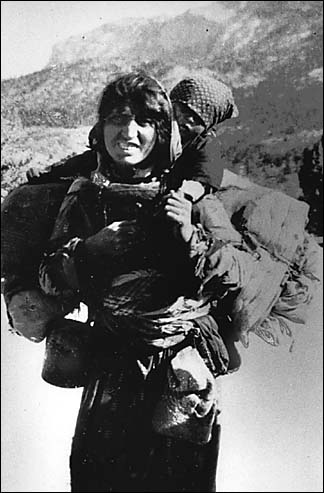
One German officer who was in Turkey at the time was Armin T. Wegner. Rather than assist in the extermination of the Armenians, he did his utmost to prevent further massacres and worked tirelessly to publicise the horrors that Enver Pasha's government was perpetrating. As well as collecting and disseminating documents on the massacres, Wegner took numerous photos of Armenian deportees and of the corpses of the genocide's victims; if you have seen any black and white pictures of corpses or desperate Armenians in the media over the last few days, they were almost certainly taken by him.

Wegner lived until the late 1970s, though he did spend some time in concentration camps during the Third Reich period. He was apparently the only German writer to publicly denounce anti-Jewish measures introduced by the Nazis in 1933.

You can see some of Wegner's pictures here: Armenian Deportees: 1915-1916

Massacres and Genocide

The Foreign Affairs Committee of the United States House of Representatives has voted to recognise the 1915 massacres of Armenians in the Ottoman Empire as genocide. The Turkish government (and, in all likelihood, Turkish people generally) are very annoyed. There are suggestions that this might have terrible repercussions regarding US efforts to pacify Iraq.

People who deny the extermination of Jewish people by the Nazis in the Second World War typically say that there was no targetted programme of mass killing and that the numbers who died are grossly exaggerated and no higher than might be expected in a continent at war. Armenian genocide denial is somewhat similar. In fairness to the Turks, my understanding is that they do not deny that very large numbers of Armenians were killed by agents of the Ottoman Empire during the First World War, or that many of these victims may well have been non-combatants. I don't know if they accept the widely accepted estimate of 1,500,000 victims, but I think they agree that the numbers were very large. The Turks also talk, however, about Turkish and people of other ethnicities (e.g. Kurds) killed by Armenian rebels and so on, though I doubt they seriously claim that massacares of Turks and Kurds by Armenians were in the same order of magnitude as killings of Armenians by Kurds and Turks.

My understanding of the Turkish position is that they take exception to the word genocide, with its connotations of systematic and deliberate extermination. They point out that many Armenians in areas of the Ottoman Empire other than Eastern Anatolia (e.g. Istanbul itself) were not exterminated en masse (though they were subject to considerable persecution), suggesting that the regime was not hell-bent on the total elimination of Armenians. Analysis of the history of the first world war does, however, make plain that the Turkish leadership under Enver Pasha were determined to expel all Armenians from Eastern Anatolia, and were not too bothered if very few of the expellees failed to arrive at their expulsion destination if not actively determined to exterminate them all. I don't know if there is documentary evidence to prove a centrally directed campaign of mass murder, but the balance of probability certainly supports the idea that such was the regime's goal.

My own feeling is that genocide has become an overly emotive word, something like terrorism in that it is thrown at whoever you don't like this week. I don't think, however, that the Turkish government is doing itself any favours on this issue; their endless carping on definitions makes them look like a shifty plea bargainers. That said, pressurising Turkey on this point does not obviously seem to serve any purpose other than to strengthen the country's reactionary nutjobs, whose current project is to invade Iraqi Kurdistan.

The BBC has an interesting article on the history of Turkish attitudes to the Armenian mass killings: Turkey's Armenian dilemma

some of what I have written here is rehashed from a comment here. This has been crossposted to The Dublin School of International Relations.