Showing posts with label Germany. Show all posts

06 May, 2012

Elections Are Fun

In France, exit polls are saying that Francois Hollande has comfortably won the presidential election. Nicolas Sarkozy thus becomes only the second incumbent president of France to lose an election. Hollande will almost certainly call an election to the French parliament to secure a socialist majority there.

Before the election, Hollande had suggested that he would seek to renegotiate the European Fiscal Compact, to introduce some kind of programme for growth and make it less about the kind of budget balancing beloved of conservatives. He also proposed some quite draconian tax increases on rich people. It will be interesting to see whether he delivers on any of this or if his election has any impact on the referendum in Ireland on ratifying the Compact.

In Greece, meanwhile, today's general election has seen support for the two hitherto dominant parties collapse. PASOK and New Democracy have been blamed for the country's economic collapse and their vote has fallen to c. 14% and 20% respectively.

PASOK and New Democracy are now too weak to govern together in a grand coalition without support from the smaller parties who have seen their vote surge. The other parties are however a bit of an ideological dogs dinner, united by nothing other than their opposition to further austerity measures in Greece. It may not be possible to form a government with majority support in parliament. Or perhaps if a government is formed, it will repudiate the bail-out programme and set off on a road leading to disorderly default, leaving the Eurozone, capital flight, and a chaotic economic and political future.

EDIT (based on Nicholas Whyte's comment): The Greek electoral system gives a seat bonus to the largest party such that New Democracy and PASOK should be able to form a majority grand coalition after all. So maybe Greece is not going to disappear down the plughole just yet.

In Germany, meanwhile, state elections in Schleswig-Holstein appear to signal the end of the CDU-FDP coalition that had governed there. The FDP (a party of rightwing liberals, in some ways akin to the now vanished Progressive Democrats of Ireland) in particular have seen their support tumble.

The CDU (the Christian Democrat party of Angela Merkel) may still be able to form a government in Schleswig-Holstein, but it may be a grand coalition with the Social Democrats. This suggests that a left-right coalition could be on the cards at a national level after the next election. Angela Merkel herself apparently remains popular in Germany, her tough stance towards the more profligate countries of the European periphery reassuring voters that their bail-out monies are not going to be squandered.

Armenia too is holding parliamentary elections today, but I am not familiar with politics in that country so I must refer you to this BBC News article: Armenia votes in parliamentary elections

And just to be part of all the election fun, Prime Minister Binyamin Netanyahu of Israel has announced plans to hold early elections in four months time. Elections are likely to lead to a coalition similar to the hawkish one Netanyahu currently heads. I do not know if Netanyahu is planning to synchronise the elections with any kind of military action against Iran.

From Hunting Monsters

12 March, 2011

Libya's Tantalising Archives

When the unrest gripping the Arab world spread to Libya and the regime there started looking shaky I must admit to having experienced a certain excitement. It is always great to see a brutal dictator like Colonel Gaddafi being overthrown by his people, even if he is a rather colourful character who brings a certain excitement to the normally bland world of international relations. More than that, though, were the treats that could become available to researchers if the regime fell and its archives became accessible. Some quantification of the level of support given by Gaddafi to the IRA in the 1980s would be fascinating. Particularly interesting would be the possibility of getting some answers to some questions that have divided opinion for the last number of years.

Older readers will recall how in 1986 the Americans bombed Libya, killing one of Gaddafi's adopted children in a botched attempt to decapitate his regime by taking him out*. This was ostensibly a response to the bombing of a discotheque in Berlin frequented by US servicemen. Now, at the time there was some discussion over whether Libya really had any hand or part in the Berlin bombing, with some suggestion that it had been perpetrated by figures linked to other unsavoury Middle Eastern regimes but seized on by the USA as a handy stick with which to beat the then-troublesome Gaddafi. It would be interesting to see what Libyan archives had to say about the Berlin bombing.

A controversy of more recent vintage is the dispute over the release from prison in Scotland of Abdelbaset Ali al-Megrahi, the Libyan man convicted for planting the bomb that brought down an American airliner over the Scottish town of Lockerbie in 1988. Doubts had been raised as to the safety of al-Megrahi's conviction and he had been appealing against the original verdict before he was released (his dropping of that appeal was a condition of his release, which meant conveniently that the arguments against his original conviction were never stated in open court). Libyan secret service archives might shed some light on the Lockerbie bombing, perhaps revealing whether he had been involved in the bomb plot, whether he had not but other Libyans had, or whether Libya had nothing whatsoever to do with the Lockerbie bombing (as has been suggested by some writers, who point the figure at certain other shady regimes).

Now, it might be naïve to expect Libyan archives to shed light on these fascinating questions. In the event of regime collapse, incriminating documents might well end up being destroyed before they can be accessed, or any newly emergent Libyan regime might itself be loth to let random academics and researchers trawl around in what would still be very sensitive files. And the people who may have been involved in organising shady events may well have taken care to keep their efforts out of potentially troublesome files. In any case, after initial successes, it does rather look like the Libyan rebels have rather run out of steam. Gaddafi looks like his thuggish rule will be continuing for some time, at least in part of Libya, so the opening up of the country's archives will probably not be happening any time soon.

EDIT: I forgot to mention the curious case of Musa Sadr. Sadr is not exactly a household name in Ireland, but in Lebanon you will still see posters of this Shia Muslim cleric in parts of the country where his co-religionists live. Musa Sadr founded the political movement that subsequently acquired the name Amal as a secular political movement for the then impoverished Shia Muslims of Lebanon. In 1978 he disappeared while visiting Libya, widely believed to have been murdered by Gaddafi's secret service. Again, Libya's archives have the potential to confirm Musa Sadr's fate, and to cast light on the reasons for his murder.

From Hunting Monsters

*though I see on Wikipedia that it has been argued that this adopted daughter of Gaddafi was essentially made up for propaganda purposes, not that anyone is denying that actual Libyan people were killed in the bombing raid.

12 November, 2010

East German Journey

I find Open Democracy a bit annoying – they publish way more stuff than I can read, they publish it only on the Internet when I am a luddite who hates reading things onscreen, and they are always looking for money. Maybe if they published a more manageable amount of stuff then they would need less money.

For all that, they do occasionally hit paydirt, like in this long piece by John Hoyland about a trip he made to East Germany when he was a young CND activist. The Berlin Wall had just gone up (because too many East Germans were scarpering out of the workers' paradise that was actually existing socialism) and the Sino-Soviet split had not yet taken place, so the party Hoyland was in had a Chinese guy translating from English to German. The article is fascinating, as a piece of travel writing, as a portrait of Communist fellow travellers going through the motions of supporting what they know to be rubbish, and as a coming of age piece about Hoyland himself. I reckon that even people who do not share my DDR fascination would find this article worth reading, so I recommend it highly.

Pictures from article.

09 November, 2009

19 August, 2009

Borders open, regimes fall

It is now twenty years since Communism trundled off to the dustbin of history. This makes for an exciting series of 20th anniversaries. The first partially free elections in an Eastern Bloc state were held in June 1989 in Poland, with Solidarity doing so well that the communists were thrown out of office (though a government was not formed until the 24th August).

Today makes for another interesting anniversary - it marks the day when Hungary began to stop policing its border with Austria. This made the country a conduit for East Germans who fancied heading to the West, setting in motion events that led to the opening of the wall and disappearance of the DDR.

More (all BBC):

How Hungary let East Germans go

Hungary marks 1989 freedom event

1989 - Europe's revolution

05 October, 2008

WORLD ECONOMY IN CRISIS!

I feel that I ought to make some ill-informed comments about the economic crisis currently sweeping the world. There were interesting developments last week, when my own government announced that the Irish state was going to guarantee all deposits in Irish banks. Apparently this decision was made because there was a real likelihood of a major Irish financial institution going bust, something that would have had catastrophic effects for confidence in our economy. The government guarantee does seem to have restored confidence in the Irish financial system, even though some people are muttering about moral hazard and that kind of thing. Other people are complaining about the state bailing out bankers, though in this case it is more that the Irish state is becoming a deposit insurer - assuming that no bank actually goes to the wall (a big assumption, perhaps), this scheme looks like being quite a money spinner for the state, as the banks will have to pay something like 0.1% or 0.2% of their deposits to the state to be covered.

Greece also instituted a state guarantee of deposits last week. All of this caused some consternation in other European countries, where people complained about how a European-wide solution should have been sought. I think that is easy for them to say, but any kind of pan-European plan would have taken ages to bring together and would not have been easy to create, given the differing opinions on what was to be done. Some countries apparently did not even feel that anything needed to be done; German leaders in particular were reported as feeling that their banks were totally sound, and so did not want them to be entangled with a plan to help stupid banks in other countries. It is hard to know how serious and pressing the crisis in the Irish financial system was last week, but it really does sound like the authorities here could not wait for a European agreement to come into being.

Ireland and Greece did nevertheless find themselves in trouble with their European neighbours. British financial institutions feared that their deposits would disappear off to Irish safe havens, while EU figures talked of the state guarantees as being anti-competitive. For good or ill, however, it looks like the rest of Europe will find themselves having to follow the Irish example. Yesterday German leaders denounced the Irish and Greek move and agreed that there should be no more unilateral moves. Today they found that their banks are as shite as everyone else's, and the German government has announced that they are going to guarantee German bank deposits. The loss of the German middle class' savings in the 1920s is always seen as paving the way for the rise of the Nazis, so presumably Chancellor Merkel wanted to avoid anything similar happening today. Commentators reckon that it is inevitable that Britain will follow suit, with other European states having no choice but to bring up the rear.

Who knows what difference this will make in the long run? There is always a smoke and mirrors aspect to banking and insurance. European states do not even remotely have the funds to cover all their banks' deposits, should all of the banks fail simultanaeously. So as long as no banks, or only a few, fail then we should all be grand. Still, I have read predictions in the Financial Times that the European economy is likely to tank even worse than the US one, due to lower flexibility and stuff like that. We'll see.

11 October, 2007

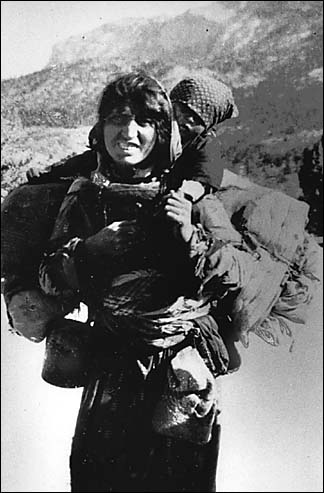
Armenia, 1915

I think it is in Robert Fisk's Pity The Nation: Lebanon at War that an odd feature of the Armenian genocide is mentioned. Ottoman Turkey was at the time an ally of the German Empire, and there were a large number of German troops stationed in the Turkish Empire to assist their allies. Fisk wonders if any junior officers lent a helping hand to the elimination of the Armenians from Eastern Anatolia, coming home with some top tips they could apply in Europe just under 30 years later.

One German officer who was in Turkey at the time was Armin T. Wegner. Rather than assist in the extermination of the Armenians, he did his utmost to prevent further massacres and worked tirelessly to publicise the horrors that Enver Pasha's government was perpetrating. As well as collecting and disseminating documents on the massacres, Wegner took numerous photos of Armenian deportees and of the corpses of the genocide's victims; if you have seen any black and white pictures of corpses or desperate Armenians in the media over the last few days, they were almost certainly taken by him.

Wegner lived until the late 1970s, though he did spend some time in concentration camps during the Third Reich period. He was apparently the only German writer to publicly denounce anti-Jewish measures introduced by the Nazis in 1933.

You can see some of Wegner's pictures here: Armenian Deportees: 1915-1916

09 October, 2007

Europe's Shame

Am I reading this right? It seems like the US Supreme Court has basically ruled that the CIA can kidnap and torture whoever it likes, and then escape legal sanctions by claiming that the prosecution of the criminals who perpetrated these acts would compromise state security.

The article concerns Mr Khaled al-Masri, who was kidnapped by the CIA from Germany and transported to a torture camp in Afghanistan. Apparently the German government has dropped an extradition request against his kidnappers. I have already mentioned the Italian government's decision not to pursue the extradtion of a gang who kidnapped one Mr Abu Omar from their country.

There is this idea in the world that European countries somehow stand in opposition to the human rights violations of the United States. In reality, Europe (or European governments) do not care, and are happy to let US gangs kidnap and torture whoever they like. No one seems to really care about this, given the way the whole extraordinary rendition story lives only in the inside pages of the newspapers.

09 November, 2006

Markus Wolf

Markus Wolf, the chief spy of the DDR for most of its existence, has died. Despite his many successes, he was unable to prevent the fall of the Berlin Wall and the end of his country, though he had by then retired. Wolf's memoirs make fascinating, if self-serving reading. Among his agency's many achievements were running an agent in the immediate circle of the West German chancellor and recruiting senior figures in West German counter-intelligence.

BBC obituary

Guardian obituary