Ed Milliband is leader of the Labour Party leader in Britain and a man who aspires to replace David Cameron as Prime Minister.
Click here to watch an embarrassing interview in which he delivers the same answer to every question he is asked: "These Strikes Are Wrong..."
Showing posts with label United Kingdom. Show all posts
Showing posts with label United Kingdom. Show all posts
03 July, 2011


12 March, 2011
Libya's Tantalising Archives
When the unrest gripping the Arab world spread to Libya and the regime there started looking shaky I must admit to having experienced a certain excitement. It is always great to see a brutal dictator like Colonel Gaddafi being overthrown by his people, even if he is a rather colourful character who brings a certain excitement to the normally bland world of international relations. More than that, though, were the treats that could become available to researchers if the regime fell and its archives became accessible. Some quantification of the level of support given by Gaddafi to the IRA in the 1980s would be fascinating. Particularly interesting would be the possibility of getting some answers to some questions that have divided opinion for the last number of years.
Older readers will recall how in 1986 the Americans bombed Libya, killing one of Gaddafi's adopted children in a botched attempt to decapitate his regime by taking him out*. This was ostensibly a response to the bombing of a discotheque in Berlin frequented by US servicemen. Now, at the time there was some discussion over whether Libya really had any hand or part in the Berlin bombing, with some suggestion that it had been perpetrated by figures linked to other unsavoury Middle Eastern regimes but seized on by the USA as a handy stick with which to beat the then-troublesome Gaddafi. It would be interesting to see what Libyan archives had to say about the Berlin bombing.
A controversy of more recent vintage is the dispute over the release from prison in Scotland of Abdelbaset Ali al-Megrahi, the Libyan man convicted for planting the bomb that brought down an American airliner over the Scottish town of Lockerbie in 1988. Doubts had been raised as to the safety of al-Megrahi's conviction and he had been appealing against the original verdict before he was released (his dropping of that appeal was a condition of his release, which meant conveniently that the arguments against his original conviction were never stated in open court). Libyan secret service archives might shed some light on the Lockerbie bombing, perhaps revealing whether he had been involved in the bomb plot, whether he had not but other Libyans had, or whether Libya had nothing whatsoever to do with the Lockerbie bombing (as has been suggested by some writers, who point the figure at certain other shady regimes).
Now, it might be naïve to expect Libyan archives to shed light on these fascinating questions. In the event of regime collapse, incriminating documents might well end up being destroyed before they can be accessed, or any newly emergent Libyan regime might itself be loth to let random academics and researchers trawl around in what would still be very sensitive files. And the people who may have been involved in organising shady events may well have taken care to keep their efforts out of potentially troublesome files. In any case, after initial successes, it does rather look like the Libyan rebels have rather run out of steam. Gaddafi looks like his thuggish rule will be continuing for some time, at least in part of Libya, so the opening up of the country's archives will probably not be happening any time soon.
EDIT: I forgot to mention the curious case of Musa Sadr. Sadr is not exactly a household name in Ireland, but in Lebanon you will still see posters of this Shia Muslim cleric in parts of the country where his co-religionists live. Musa Sadr founded the political movement that subsequently acquired the name Amal as a secular political movement for the then impoverished Shia Muslims of Lebanon. In 1978 he disappeared while visiting Libya, widely believed to have been murdered by Gaddafi's secret service. Again, Libya's archives have the potential to confirm Musa Sadr's fate, and to cast light on the reasons for his murder.
From Hunting Monsters
*though I see on Wikipedia that it has been argued that this adopted daughter of Gaddafi was essentially made up for propaganda purposes, not that anyone is denying that actual Libyan people were killed in the bombing raid.
Older readers will recall how in 1986 the Americans bombed Libya, killing one of Gaddafi's adopted children in a botched attempt to decapitate his regime by taking him out*. This was ostensibly a response to the bombing of a discotheque in Berlin frequented by US servicemen. Now, at the time there was some discussion over whether Libya really had any hand or part in the Berlin bombing, with some suggestion that it had been perpetrated by figures linked to other unsavoury Middle Eastern regimes but seized on by the USA as a handy stick with which to beat the then-troublesome Gaddafi. It would be interesting to see what Libyan archives had to say about the Berlin bombing.
A controversy of more recent vintage is the dispute over the release from prison in Scotland of Abdelbaset Ali al-Megrahi, the Libyan man convicted for planting the bomb that brought down an American airliner over the Scottish town of Lockerbie in 1988. Doubts had been raised as to the safety of al-Megrahi's conviction and he had been appealing against the original verdict before he was released (his dropping of that appeal was a condition of his release, which meant conveniently that the arguments against his original conviction were never stated in open court). Libyan secret service archives might shed some light on the Lockerbie bombing, perhaps revealing whether he had been involved in the bomb plot, whether he had not but other Libyans had, or whether Libya had nothing whatsoever to do with the Lockerbie bombing (as has been suggested by some writers, who point the figure at certain other shady regimes).
Now, it might be naïve to expect Libyan archives to shed light on these fascinating questions. In the event of regime collapse, incriminating documents might well end up being destroyed before they can be accessed, or any newly emergent Libyan regime might itself be loth to let random academics and researchers trawl around in what would still be very sensitive files. And the people who may have been involved in organising shady events may well have taken care to keep their efforts out of potentially troublesome files. In any case, after initial successes, it does rather look like the Libyan rebels have rather run out of steam. Gaddafi looks like his thuggish rule will be continuing for some time, at least in part of Libya, so the opening up of the country's archives will probably not be happening any time soon.
EDIT: I forgot to mention the curious case of Musa Sadr. Sadr is not exactly a household name in Ireland, but in Lebanon you will still see posters of this Shia Muslim cleric in parts of the country where his co-religionists live. Musa Sadr founded the political movement that subsequently acquired the name Amal as a secular political movement for the then impoverished Shia Muslims of Lebanon. In 1978 he disappeared while visiting Libya, widely believed to have been murdered by Gaddafi's secret service. Again, Libya's archives have the potential to confirm Musa Sadr's fate, and to cast light on the reasons for his murder.
From Hunting Monsters
*though I see on Wikipedia that it has been argued that this adopted daughter of Gaddafi was essentially made up for propaganda purposes, not that anyone is denying that actual Libyan people were killed in the bombing raid.
15 May, 2010
Confidence and Dissolution
The election campaign in the UK was very interesting. One thing I was struck by how was how disappointing the final result was for the three main UK parties. Labour received their worst drubbing since the early 1980s, while the Conservatives failed to win enough seats to be able to govern alone. The Liberal Democrats, meanwhile, failed to achieve the kind of breakthrough result that their early performance in the campaign promised. This is arguably a parliament of the defeated.
The new government is proposing to change the rules regarding when UK elections are called. At present, a prime minister can have an election called whenever he or she likes. A general election also typically follows if the government loses a confidence vote in the Houses of Commons. Under the new proposal, a dissolution would require a 55% vote of the House of Commons.
The proposed new rule for parliamentary dissolutions has attracted much comment, a lot of it ill-informed. Many commentators are seeing it as a plot by the Conservatives to keep themselves in power forever. This seems to arise from confusion between a vote of confidence in the government and a vote to dissolve parliament. Under the new rules, if Cameron loses his majority then he would have to resign as prime minister. It would then be up to someone else to have a crack at forming a government with majority support. If 55% of MPs felt that an election was desirable then they could force a dissolution, but otherwise it would be up to them to form a new government.
In Westminster, this kind of constitutional change is unusual, but it is common elsewhere. Many European parliaments sit for fixed terms, with it being very difficult to bring about an early dissolution. In the devolved parliaments of Scotland and Wales, it requires a two-thirds majority to trigger an election.
Given that fixed-term parliaments have been a core Liberal Democrat policy for decades, it is hard to see why people are so surprised by the new dissolution rules. There is a certain parochialism among those who assume that the pre-existing Westminster rules are the natural order of things, and a certain fuzzy thinking by those who confuse confidence votes and votes to call elections. But another factor seems to be that some people see the new UK government as fundamentally illegitimate, perhaps because it includes the Conservatives. They were perhaps hoping that the coalition would hang on for a couple of months before being ousted in a new election.
The new rules make it more likely that the government will last the full parliamentary term, because Cameron does not have the option of calling an election if he senses a momentary advantage. However, the Liberal Democrats are probably their real beneficiary. If irreconcilable differences emerge in the government, Cameron would be unable to call an election and hope that the electorate would punish his erstwhile partners. Instead, the Liberal Democrats would be able to open negotiations with Labour on the formation of a rainbow government, possibly including some of the minor and regional parties. An election could only be called if both Labour and the Conservatives wanted one. This is a fairly unlikely prospect, though it might happen if both thought they could wipe out the Liberals.
The new government is proposing to change the rules regarding when UK elections are called. At present, a prime minister can have an election called whenever he or she likes. A general election also typically follows if the government loses a confidence vote in the Houses of Commons. Under the new proposal, a dissolution would require a 55% vote of the House of Commons.
The proposed new rule for parliamentary dissolutions has attracted much comment, a lot of it ill-informed. Many commentators are seeing it as a plot by the Conservatives to keep themselves in power forever. This seems to arise from confusion between a vote of confidence in the government and a vote to dissolve parliament. Under the new rules, if Cameron loses his majority then he would have to resign as prime minister. It would then be up to someone else to have a crack at forming a government with majority support. If 55% of MPs felt that an election was desirable then they could force a dissolution, but otherwise it would be up to them to form a new government.
In Westminster, this kind of constitutional change is unusual, but it is common elsewhere. Many European parliaments sit for fixed terms, with it being very difficult to bring about an early dissolution. In the devolved parliaments of Scotland and Wales, it requires a two-thirds majority to trigger an election.
Given that fixed-term parliaments have been a core Liberal Democrat policy for decades, it is hard to see why people are so surprised by the new dissolution rules. There is a certain parochialism among those who assume that the pre-existing Westminster rules are the natural order of things, and a certain fuzzy thinking by those who confuse confidence votes and votes to call elections. But another factor seems to be that some people see the new UK government as fundamentally illegitimate, perhaps because it includes the Conservatives. They were perhaps hoping that the coalition would hang on for a couple of months before being ousted in a new election.
The new rules make it more likely that the government will last the full parliamentary term, because Cameron does not have the option of calling an election if he senses a momentary advantage. However, the Liberal Democrats are probably their real beneficiary. If irreconcilable differences emerge in the government, Cameron would be unable to call an election and hope that the electorate would punish his erstwhile partners. Instead, the Liberal Democrats would be able to open negotiations with Labour on the formation of a rainbow government, possibly including some of the minor and regional parties. An election could only be called if both Labour and the Conservatives wanted one. This is a fairly unlikely prospect, though it might happen if both thought they could wipe out the Liberals.
18 January, 2010
Who bombed Lockerbie?
I have previously mentioned the release from a Scottish jail of Abdelbaset Ali al-Megrahi. Mr al-Megrahi was convicted for causing the Lockerbie bombing. In my previous post I mentioned how the relatives of the British victims are much more open to the idea that Mr al-Megrahi was framed, while relatives of the American victims seem to be uniformly outraged at his release. I suggested this might be because of a series of high-profile miscarriages of justice, in which convictions for terrorist and other crimes were quashed, often after those falsely convicted had served many years in jail.
The solicitor Gareth Peirce played a major role in overturning those Britiish miscarriages of justice. Now she has written on the al-Megrahi case in the London Review of Books. She asserts that his conviction is a stitch-up and a travesty of due process. Forensic and eye-witness evidence were used to convict al-Megrahi. Peirce suggests these are both deeply flawed. The forensic evidence was largely prepared by the same dodgy scientists who produced the flawed evidence used in earlier miscarriages of justice. The eye-witness, meanwhile, initially failed to pick out al-Megrahi in an identity parade, but subsequently was miraculously able to do so and now is living in suddenly acquired affluence.
Peirce also points out that in the early stages of the Lockerbie investigation, the finger of suspicion was pointing at Iran. The Iranian regime had a motive – a US warship had just shot down an Iranian airliner, and then, grotesquely, the crew of that ship had been honoured by President Reagan. As the US regime started to engage with the Iranians to buy out its hostages in Lebanon, it became inconvenient to blame Iran for Lockerbie. Someone had to pick up the tab, with Peirce arguing that that someone ended up being Libya and Abdelbaset Ali al-Megrahi.
It is unfortunate that al-Megrahi was required to drop his appeal when he was released on compassionate grounds, as it would surely be better for everyone if these allegations could be addressed in an open court.
See also: 'Flaws' in key Lockerbie evidence (BBC)
The solicitor Gareth Peirce played a major role in overturning those Britiish miscarriages of justice. Now she has written on the al-Megrahi case in the London Review of Books. She asserts that his conviction is a stitch-up and a travesty of due process. Forensic and eye-witness evidence were used to convict al-Megrahi. Peirce suggests these are both deeply flawed. The forensic evidence was largely prepared by the same dodgy scientists who produced the flawed evidence used in earlier miscarriages of justice. The eye-witness, meanwhile, initially failed to pick out al-Megrahi in an identity parade, but subsequently was miraculously able to do so and now is living in suddenly acquired affluence.
Peirce also points out that in the early stages of the Lockerbie investigation, the finger of suspicion was pointing at Iran. The Iranian regime had a motive – a US warship had just shot down an Iranian airliner, and then, grotesquely, the crew of that ship had been honoured by President Reagan. As the US regime started to engage with the Iranians to buy out its hostages in Lebanon, it became inconvenient to blame Iran for Lockerbie. Someone had to pick up the tab, with Peirce arguing that that someone ended up being Libya and Abdelbaset Ali al-Megrahi.
It is unfortunate that al-Megrahi was required to drop his appeal when he was released on compassionate grounds, as it would surely be better for everyone if these allegations could be addressed in an open court.
See also: 'Flaws' in key Lockerbie evidence (BBC)
25 August, 2009
Lockerbie relatives and their faith in legal systems
As you know, Abdelbaset Ali al-Megrahi was released from prison in Scotland and allowed to return home to Libya. Al-Megrahi had been convicted of causing the Lockerbie bombing, but was released by the Scottish government on compassionate grounds as he is terminally ill and due to die in the near future.
There are any number of interesting things that could be said about this case – the separate roles of the Scottish and UK governments, differing conceptions of what constitutes justice, and so on. One thing I was particularly struck by, though, was the differing attitudes of British and American relatives of those killed at Lockerbie. It was reported that while the US relatives were very angry about al-Megrahi's release, many of those in the UK were more sympathetic. This seemed to be related to doubts that have been raised about the safety of al-Megrahi's conviction (he had been appealing his conviction prior to his release, and still maintains his innocence), with many of the UK victims sharing doubts as to his guilt, doubts not shared by the Americans.
What interests me is why the UK relatives are more open to the idea of al-Megrahi's innocence. There might be deep-rooted cultural factors at play here, but something that must be significant here is the UK's experience over the last few decades with miscarriage of justice cases, where those convicted of high profile crimes (often of a terrorist nature) saw their convictions quashed years after their initial trials. These people were freed because it was shown that they had been convicted on the basis of such things as ludicrous forensic evidence or confessions extracted under torture. These cases must have planted the seeds of doubt in people's minds, establishing the idea that the authorities can get it wrong and can pin the blame for terrible crimes on the wrong people.
My understanding is the US justice system is not so rock solid that people are not sometimes convicted of crimes they did not commit. I have read of some analysis where innocent people were executed for crimes committed by others. However, I do not think that any of these miscarriage cases have become massive causes célèbres in the way that the cases of the Guildford 4, Maguire 7, Birmingham 6, Bridgewater 4, etc. did. This makes it easier for Americans to maintain a naïve confidence in the correctness of the judicial process. Britons, on the other hand, must find it far easier to believe that high-profile cases can produce miscarriages of justice.
This is not, by the way, to say that I believe in al-Megrahi's innocence or guilt, as I have not followed the case that closely. It is more the general idea of how much confidence people have in justice systems that I am interested in.
There are any number of interesting things that could be said about this case – the separate roles of the Scottish and UK governments, differing conceptions of what constitutes justice, and so on. One thing I was particularly struck by, though, was the differing attitudes of British and American relatives of those killed at Lockerbie. It was reported that while the US relatives were very angry about al-Megrahi's release, many of those in the UK were more sympathetic. This seemed to be related to doubts that have been raised about the safety of al-Megrahi's conviction (he had been appealing his conviction prior to his release, and still maintains his innocence), with many of the UK victims sharing doubts as to his guilt, doubts not shared by the Americans.
What interests me is why the UK relatives are more open to the idea of al-Megrahi's innocence. There might be deep-rooted cultural factors at play here, but something that must be significant here is the UK's experience over the last few decades with miscarriage of justice cases, where those convicted of high profile crimes (often of a terrorist nature) saw their convictions quashed years after their initial trials. These people were freed because it was shown that they had been convicted on the basis of such things as ludicrous forensic evidence or confessions extracted under torture. These cases must have planted the seeds of doubt in people's minds, establishing the idea that the authorities can get it wrong and can pin the blame for terrible crimes on the wrong people.
My understanding is the US justice system is not so rock solid that people are not sometimes convicted of crimes they did not commit. I have read of some analysis where innocent people were executed for crimes committed by others. However, I do not think that any of these miscarriage cases have become massive causes célèbres in the way that the cases of the Guildford 4, Maguire 7, Birmingham 6, Bridgewater 4, etc. did. This makes it easier for Americans to maintain a naïve confidence in the correctness of the judicial process. Britons, on the other hand, must find it far easier to believe that high-profile cases can produce miscarriages of justice.
This is not, by the way, to say that I believe in al-Megrahi's innocence or guilt, as I have not followed the case that closely. It is more the general idea of how much confidence people have in justice systems that I am interested in.
08 April, 2009
What are those British bases on Cyprus for?
This is basically an adjunct to my piece on Northern Cyprus. When Cyprus became independent, Britain obliged its former colony to retain a number of British military bases on the island. As far as I know, these were granted to Britain in perpetuity. Not merely that, but sovereignty in the territory of the bases lies with the UK – Cypriot law does not apply to them, and the bases are effectively part of the UK (or part of the territory of the UK crown).
Now, normally speaking, when you get these kind of bases forced onto a host country, the owner of the base usually undertakes to provide the host with some kind of military protection. I do not know if Britain did this when Cyprus became independent, but I do know that when Cyprus was subject to foreign invasion, the British forces sat on their hands and decided that the defence of their host was nothing to do with them. The British bases on Cyprus seem to exist solely for the benefit of the former colonial master, without even the pretence that they exist to provide security to their Cypriot hosts.
Now, normally speaking, when you get these kind of bases forced onto a host country, the owner of the base usually undertakes to provide the host with some kind of military protection. I do not know if Britain did this when Cyprus became independent, but I do know that when Cyprus was subject to foreign invasion, the British forces sat on their hands and decided that the defence of their host was nothing to do with them. The British bases on Cyprus seem to exist solely for the benefit of the former colonial master, without even the pretence that they exist to provide security to their Cypriot hosts.
02 April, 2009
Man Dies In Police Custody During G20 Protest
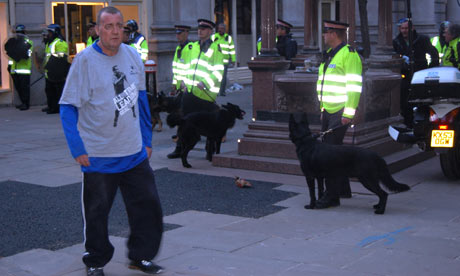 Meanwhile, the guy who died yesterday during the G20 protests yesterday has been named as Ian Tomlinson. He seems to have been someone who worked in a newsagent in the City of London. It is unclear whether he was taking part in the protests or was just trying to get home from work. Either way, he found himself caught in a "kettle", this being what the British cops call an area in which they contain protesters, preventing them for leaving sometimes for hours on end. At this stage it is unclear what caused Mr Tomlinson's death.
This "kettle" tactic of the UK cops – on the face of it, it sounds like a form of mass arrest, in that the people held in the "kettle" are prevented from leaving until such time as the police decide to let them. This imprisonment can last for considerable periods of time – yesterday the police held protesters for some seven hours. Following an earlier incident, in which a person so held challenged their imprisonment in the courts, the House of Lords ruled that this form of detention is not illegal under British law.
Ian Tomlinson image source
Three more articles (all from the Guardian):
G20: Questions need to be asked about 'kettling'
G20: The upside of 'kettling'
G20: Did police containment cause more trouble than it prevented?
EDIT: You have probably seen this by now, but the Guardian has obtained footage showing some cops walking up behind Mr Tomlinson and decking him for no obvious reason. See: Ian Tomlinson death: Guardian video reveals police attack on man who died at G20 protest
20 March, 2009

04 June, 2008
Gordon Brown - please do not send Hicham Yezza to be tortured in Algeria
I know Gordon Brown is a close reader of Hunting Monsters, so perhaps a plea from me will soften his heart.
Hicham Yezza is an administrator working in Nottingham University. He is currently due to be deported to Algeria, over some not entirely convincing immigration faux pas he may have committed. The real reason he is being deported is that he helped a Nottingham University student, Rizwaan Sabir, by printing out a document for him. The document was downloaded from the website of the Central Intelligence Agency, and purports to be a training manual for Al-Qaeda. Some busybody in Nottingham University saw the document being printed, noticed that Mr Sabir and Mr Yezza both have foreign sounding names, and did what any decent person would do, calling in the police. They unfortunately discovered that Mr Sabir is a student of International Relations who is writing a dissertation on the methods of Al-Qaeda. Just to be on the safe side, the authorities are deporting Mr Yezza, but cannot do so with Mr Sabir, as he appears to be a British national. Mr Yezza is originally from Algeria, a country where they typically torture anyone who might conceivably have anything to do with political Islam, and his prospects are rather grim should he end up there.
Just on the off-chance that anyone reading this is considering a university in which to study International Relations, it might be a good idea not to go to Nottingham, if you think that Islamist extremism might be one of your areas of study.
More:
THE WAR ON TERROR COMES TO CAMPUS (blog)
NOTTINGHAM TERROR ARRESTS (blog)
Deportation plan to be reviewed (BBC)
Hicham Yezza is an administrator working in Nottingham University. He is currently due to be deported to Algeria, over some not entirely convincing immigration faux pas he may have committed. The real reason he is being deported is that he helped a Nottingham University student, Rizwaan Sabir, by printing out a document for him. The document was downloaded from the website of the Central Intelligence Agency, and purports to be a training manual for Al-Qaeda. Some busybody in Nottingham University saw the document being printed, noticed that Mr Sabir and Mr Yezza both have foreign sounding names, and did what any decent person would do, calling in the police. They unfortunately discovered that Mr Sabir is a student of International Relations who is writing a dissertation on the methods of Al-Qaeda. Just to be on the safe side, the authorities are deporting Mr Yezza, but cannot do so with Mr Sabir, as he appears to be a British national. Mr Yezza is originally from Algeria, a country where they typically torture anyone who might conceivably have anything to do with political Islam, and his prospects are rather grim should he end up there.
Just on the off-chance that anyone reading this is considering a university in which to study International Relations, it might be a good idea not to go to Nottingham, if you think that Islamist extremism might be one of your areas of study.
More:
THE WAR ON TERROR COMES TO CAMPUS (blog)
NOTTINGHAM TERROR ARRESTS (blog)
Deportation plan to be reviewed (BBC)
18 October, 2006
Britain goes veil mad
Following on from Jack Straw's intervention on women who wear veils that obscure their faces, it seems like Britain has become obsessed with the question of what women do or do not, should or should not wear on their heads. It all seems a bit prurient.
One thing that often strikes me about those propounding an anti-Muslim discourse is the idea that They (Muslim Men) oppress "their" women. That the same people who say this are quite happy to tell women what they can and cannot wear is an irony that never seems to strike them.
Anyway, I was very taken by a piece by Zaiba Malik that appeared in The Guardian on Tuesday: 'Even other Muslims turn and look at me' In this, the journalist, a Muslim woman, wears the full-on niqab for the first time in her life. She finds it dehumanising, but is struck by how it makes her a magnet for pervs and racists.
One thing that often strikes me about those propounding an anti-Muslim discourse is the idea that They (Muslim Men) oppress "their" women. That the same people who say this are quite happy to tell women what they can and cannot wear is an irony that never seems to strike them.
Anyway, I was very taken by a piece by Zaiba Malik that appeared in The Guardian on Tuesday: 'Even other Muslims turn and look at me' In this, the journalist, a Muslim woman, wears the full-on niqab for the first time in her life. She finds it dehumanising, but is struck by how it makes her a magnet for pervs and racists.
Subscribe to:
Posts (Atom)

