18 May, 2009

This is the dawning of the age of Bavaria...

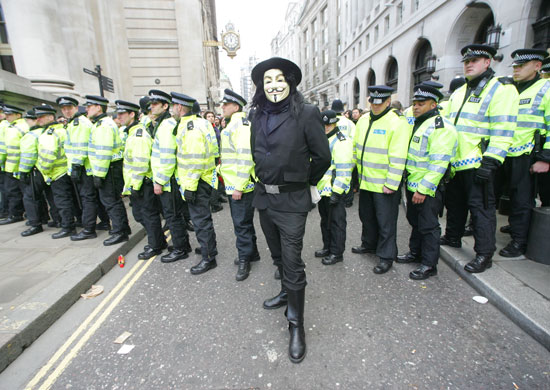
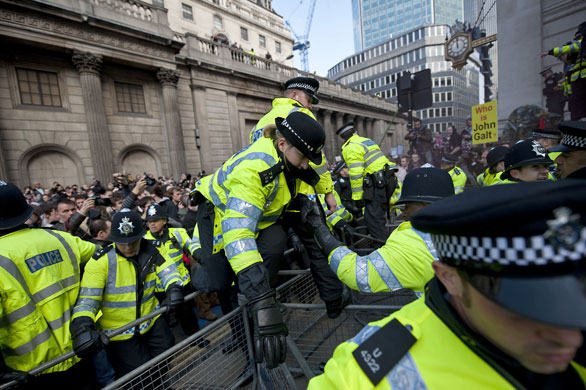
The Bilderberg Group met last weekend. This lot take their name after the hotel where they first met. As anyone who has read books like Jon Ronson's Them will know, the Bilderbergers are seen by some as the secret rulers of the world. Certainly they seem to include some very influential world figures, and they seem also to be surprisingly secretive. There was no live blogging or Twitter feed coming from Bilderberg attendees. The likelihood is that no public figure will admit to having attended the Bilderberg meeting.

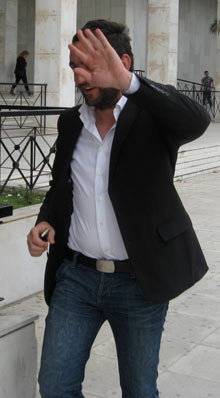
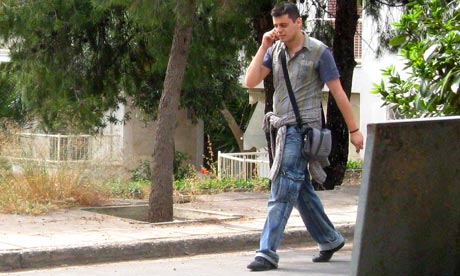
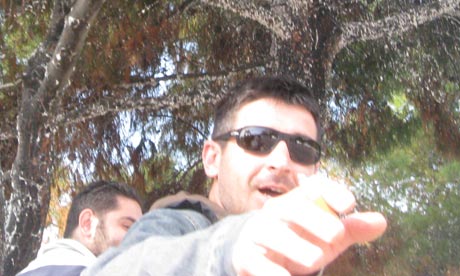
Charlie Skelton has been writing about trying to cover Bilderberg for the Guardian. Getting wind that the event was taking place in Greece, near Athens, he flew out to check it out. He then spent the next few days being followed by undercover policemen (pictured) and having his hotel room repeatedly broken into. Skelton comes across as primarily a humour writer, and his unsuccessful attempts to take photographs of Bilderberg attendees and to shake off his obvious tails are pretty funny, as is his increasingly frazzled mental state. But his writing begs some obvious questions. Like, why are Bilderberg meetings so secret? I know that these days it is impossible for two important people to meet for a cup of coffee without a load of crusties showing up to protest against them, but, even so, the veil of total secrecy that surrounds Bilderberg seems a bit obsessive. The fear of protesters is all very well, but it does not even explain the retrospective secrecy about Bilderberg meetings – the non-disclosure by attendees that they were even at this obviously important gathering. This goes a bit further – if Skelton could find out about this event then so could the media generally, so why were there not loads of proper journalists in Greece to cover this meeting of the great and the good?

One thing you hear about Bilderberg meetings is that they only take place in hotels with golf courses. I wonder if any have ever been held in Ireland?

16 May, 2009

More European Parliament election action

Libertas is an organisation headed by Irish businessman Declan Ganley. They were heavily involved in last year's campaign against the Lisbon Treaty here. Libertas has now been transformed into a political party contesting the European Parliament elections across the EU. Mr Ganley hopes to transform the election into a European referendum on the Lisbon Treaty and the direction being taken by the EU. There is, of course, a certain irony about a euro-sceptic party contesting elections in every member state of the EU. However, Mr Ganley himself decries the euro-sceptic label, asserting that he is actually just trying to reform the way the European Union operates.

This week two of Libertas' Irish candidates declared their opposition to further immigration to Ireland from other EU states. This is a particularly odd position for a pan-European party to adopt, as they seem to be saying that the free internal movement of people – a core value of the European Union – should be rescinded. At this stage I do not know if these utterances by the Irish Libertas candidates have been reported in those EU states that have sent people to Ireland. I am also unaware of their reception among nationals of other EU states living in Ireland; such people are entitled to vote in European Parliament elections here.

Links (both Irish Times):

Libertas accused of being 'fascist' over migrant plan

East candidate seeks block on immigrants

Why should anyone vote in the European Parliament elections?

In national elections, various arguments can be made for why voting is a good idea. If people like you vote then it is more likely that the kind of things you want will be implemented by government. Also, the mere fact that politicians have to face the electorate makes them less likely to corruptly line their pockets or behave in a lazily incompetent manner. So goes the theory, anyway.

With European Parliament elections, it is a bit less obvious what you are voting for. For most people, the European institutions are a bit vague, and it is not entirely clear where the European Parliament fits into it all. The really big European decisions are made by those big summits where Europe's leaders get together to talk about important things. The more day-to-day big decisions are made by the Council of Ministers (the ministers of member states with responsibility for the policy area) and the Commission (the body that heads the EU's permanent secretariat). As a permanent body, the Commission has more influence than its strict constitutional status would suggest, and it functions almost as the EU's government.

In national politics, elections decide who constitutes the government, but this is only kind of true in the EU (at least with regards to the European Parliament elections). The EU is not a parliamentary democracy, and the Commission is only semi-responsible to the European Parliament. It is the member states' governments who nominate the commissioners, though the European Parliament has to approve the incoming Commission and may thereafter remove it. The European Parliament has flexed its muscles in this area over the last number of years, forcing the resignation of one Commission over a corruption scandal and threatening to block the accession of another unless Italy withdrew the candidacy of an ultra-conservative right-winger.

The European Parliament does have a certain role in making EU policy. To be honest, I am a bit vague on the details, but my impression is that very much it rubber stamps the decisions taken elsewhere, only occasionally making real changes to them. Jamie Smyth in The Irish Times mentions one such case, where the EU Parliament forced through a change in a Commission proposal so that people could not be employed under one country's terms and conditions while working in another*.

Even so, given that it actually does stuff, the European Parliament faces a fundamental problem that seriously undermines its credibility as a democratic institution – namely, that no one votes for it. And when people do vote for it, they typically vote as a way of signaling their support or opposition to domestic governments, not because they reckon the people they are voting for will keep an eye on the Commission or block repugnant EU policies. |n Ireland, there is the added element of European Parliament elections becoming personality driven games, kind of like a celebrity TV version of politics. Low turn-outs make it harder for the European Parliament to challenge decisions by the Council of Ministers or the intergovernmental summits. The latter groups have come to office thanks to national elections with generally higher turnout, giving them more legitimacy than the European Parliament.

I am not sure what the way round this is. European Parliament election turn-outs have been in permanent decline, something unaffected by any flexing of muscles by European parliamentarians. At the same time, one of the things people who like moaning about the EU say is that it is undemocratic. Maybe these people vote disproportionately in the elections for the one directly elected part of the EU decision-making apparatus, but I kind of doubt it.

Links:

Viewpoint: A truly European vote? (Simon Hix of the LSE gamely claims that the EU is an important body and suggests that STV or open list PR system would make people more engaged with the European Parliament; he then rather fancifully claims that Irish voters are very engaged with European issues and the workings of the European Parliament)

Parliament can no longer be seen as MEP 'Eurodisney' (Jamie Smyth in The Irish Times talks about what the European Parliament does and advances several instances where it made a difference to the EU's direction and/or policies)


*Charlie McCreevy, Ireland's commissioner, who proposed this rule. One of the arguments advanced by Irish euro-sceptics during the Lisbon referendum campaign was that Ireland needed to have a commissioner. Left euro-sceptics also complained about the neo-liberal direction of some EU policies. I have never really understood why they felt it was so important to have McCreevy in the Commission, unless it was a way of keeping him out of domestic politics.
12 May, 2009

The Council of Europe

Here is an article about The Council of Europe: Council to battle Russia on Protocol 14. This organisation, not to be confused with the Council of Ministers or the European Council is in the odd position of being far less well-known that one of its subsidiary parts. The Council was formed after the Second World War, and was basically an excuse for people from European parliaments to get together and talk about stuff (as opposed to fight wars against each other). The more famous subsidiary of the Council of Europe is the European Court of Human Rights (ECHR).

Member countries of the Council of Europe have to agree to abide by the European Convention of Human Rights, a set of legal principles enacted as a reaction to the gross violation of human rights that marked the Third Reich period and (to a somewhat lesser extent) the period of Commmunist rule in Eastern Europe. Citizens of member countries can appeal directly to the European Court of Human Rights. Ireland's legalisation of male homosexual acts was triggered by a decision of the ECHR. As with so much of international law, Council of Europe member states could decide to leave the organisation if faced with an ECHR decision they do not like, but no one has ever done that because it would make you look like the kind of country that hates freedom.

Currently the Council of Europe is proposing to change its rules for processing ECHR cases, to eliminate legal backlogs. Unfortunately, one member country is adamantly opposed to these rule changes. Curiously, this country (Russia) is one with a very large number of cases pending where its citizens are accusing its government of trampling on their rights. It appears that the streamlined rules will be adopted by the other Council of Europe members, while Russian citizens will continue to wait for their cases to be heard.

10 May, 2009

Armageddon Sri Lanka

I feel like I should follow events in Sri Lanka more closely, and would like to have a less superficial understanding of the conflict there. The island has had this big civil war for the last number of decades, with the Liberation Tigers of Tamil Eelam (better known as the Tamil Tigers) seeking to separate a Tamil independent state from the rest of the island. I think there is a religious-ethnic aspect to the conflict, with the mainly Hindu Tamils having a certain sense of distinctness from the mainly Buddhist Sinhalese (the majority Sri Lankan community).

After decades of laying into each other (with loads of civilians getting hammered in the process), some kind of peace process emerged in the 1990s, the Sri Lankan state and the Tamil Tigers entering into negotiations and stuff. This process eventually stalled, and the war started again. The Sri Lankan army recently launched an all-out offensive on the Tigers, apparently intending to bring the conflict to a final conclusion by military means. The impression I am picking up is that, like the Tigers, the Sri Lankan army is not really that bothered about incidental civilian casualties, but unlike the Tigers they have heavy artillery. The BBC reports today on claims that 257 people were killed by Sri Lankan army shelling last night (claims denied by the Sri Lankan army).

One thing I do not really understand is how the Sri Lankan army now seems to have the capability to wipe out the Tamil Tigers. They were never able to do this before - indeed, to a casual observer the ability of the Tigers to dish out serious pain to the Sri Lankan army was always rather striking. I am curious as to whether the apparently approaching end of the Tigers is a result of some kind of collapse on their part or a significant increase of capabilities by the Sri Lankan army. Can anyone advise?

20 April, 2009

Tel Aviv at 100

Tel Aviv was 100 year's old on the 11th April. Here's an interesting post on the city's early history by Mark A. LeVine: 100 Years of Solitude: Tel Aviv's Anniversary. Like many places in the world, Tel Aviv has a somewhat fictional history, based in this case on the idea that it sprang out of the sand and grew into the modern city it is now without any Arab involvement or displacement.

I am somewhat sorry that I never made it to Tel Aviv when I was in Palesrael, everything I have ever read about it suggests that it is a bizarre and interesting place. Maybe one day, when the Israel-Palestine issue has been settled...

Where I heard about this

18 April, 2009

Communism Fail

The opening of the Berlin Wall on the 9th of November 1989 is probably the most emblematic moment in the fall of communism in Eastern Europe. A less remarked upon, but perhaps more ultimately significant, event took place twenty years ago yesterday. On the 17th of April 1989, the ruling communists in Poland agreed to hold partially competitive elections. The elections were meant to leave the communists in power, as 70 out of 100 seats in the Polish parliament's lower house were reserved for them and their allies in various front parties. When the elections were held (on the 4th of June), the communists were humiliated - they and their allies failed to win a single one of the contested seats in the lower house, while the communists only won one seat in the Senate (where all seats were contested). Although they still had a massive parliamentary majority, their political bankruptcy was exposed, and the opposition Solidarity movement was invited to form a non-communist government.

People still argue over what caused the collapses of communism in Eastern Europe. Whatever the cause, my own view is that once one of the Soviet satellites started unambiguously on the road to free elections the jig was up for the lot of them. Any one country's progress down the road to freedom made it apparent to oppositions and governments everywhere that the Soviets were not going to send in the tanks to shore up their allies. None of the communist regimes ultimately had the wherewithal to maintain themselves in power, and they all fell to the upsurge in oppositional activity triggered by developments in Poland.

Poland's history since the transition has been... interesting. Successive governments have had to grapple with the economic bankruptcy bequeathed by the communists, while the inevitable break up of Solidarity made politics somewhat chaotic. People like Lech Walesa, who were genuinely heroic in opposition, seemed somewhat less than suited for the nuanced world of democratic politics. Nevertheless, the country has made impressive progress, apparently weathering the current economic storm better than most.

Some interesting pieces on the BBC website:

How Poland became an aid donor (one of the more benign views of Poland's "shock therapy" transition to market economics).

Children of the Solidarity revolution (the human cost borne by those whose family members ultimately brought down the dictatorship)

1989: Key events in Europe's revolution (a series of pieces on the momentous events of 1989)

1989 - Europe's revolution (more on that great year)

13 April, 2009

Phantom Countries: Transnistria

Transnistria exists on territory recognised internationally as part of Moldova. It is divided from the rest of Moldova by the Dniester river (hence then name, though the variation in spelling confuses me). I understand that it is inhabited mainly by ethnic Russians (despite being separated from Russia by Ukraine), while Moldova proper is mainly inhabited by ethnic Moldovans (who may or may not be a subset of ethnic Rumanians). Moldova was part of the Soviet Union, and when the USSR broke up it became an independent state. Transnistria came into being when some local politicians decided that they would rather have their own little country. Russian troops based in the region supported their rejection of Moldovan rule. Since then, Transnistria retains its independence thanks to the ongoing presence of Russian troops. Transnistria also houses most of Moldova's electricity plants, so if the Moldovans ever get bolshy then Transnistria turns off their lights.

As far as I know, Transnistria has no external recognition, although it gets ambiguous support from Russia. Its situation is thus somewhat analogous to that of Abkhazia and South Ossetia. Politically, Transnistria seems to be run by a thuggish authoritarian clique. I understand that the country functions as a kind of Soviet theme park, with its towns still full of red stars and statues of Lenin. I have also read it described as the kind of country you would not want to stay in after dark, particularly if driving in a car with Moldovan registration plates.

Image source

10 April, 2009

Phantom Countries: Puntland

Even by the standards of phantom countries, Puntland is a funny place. Like Somaliland, It sits on part of the territory of the internationally recognised country of Somalia, with Puntland occupying the Somali corner. Unlike Somaliland it is not a secessionist entity as such. Although Puntland has its own administration and has left the chaotic south of Somalia to its own devices, the leaders of Puntland have not declared independence and have not sought international recognition. Rather, they have just set up their own semi-functional administration, and declared a willingness to reintegrate into the rest of Somalia once there is a Somali state to reintegrate with.

Given the disorganised nature of the rest of Somalia, the likelihood is that Puntland will be left to its own devices for some time to come. This may be just the way its leaders like it. My understanding is that Puntland is the main base for the notorious Somali pirates, and its anomalous status makes it easy for the pirates to go about their business. In some respects, therefore, Puntland is like a giant Port Royal, with the leaders of the territory using the pirates as a handy source of foreign exchange. Perhaps in the future the leaders of Puntland, with their experience of actual administration, may stage some kind of reverse takeover of the rest of Somalia, but for the moment they will have their little kingdom to themselves.

The territory administered by Puntland's government overlaps the former border between the British and Italian Somali colonies. This is problematic for Somaliland, as part of its independence claim is based on it being a withdrawal by the former British Somaliland from unified Somalia. That claim becomes somewhat fanciful if the Somaliland government does not actually administer all the territory of the former British colony. Somaliland does nevertheless claim sovereignty over all of British Somaliland, so it finds itself claiming territory occupied by Puntland. I don't know if either Somaliland or Puntland have much in the way of armed forces, but it would be a bit ironic if the two semi-functional bits of Somalia were to find themselves locked into a border war.

Image source

08 April, 2009

What are those British bases on Cyprus for?

This is basically an adjunct to my piece on Northern Cyprus. When Cyprus became independent, Britain obliged its former colony to retain a number of British military bases on the island. As far as I know, these were granted to Britain in perpetuity. Not merely that, but sovereignty in the territory of the bases lies with the UK – Cypriot law does not apply to them, and the bases are effectively part of the UK (or part of the territory of the UK crown).

Now, normally speaking, when you get these kind of bases forced onto a host country, the owner of the base usually undertakes to provide the host with some kind of military protection. I do not know if Britain did this when Cyprus became independent, but I do know that when Cyprus was subject to foreign invasion, the British forces sat on their hands and decided that the defence of their host was nothing to do with them. The British bases on Cyprus seem to exist solely for the benefit of the former colonial master, without even the pretence that they exist to provide security to their Cypriot hosts.

07 April, 2009

Phantom Countries: Northern Cyprus

My series on anomalous and unrecognised countries returns!

The full name of this phantom country is the Turkish Republic of Northern Cyprus. As that suggests, Northern Cyprus lies along the northern edge of Cyprus, and it is inhabited by people who have a Turkish ethnic identity. Turkey is the only country that recognises its independence. This is not entirely coincidental. Northern Cyprus was established on the territory seized from the rest of Cyprus by the Turkish army in 1974.

Cyprus had previously become independent from Britain as a unified state. Ethnic Greeks formed a substantial majority. Relations between them and the Turkish Cypriot minority were often tense. In coup brought a right-wing clique to power in Cyprus. They were committed to unifying Cyprus with the rest of Greece, then also ruled by an ultra-nationalist right-wing dictatorship. The prospects for Cypriot Turks would then have been rather poor. In response, Turkey launched an invasion of the island. Resistance was easily crushed, with the Turkish army establishing control of what subsequently became Northern Cyprus.

My understanding is that the invasion triggered a bout of ethnic cleansing. All (or almost all) Greek Cypriots were expelled from the northern zone, with almost all Turkish Cypriots moving north (freely or under duress) from the territory retained by the Republic of Cyprus. The Turkish Republic of Northern Cyprus was formally established in the early 1980s.

For many years after the Turkish invasion, the island of Cyprus was divided by a no-man's land patrolled by UN troops, with the capital city of Nicosia divided by a mini-Berlin Wall. The restrictions on movements between the two parts of the island have eased in recent years. Nevertheless, without the ongoing support of Turkey (which maintains a sizeable military presence on the island), Northern Cyprus would not be able to resist reabsorption into the Republic of Cyprus.

Northern Cyprus is an odd and ambiguous place, even by the standards of phantom countries. It is largely unrecognised as a state, yet it seems to have a certain tacit recognition as a de facto player in the drama of Cypriot politics (not least from the internationally recognised Republic of Cyprus, whose leaders negotiate directly with their Northern Cypriot counterparts). The region nevertheless looks unlikely to gain widespread recognition as an independent state. This does not seem to even be a key goal of the Northern Cypriot leaders - they seem to be seeking not so much wider recognition for their "state", but its dissolution. Their goal is to unify Cyprus as a confederal state, with Northern Cyprus and the internationally recognised Republic of Cyprus as sub-units. The motor for this lack of interest in Northern Cypriot nationalism is economic – Northern Cyprus has stagnated since the island was partitioned, while the internationally recognised Republic of Cyprus has motored ahead.

In 2004 it seemed as though the conflict on Cyprus was about to be resolved. Under EU & UN auspices, the leaders of the two Cypriot entities had agreed a deal that would have seen the island reunited as a decentralised state comprising two subunits. The deal failed because southern Cypriot leaders developed second thoughts and successfully urged their compatriots to reject the deal in a referendum. The EU was caught on the hop by this unexpected outcome, as southern Cyprus had been allowed to accede to the European Union regardless of the outcome of the referendum. That allows southern Cyprus to block or disrupt EU engagement with either Turkey or Northern Cyprus.

So where now lies the future for Northern Cyprus and the rest of the island? The likelihood must be that eventually some kind of deal is done that is acceptable to both parts of the island, and this will lead to the establishment of a bi-national state with Greek and Turkish sub-units. One odd thing about all this is that this is likely to be an apartheid solution, with the Greek and Turkish Cypriot populations remaining in their ethnically homogenous regions. Northern Cyprus will probably surrender substantial territories to the Greek Cypriot zone, reflecting the relative imbalance in power, wealth, and population between the two communities.

Politically, Northern Cyprus seems to be a functional representative democracy. It has semi-presidential constitution, with the president exercising more power than the prime minister.

As an aside, Northern Cyprus is one of the more readily visit able phantom countries. One can fly there, albeit with a stopover in Turkey, and my understanding is that one can now cross from the Republic of Cyprus to the TRNC. I believe Northern Cyprus to have a reasonably developed tourist infrastructure and a surprising number of sites of interest to the discerning traveller.

EDIT: see comments for fascinating semi-presidentialism related chit chat.

image source

06 April, 2009

The Guardian: Dealing with the REAL issues

It is sometimes easy to forget the extent to which the supposedly serious media has given itself over to fatuous and inconsequential pursuits. And then last Friday I found the Guardian running this prominently on their website's front page.

02 April, 2009

Man Dies In Police Custody During G20 Protest

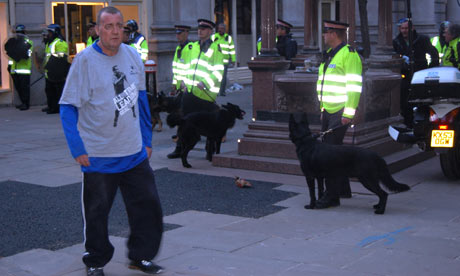
Meanwhile, the guy who died yesterday during the G20 protests yesterday has been named as Ian Tomlinson. He seems to have been someone who worked in a newsagent in the City of London. It is unclear whether he was taking part in the protests or was just trying to get home from work. Either way, he found himself caught in a "kettle", this being what the British cops call an area in which they contain protesters, preventing them for leaving sometimes for hours on end. At this stage it is unclear what caused Mr Tomlinson's death.

This "kettle" tactic of the UK cops – on the face of it, it sounds like a form of mass arrest, in that the people held in the "kettle" are prevented from leaving until such time as the police decide to let them. This imprisonment can last for considerable periods of time – yesterday the police held protesters for some seven hours. Following an earlier incident, in which a person so held challenged their imprisonment in the courts, the House of Lords ruled that this form of detention is not illegal under British law.

Ian Tomlinson image source

Three more articles (all from the Guardian):

G20: Questions need to be asked about 'kettling'

G20: The upside of 'kettling'

G20: Did police containment cause more trouble than it prevented?

EDIT: You have probably seen this by now, but the Guardian has obtained footage showing some cops walking up behind Mr Tomlinson and decking him for no obvious reason. See: Ian Tomlinson death: Guardian video reveals police attack on man who died at G20 protest

The Summit of the Spectacle

People are getting very excited about the current G20 summit. In the past, we used to have the G7 summits, where the leaders of what were then the seven largest industrial economies in the world used to get together to hold very important discussions on stuff. In the 1990s, this expanded into the G8, with Russia's leader invited along to the party. Perhaps in response to complaints that the G8 was unrepresentative, this year's event is hosting the leaders of 20 countries – the previous G8, plus a number of others recruited in a mysterious manner.

G8 Summits have always been rather inconsequential, and the G20 will no doubt be the same. Maybe they will agree some communiqué stating the need to take urgent action to address the pressing problems of the world. Or maybe they will not. Either way, things will go on pretty much as before. G* communiqués do not have the force of international law, and I do not think that any one of these summits has ever produced a major policy initiative that was subsequently delivered upon. These summits are simply talking shops, occasions for the world's leaders to get together and feel important because of all the other important people they are getting to have chit chat with.

One might ask, then, why it is that these summits are taken so seriously. In the case of the media, this is not too surprising. Whatever about the lack of substance to these events, they have a certain razzamatazz. Particularly with the USA having an excitingly charismatic new president, the whole event has the kind of glamour that easily fills column inches or nightly news bulletins. What is perhaps a bit more surprising is the vigour with which various groups take to protesting or trying to disrupt these summits. For some protesters, the media spotlight on the summits is an opportunity to publicise their own demands and proposals. For the more fundamentally anti-system protesters (people who want to, you know, overthrow capitalism and stuff) the payoff is less clear.

In conversation, some anarchists put it to me that their kind of protests serve to delegitimise the summits. I suspect, though, that they have almost the opposite effect. I do not mean that rowdy protests discredit opponents of the summits. Rather, noisy and disruptive protests make these summits appear like more significant events than they actually are. It looks to me like the anti-summit protests feed the egos of the very important people attending the summit, making them feel like their chit chat must be of great moment if people are so eager to protest against it. If the G* summits are simply a spectacular event, then the protesters are just playing their part in the spectacle's reproduction.


a man of wealth (and taste) image source

who is John Galt?

edited to remove dud picture code and associated link

01 April, 2009

Lebanon Media Unfail

I mentioned ages ago that the Daily Star, Lebanon's English language newspaper, had ceased publication. Well it seems to be back now. There seem to be parliamentary elections coming up in June, and the Daily Star has a report on the various parties' candidates.

31 March, 2009

Don't Bother Rounding Up The Usual Suspects

An Israeli army investigation into alleged Israeli army war crimes during the recent bombardment of Gaza has concluded that the Israeli army has no case to answer. Israeli Defence Minister Ehud Barak has announced that the investigation reveals that Israel still has "the most moral army in the world".

18 March, 2009

The USA's Israel Lobby (slight return)

You have probably heard about this "Israel Lobby" controversy. What happened was that Stephen Walt and John J. Mearsheimer, two American International Relations academics, wrote an article about the USA's tendency to support the most hawkish elements in the Israeli body politic. They saw this as being thanks to the influence of a powerful pro-Israel lobby in the USA. They furthermore asserted that this support for the Israeli right was detrimental to US interests (and, ultimately, to those of Israel). The authors of this article were not the usual leftist types, but theorists from the Realist school of International Relations. Their article let to predictable outrage.

Recently, President Obama proposed to appoint some guy called Charles Freeman to chair the US National Intelligence Council. Last week, however, Freeman withdrew his candidacy, citing a campaign of vilification against him by this Israel Lobby.

There is an interesting article in the Guardian by Jonathan Freedland on this incident: "Discard the mythology of 'the Israel Lobby', the reality is bad enough". Freedland is asserting that the Israel Lobby is not responsible for the near unconditional support that the USA gives to Israel. He is, however, doing it from a leftist perspective, and like Mearsheimer and Walt he sees the American support for Israel as ultimately malign. He does not deny the existence of a US lobby in favour of Israel (it would be hard to claim that the likes of AIPAC do not exist), but sees US support for Israel as being driven not by it but by self-interest – the self-interest of the USA's power-elite.

Freedland's article is interesting, and is a useful summary of the kind of argument he and others have advanced. It does have its problems, however. He creates something of a straw man out of Mearsheimer and Walt's argument, claiming that they see this Israel Lobby as omnipotent, when clearly they do not. Ironically, like many pro-Israeli opponents of Mearsheimer and Walt, Freedland seems also to casually conflate their idea of a powerful pro-Israel lobby with anti-semitic ideas of a sinister cabal of Zion's elders ruling the world. I am also unconvinced by his assertion that Israeli leaders were against the invasion of Iraq; I recall numerous Israeli commentators writing in the pages of Ha'aretz before the invasion, more or less asserting that anyone opposing the invasion was clearly an enemy of Israel.

At some stage of the game I will probably write more on different explanations offered for the obvious closeness between the USA and Israel, before going on to offer my own synthesis of them.

15 March, 2009

L'enfer, c'est les Australiens

Australia's foreign minister Steven Smith is very concerned about recent events in Pakistan, in particular the attacks on the Sri Lankan cricket team.

"This was very much an existentialist threat to Pakistan itself," commented Mr Smith.

The Pakistani authorities are reportedly on the lookout for gitanes and gauloises being smuggled in to the country's beret-wearing maniacs.

Hat-tip

image source one

image source two

Cast Lead Fail

You will recall that the Israeli state's recent campaign against Gaza was dubbed Operation Cast Lead, a name picked to denote how uncompromisingly brutal it would be for the Palestinians. Two months after the campaign ended, some people in Israel have started wondering whether Cast Lead achieved anything for them. Although death and destruction was meted out to the people of Gaza, it has not succeeded in its stated aim of halting the firing of rockets from Gaza into adjacent Israeli territory. The level of rocket fire now is down on what it was in late December; I suspect it is roughly comparable to what it would have been before the Israeli state repudiated the truce it had with Hamas by assassinating three of that party's activists back in November. It seems also that members of the Israeli public have started to register how badly the Gaza war has affected their country's image – it never really looks that good when your army tells people to shelter in a school and then fires tank shells at them.

What is both interesting and disturbing about all this is that anyone with half a brain could have predicted this outcome from the Gaza campaign – that Israel would fail to halt the rockets and would further erode its international standing. Whatever you think about the morality of their actions, there seems to be a lack of basic rationality on the part of many Israeli decision-makers. The Gaza campaign did not even succeed as a cynical attempt by the then government to buy popularity with the Israeli public. The decision to launch the Gaza campaign was taken by a government led by the Labour and Kadima parties, both of whom have been consigned to the opposition benches by the recent elections.

Israel's new ultra-right coalition has reputedly decided that for now the rockets from Gaza can be lived with. Minds are apparently being focussed on how the economic crisis is hitting Israel, making a repeat of Operation Cast Lead now rather unlikely. The new government of Binyamin Netanyahu, however, has not decided on a new pacific course of interaction with the country's neighbours. Instead, his leadership is reported to be planning a strike of some sort against Iran.