Showing posts with label Arab World. Show all posts

15 September, 2011

Bahrain's Throne of Blood

When the wind of change started blowing through the Arab world earlier this year, Bahrain was one of the countries affected by unrest. In some ways this was not too surprising – like the other countries of the region, it languished under authoritarian rule, this time of a monarchical stripe. But the unrest was unusual in that it was occurring in an oil producing country, as conventional thinking on the Arab world describes countries like Bahrain – oil producers with a relatively small population – as rentier states. The government earns its money from oil production, so it does not have to tax its people and concede the political participation they might look for in return. Furthermore, oil revenue gives regimes the monies to buy off potential opposition.

But Bahrain still saw considerable unrest. This might be because of its own unique features – it is a Shia Muslim majority country with a Sunni Muslim monarch who has been careful to exclude Shia Muslims from positions of power. This blatant unfairness cannot but have triggered resentment that then erupted when the Arab masses were vitalised by the emerging Arab Spring. Yet the unrest in Bahrain does not seem to have had a particularly sectarian quality*, with both Sunni and Shia Muslims all taking to the streets and looking for freedom.

Sadly, the king of Bahrain has been able to crush the rebellion of his people, at least for now. Several factors allowed him to succeed where Mubarak, Ben Ali, and now Qaddafi failed. One of these was the oil wealth that came the king's way, which had allowed him to build up a mercenary army of thugs from around the Arab world. These people could be relied on to fire on Bahraini protesters because they would not be worrying that the people they were killing could be their friends and relations. The king also had the support of Saudi Arabia, which sent in its own army to help crush the protests; the Saudi rulers were obviously keen to prevent Bahraini protesters succeeding and encouraging their people to follow their example. And the king benefited from the tacit support of the USA and its allies. A US fleet is based in Bahrain, and any democratic transition there might have sent it packing. The Americans also feared that a democratic Bahrain might move into the orbit of Iran.

Since the democracy movement was crushed, Bahrain has been enduring a reign of terror, with protesters and activists rounded up and subjected to torture before receiving long prison sentences in kangaroo courts. This has all happened largely away from the attention of the world, as dramatic and more photogenic events in other countries have taken over the news cycles. That the unrest was crushed relatively quickly has probably also played to the advantage of the king, saving him from the kind of ongoing travails that the Syrian regime is continuing to endure.

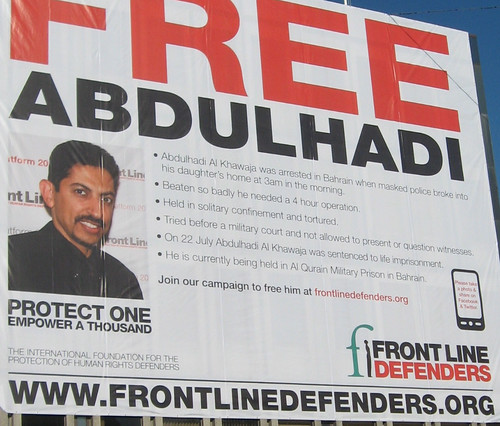
In my own country, the involvement of a prestigious medical school here in the education of Bahraini doctors has somewhat kept the Bahraini crisis in the public eye. Although the medical school has largely washed its hands of the crisis, some doctors in Ireland have campaigned to publicise the fate of doctors in Bahrain who have found themselves facing the wrong end of the regime after they took part in protests or simply gave medical treatment to people the regime's thugs had injured. The Front Line Defenders organisation has also tried to keep Bahrain in the spotlight, placing enormous posters in central Dublin concerning the arrest, torture, and detention of human rights defenders in Bahrain like Abdulhadi Al-Khawaja.

It's hard to know what will happen in Bahrain. At the moment, the Arab Spring looks like it has to some extent run out of steam across the region generally. However, this may be a false impression – away from Libya, Egypt, and Tunisia the dictators and kings may think they have things there way, but they could soon be facing another wave of freedom. Hopefully this will see the region's brutal rulers, including Bahrain's tyrant king, swept away to the dustbin of history.


*I am open to correction on this point.
Free Abdhulhadi al-Khawaja

02 April, 2011

Syria part 1 – Before the Assads

The wave of unrest spreading across the Arab World has now arrived in Syria. This is interesting, as Syria is a bit of an outlier in the region and some commentators had assumed that its unusual features would lead it to escape an emergence of people demanding political rights. What are those unusual features? Well, for one, Syria is rigidly authoritarian, with almost no space for political activity not sanctioned by the state. The country has also declined to sign a peace treaty with Israel, with Damascus hosting the exiled leadership of several of the more radical Palestinian groups. The Syrian regime is also a bit of a historical relic, flying the flag for a kind of vaguely leftist, secular, pan-Arab nationalism that largely died out elsewhere with the end of the 1960s. How did Syria get to where it is today? Read on.

Until the First World War, Syria was part of the Ottoman Empire, existing as a geographic concept running from what is now Turkey to the borders of Egypt and what is now Saudi Arabia (and so including all of Jordan, Lebanon, Palestine, and Israel). After the First World War, this region was divided up and modern Syria came into being under French rule. Some people there continued (and continue) to hanker after a restored Greater Syria, with many Syrians in particular finding it hard to think of Lebanon as a truly independent country.

Syria became independent after the Second World War, initially with a parliamentary regime on the French model. The new Syrian state was remarkably plural in its ethnic and religious make-up. Sunni Muslim Arabs made up about 60% of the population, with the rest being Arabs of all kinds of religious persuasion (Shia, Druze, Alawite, varieties of Christian) and there are also ethnic minorities (Kurds and Armenians, notably).

Once independent, Syria fell into a long period of instability in which military coups followed each other every couple of years, with politics in the country being characterised by conspiracy and intrigue. The country even merged with Egypt for a time in the 1960s, to create a United Arab Republic, but the union proved short-lived and was dissolved acrimoniously.

One ongoing feature of Syrian political life in the 1950s and 1960s was the rise of the Ba'ath Party. The Ba'ath (which literally translates as "Awakening") was a party advocating a secular, socialist pan-Arab nationalism. Yet for all its pan-Arabism, the Ba'ath never really amounted to much outside Syria (apart from in Iraq, where the local Ba'athists soon became the bitter enemies of their Syrian comrades) and it never attracted a mass following in Syria itself. It was however influential in the military, the state administration and intellectual circles. However, the Ba'ath was also highly factionalised and much of Syria's period of instability saw different groups of Ba'athists feuding with each other and struggling to suppress their rivals.

In 1967 Syria joined in the Six Day War against Israel and received a sound thrashing in return. After destroying the Syrian air force, Israeli forces overran the Golan Heights. This triggered more instability within Syria, culminating in a 1970 coup led by the Defence Minister, Hafez al-Assad. Assad's new government wished to conduct a more pragmatic foreign policy, avoiding the radical adventurism that had led to the 1967 disaster.

From Hunting Monsters

14 February, 2011

After Mubarak: Part 3 - International Effects of the Fall of Mubarak

Final Episode

In the short term, the successful ouster of Mubarak is likely to lead to more protests in other Arab countries. There has already been unrest in Yemen and Libya, two countries with long-serving leaders who have, like Mubarak, considerably outstayed their welcome; it will be interesting to see whether this intensifies. There are also reports of emerging unrest in Algeria, where a thuggish military clique has been in power since not long after independence, and also in Sudan.

Whether the reformist wave spreads to the monarchies will be interesting. I suspect that the Gulf oil plutocracies may well prove immune to serious pressures for democratisation, but the likes of Jordan and Morocco may find their regimes under serious threat if a wind of change blows through the rest of the Arab world. Whether unrest spreads to Syria will also be interesting to see. Syria has been ruled by the same family since the early 1970s and has the usual underperforming economy of Arab countries, but it is a bit of an outlier in other respects, being perhaps the most rigidly authoritarian country in the region but also the one Arab country that is still an enemy of the West* and Israel. The latter maybe gives the Syrian regime a credibility that the various US-backed kings and dictators elsewhere lack.

The really interesting possible contagion effect of the Egyptian protests could be in Iran. The Iranian regime announced a while ago that it supported the Egyptian protests because they were akin to the 1978-1979 protests that brought down the Shah and brought the Islamic Republic into being. However, opposition figures in Iran have drawn similarities between the Egyptian protests and Iran's own protests against last year's rigged presidential election. There is talk of Iranians taking to the streets to support Egypt's revolution and then implicitly or explicitly demand democratic change at home, something the country's power elite do not want to happen.

In the longer term, the country with most to lose from the transition in Egypt is Israel. Even if a new government in Egypt does not go to war with Israel or start arming Palestinian militants, any government in a more democratic Egypt is going to be less accommodating of Israeli interests than Mubarak was. Israeli leaders will therefore be watching developments in Egypt with some nervousness. In particular, it will be interesting to see whether Egypt continues to assist Egypt in maintaining the siege of Gaza (up to now Mubarak had been keeping the Gazan-Egyptian frontier largely closed). I find it hard to see how any democratically based Egyptian government can continue doing Israel's work for it, so some opening of Gaza's southern border is to be expected. I am not sure what the Israeli government would do in response, though I note their tendency to respond with extreme violence whenever a problem presents itself.

At the moment, Egypt receives an enormous amount of aid from the United States of America. If Egypt moves to a more confrontational relationship with Israel then this aid is likely to dry up. I am not sure how much of a loss this would actually be to Egypt, as much of it comes in the form of tanks, airplanes, and other toys for the Egyptian armed forces – does anyone know if a significant proportion of it comes in more socially useful forms? Either way the loss of this aid would hurt Egypt, so a less confrontational line towards Israel may be pursued in the hope of hanging onto at least some of it.


*The extent to which Syria is actually an enemy of the West is a bit arguable; it is more that successive American regimes are hostile to it, for all that they are happy to subcontract torture and intelligence gathering to the Syrian security services. American hostility stems from Syria's support of Hezbollah in Lebanon and its reluctance to accept a one-sided peace deal with Israel. Syria's attempts to run Lebanon as a client state, meanwhile, cause problems in its relations with other western countries, notably France.

From Hunting Monsters

10 November, 2007

BOOKS ABOUT THE MIDDLE EAST: "The Iron Wall: Israel and the Arab World" by Avi Shlaim

Before discussing the book itself, I need to quickly talk about the Israeli New Historians. These fellows set themselves the task of approaching their country's history the way historians are meant to – by looking at documents and the historical record to establish what had actually occurred in the past, rather than by simply regurgitating self-serving national myths. In a young country like Israel, with a carefully cultivated narrative around its founding, this kind of approach proved rather contentious, uncovering as it did events and counter-narratives that many would prefer to see forever buried.

Avi Shlaim is one of these New Historian people. His back academic work was the book "Collusion Across The Jordan", about the then largely obscured negotiations between the Israeli leaders and King Abdullah of Jordan around the time of the Israeli state's founding. "The Iron Wall" is a more general work, covering the relationship between the Israeli state and the Arab World; in this context, the Arab World includes both the various Arab states as well as the Palestinian people living inside what became Israel and in the territories it came to occupy. In time, the book covers the period from the foundation of the Zionist community in Palestine in the early 20th century to the election of Ehud Barak as prime minister in 1999. At this stage of the game the book cries out for a second edition, given subsequent events and the rather naïve note of optimism on which the book ends.

Shlaim's book takes its title from an article written in 1923 by Ze'ev Jabotinsky. Jabotinsky was committed to the establishment of a Jewish state in what was then Palestine, but he acknowledged a key obstacle to the project – the Arab majority population in Palestine (and, the Arabs generally beyond the territory's borders). Other Zionist leaders had fudged the issue of what to do with these people and how the emerging Jewish state would deal with them. Jabotinsky called a spade a spade, and foresaw that as the Israeli project advanced the Arabs would increasingly resist their expropriation. Jabotinsky argued that attempts to conciliate or negotiate with the Arabs were pointless, at least initially, as their wish would be to destroy the Zionist colonies and re-establish their authority in the country. Jabotinsky proposed instead to erect a metaphorical "Iron Wall" of military might around the Zionist project. Eventually the Arabs would realise that this Iron Wall was unbreakable, that the Israelis could not be defeated, and then it would be possible for the Zionists to negotiate with them and reach some sort of accommodation (that would presumably see them permanently reduced to second class citizenship or some such status).

Jabotinsky remained an oppositional figure within Zionism, but Shlaim's assertion is that his Iron Wall doctrine became the established model on the Israeli side for dealing with the Arabs. Shlaim sees this in the tendency of the Israeli state for much of its history to make early resorts to force and to happily choose escalation over the defusing of tensions. Part of Shlaim's argument, though, is that successive Israeli leaders have had a less sophisticated understanding of the idea than Jabotinsky himself, in that they have failed to register that the Iron Wall has done its job and convinced the Arab World of Israeli permanence, in that the Israeli state has been slow to pick up on opportunities to pursue negotiations and non-violent options with its neighbours.

OK, so that is the theoretical underpinning of the book. What you actually get when you read it is an account of Arab-Israeli relations based on documentary research and interviews with many leading figures. The story is mostly told from the Israeli point of view, probably because of the difficulties an Israeli researcher (or indeed anyone) would have consulting archives or conducting serious research in most Arab states. It is basically an account of interstate politics in the Middle East, from an Israeli point of view. The Israeli point of view is one of perspective rather than sympathy, however, in that Shlaim is not an apologist for his government's actions. He does not gloss over situations where Israel appears to be in the wrong, and where he feels the situation warrants it he is happy to criticise Israeli actions (one criticism sometimes made of this book is that it is too critical of Israel).

The section of this book I found most interesting was the one dealing with Israel in the 1950s, perhaps because I am more familiar with the later periods. In this period, after Israel had won the war that led to its formation, the Israeli state is generally seen as being surrounded by enemies hell-bent on its destruction, but Shlaim argues that this perspective is somewhat illusory and one deliberately cultivated. He suggests that this period was one in which Israeli leaders, wedded to the militarist ideas of Jabotinsky, missed numerous opportunities to move Middle Eastern politics onto a more pacific course. He talks in particular about various back-door negotiation channels open in the early 1950s with Nasser and about how countries, ultimately buried by an Israeli raid against an Egyptian military position (in retaliation against an attack on Israelis by Palestinians). He also asserts that Jordanian and Syrian posturing against Israel was reactive, whereas Israel was always keen to escalate any encounters.

And so it goes. While the section on the 1950s was the most interesting to me, I reckon that anyone with a beginner's interest to the Middle East would find all of this book very interesting. One thing, though, that I would like to read is a more pro-Israel book, albeit one written subsequent to this and to the work of the New Historians – that is to say, a book which is still putting a pro-Israel slant on events, even if, unlike earlier books, it is not just ignoring or explaining away events that do not fit its narrative. Can anyone recommend me such a work?

The Iron Wall also features a fascinating photo of Kissinger leering at Leah Rabin.

07 May, 2007

Democratising the Middle East

I had my last ever lecture in Spy School on Friday. It was about US attempts to democratise the Arab world. By an astonishing coincidence, the BBC ran an article on this kind of thing last week: Has the US ditched Mid-East reform?

I have already mentioned the prevalence of authoritarian rule in the Middle East. Part of the picture here is the historic fondness of the USA for friendly Arab dictators or kings. This assisted various shady Arab world leaders in the repression of their people. After 9-11, though, elements within the US administration began to wonder if this strategy had essentially failed – something designed to advance US security is hardly achieved if maniacs take to flying aircraft into New York skyscrapers. So the US regime started talking about how it was vitally important that the Arab world move towards democracy. The use of democratisation as part of the justification for invading Iraq was part of this, but the piling of pressure on US clients was another. Egypt's Hosni Mubarak had long been one of the USA's most reliable allies in the region, but suddenly he found himself being put under real pressure to introduce democratic reforms to his country.

Fortunately for Mubarak, the USA lost interest in Arab democratisation, and the Egyptian regime found itself free to throw civil rights activists and bloggers into jail without any problematic statements from the Americans. The reason for this is simple enough – democracy is a mysterious business, and you can never be sure that the guys you like will win. The Palestinian Authority elections in 2006 were a worrying reminder of what can happen when people are allowed to vote – despite the high education of Palestinians, their extensive links to a worldwide diaspora, and all the money the USA has pumped into the country, the Palestinian ingrates chose to vote for Hamas, the evil Islamist party. After that the US administration decided that actually the friendly dictators and monarchs were not so bad after all, and they have been subjected to only the most token pressures towards democracy.

You could say, therefore, that the clock has turned full circle and the USA is back to letting security concerns dictate its agenda with respect to Middle Eastern regimes. Unfortunately, the pro-democracy interlude has the effect of greatly strengthening the dictators, as they (and their opposition) can now reasonably predict that if the Americans pile on the pressure for democracy then this will simply be a short-lived fad to which they are not really committed. There is also the damage to US credibility – if you start saying that Egypt needs to democratise and then a couple of years later revert to a failed policy of boosting Mubarak then you look like a bit of an idiot, and a hypocritical one at that.

20 February, 2007

The Islamists - our new friends?

I posted over on the Dublin School about something I read in an online newsletter, which was relevant to both the Spy School course on Political Islam some of us are taking and also, by extension, my last post. I suspect that even less people read the Dublin School than read Hunting Monsters, so I am going to redo the post here.

Basically, I read the latest issue of the CEPS European Neighbourhood Watch newsletter, put out by the Centre for European Policy Studies. The editorial discusses an emerging dialogue between Europe and Islamists of the Middle East & North Africa. On both sides the governments are being bypassed, with oppositional Islamist groups from the Arab world talking to think tanks and policy oriented NGOs. The discussions seem interesting, partly because they are happening at all, indicating that in coming years the Arab authoritarians will find it harder to prop themselves up with European support. At the same time, it is striking how frank the parties to this dialogue are about the fundamental differences in outlook that divide them.

The article also reproduces a piece by Dr. Saad el-Deen al-Katany, the parliamentary leader of the Muslim Brotherhood in Egypt, in which he sets forth the need for dialogue between Islamists and the West. I found this interesting because Dr. Al-Katany is attempting to drive a wedge between the West and the Arab world dictators it backs, calling on us prove we are not lying when we say we love democracy. Again, it looks like the Islamists are seeing the advantages of talking our language back to us.

There is also a reprinted interview with Belarus President, Alexander Lukashenko, one of the world's great scary leaders.

You can download the newsletter or subscribe to updates here: CEPS European Neighbourhood Watch

18 February, 2007

Arab World Despotism


So these days I am taking this course on Political Islam, with the course focussing on Islamist movements in the Middle East and North Africa, an arc stretching from Morocco to Iran*. Thus far it seems quite interesting. I am doing it more because I am interested in the politics of the Arab World rather than in Islamism as such.

One thing that came up in the last class was the subject of how undemocratic the regimes in the region are. If you look at the area covered, almost all of the countries are places where ultimate political power resides with unaccountable elites. This is in contrast with the world generally, where democratic politics of some sort or another is considerably more common. In the world generally there is an association between rising national income levels and democratic regimes, but the Middle East and North Africa is far less democratic than its income levels would predict, with the richest countries in the region being as comedically undemocratic as the poorest.

There are, of course, a couple of regimes with democratic elements. The Palestinian Authority seems to run elections that meet the highest international standards and see turnover of office holding, but it is not a state and its elected leaders do not actually rule anything of substance. Lebanon has elections all the time, but its consociational setup means that the same clique of family bosses are always in power. Turkey in many ways looks like it has democratic politics, though there is the unfortunate question of Kurdish oppression and the fact that the army still sees itself as having the right to sack the government, even if it has not chose to do so for a while. Israel has a lot of the features one expects for a democratic regime - parties, elections, free press, robust political argument, etc. - but it has its own democratic problems: firstly, the country rules over a huge subject population to whom it gives no political rights, and secondly, within its own citizenry those not from the dominant ethnic-religious group are subject to degrees of discrimination and marginalisation.

It is interesting to consider why the Middle East and North Africa seem so prone to authoritarian rule. One has to be careful of lazy explanations, particularly when you consider the differences between the countries (oil rich Qatar with its tiny population, oil poor Egypt with its teeming masses) and the different regimes that rule the countries. One possible cause can be discounted - there does not seem to be in practice a general Muslim problem with democracy. If you exclude the Middle East and North Africa the countries of the Islamic world are apparently more democratic than their income levels would suggest.

So, what has kept the authoritarian regimes in power, in a world where since 1989 there has been considerable pressure to move to democracy? Our lecturer suggests that the regimes have maintained themselves by playing their opponents off against each other. Some oppositional figures are simply bought off with plush government jobs or hard cash, but more subtly the regimes can throw minor concessions to their more old-school liberal-secular-nationalist opponents as a way of turning them into allies against the Islamists. Meanwhile, with the Islamists the main opposition forces, the regimes can always face down Western pressure to democratise by scaring the West with the prospect of democratic elections leading to mad bearded clerics occupying the Presidential palace and organising the country for Jihad against Israel, Europe, the USA, and anyone they take a dislike to.

I find this theory interesting, as it suggests that it is Western disdain for the region's main oppositional force that keeps the authoritarians in power. Certainly, when the generals in Algeria annulled their country's last free election and banned the party that won it, the world community somehow managed to see the election winners, and not the generals, as the enemies of democracy.

I am curious as to how this kind of thing will progress in the future. Maybe the mainstream Islamists will try to create a new friendly image for themselves and to cultivate alliances with the secular opposition while trying to reassure the West that they are not maniacs. Or maybe they will continue to grow their popularity in society at large to such an extent that the authoritarian regimes simply cannot sustain themselves any longer and collapse in a manner reminiscent of the Shah's. Or maybe the current situation is indefinitely sustainable. Time will tell.

*as you and I know, Arab countries do not make up all of those in the Middle East and North Africa. Iran is not an Arab country (though it has a small Arab minority). Neither is Turkey. Israel and the territory it rules has a large Arab population but a (declining) non-Arab majority.