19 November, 2010
IRELAND IN CRISIS
Ireland is in crisis. I may at some stage talk about the full horror of what is happening here, but probably will not get round to it. I have nevertheless been quite taken with the way UK media outlets seem to feel obliged to include generic images of beggars on the streets of Dublin with everything they run on the situation here. I have posted a series of these pictures over on my other blog: Beggars of Dublin


12 November, 2010
East German Journey
 I find Open Democracy a bit annoying – they publish way more stuff than I can read, they publish it only on the Internet when I am a luddite who hates reading things onscreen, and they are always looking for money. Maybe if they published a more manageable amount of stuff then they would need less money.
 For all that, they do occasionally hit paydirt, like in this long piece by John Hoyland about a trip he made to East Germany when he was a young CND activist. The Berlin Wall had just gone up (because too many East Germans were scarpering out of the workers' paradise that was actually existing socialism) and the Sino-Soviet split had not yet taken place, so the party Hoyland was in had a Chinese guy translating from English to German. The article is fascinating, as a piece of travel writing, as a portrait of Communist fellow travellers going through the motions of supporting what they know to be rubbish, and as a coming of age piece about Hoyland himself. I reckon that even people who do not share my DDR fascination would find this article worth reading, so I recommend it highly.

Pictures from article.

11 November, 2010
Crackdown in Western Sahara
There are a reports of a crackdown by Moroccan government forces against residents of a refugee camp in Western Sahara, the territory that has been under Moroccan occupation since the end of the Spanish colonial regime. Saharawi* sources are claiming 11 of their people killed, while the Moroccan authorities are saying that 5 members of the security forces were killed by separatists.
Efforts by supporters of Western Saharan independence have largely failed because the Moroccan regime is in with the right people – leaders of the USA and major EU countries see it as a bulwark against Islamic fundamentalism and are loth to antagonise it by asking embarrassing questions about the occupation of Western Sahara, the illegal planting of Moroccans there, and the failure to hold a referendum on independence for the country. My understanding is that the EU has also signed a fisheries deal with Morocco, in which that country's king has basically agreed to let European trawlers steal the fish of the Western Saharans.
More:
Deadly clashes as Morocco breaks up Western Sahara camp (BBC)
*the name by which the people of Western Sahara call themselves
Efforts by supporters of Western Saharan independence have largely failed because the Moroccan regime is in with the right people – leaders of the USA and major EU countries see it as a bulwark against Islamic fundamentalism and are loth to antagonise it by asking embarrassing questions about the occupation of Western Sahara, the illegal planting of Moroccans there, and the failure to hold a referendum on independence for the country. My understanding is that the EU has also signed a fisheries deal with Morocco, in which that country's king has basically agreed to let European trawlers steal the fish of the Western Saharans.
More:
Deadly clashes as Morocco breaks up Western Sahara camp (BBC)
*the name by which the people of Western Sahara call themselves
21 October, 2010
The Netherlands Says No To Tourism
The new right wing government in the Netherlands is taking bold steps against the country’s famous marijuana-selling coffee shops. New measures will mean that these establishments will have to become members-only clubs, making them unable to deal the demon weed to the estimated two million “drug tourists” who visit Amsterdam alone each year. The new measure seems to be driven by an alliance between the god-bothering moralists in the CDA (a junior coalition partner) and the right-wing head-bangers in Geert Wilders’ so-called Freedom Party, who are providing support to the government. In pandering to these reactionaries, the liberals in the WD party (the coalition’s largest group) are basically turning their back on the Netherlands’ famous history of tolerance and embracing the same kind of failed drug policies that other European countries continue to pursue.
The latest Dutch experiment will be eagerly observed across Europe. There are reports that the Irish government has plans to follow the Dutch example. Public houses may soon be forced to become members-only establishments, as a way of stamping out the “beer tourism” that has long-bedevilled the country.
more
The latest Dutch experiment will be eagerly observed across Europe. There are reports that the Irish government has plans to follow the Dutch example. Public houses may soon be forced to become members-only establishments, as a way of stamping out the “beer tourism” that has long-bedevilled the country.
more
24 September, 2010
"Nothing to Envy: Real Lives in North Korea" by Barbara Demick
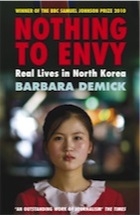 This is a book about North Korea by an American journalist. She attempts to sketch everyday life in that most isolated country by talking to a number of people who have defected to South Korea from it. Mindful of the problems associated with exile narratives (almost by definition, exiles are going to be disaffected from the country they have left and may also be inclined to tell a listener the story they want to hear), Demick bases her book on a small number of exiles from the city of Chongjin in the north east of the country. The logic of this is that picking people from the same place means that she can cross-reference incidental details about the town in their narratives as a way of gauging their overall truthfulness. That's what she tells us in the introduction anyway. In the book as a whole she presents the defectors' narratives as Fact, without ever questioning whether they might be presenting a self-serving narrative. Perhaps she weeded out other subjects who she felt were feeding her bullshit, though she does not mention this.
The book follows its characters from roughly the late 1980s to their escapes to South Korea in the early 21st century, with an epilogue on their adjustment to a new life in a very different country. The subjects represent something of a cross-section of society – a textile worker who is an ardent supporter of the regime, a high-flying science student, a school teacher, a paediatrician, and a young lad orphaned by the collapse of North Korean society.
This is basically a book about social collapse*. North Korea's economy tanked in the 1990s. Previously the country had been relatively wealthy in world historical terms, with North Koreans even enjoying a higher standard of living than their southern neighbours until the South began to take off in the 1960s. However, the North Korean economy was dependent on imports of oil and other commodities from the Soviet Union, supplied at well below world prices. When the USSR went into decline in the later 1980s and then broke up in the 1990s, North Korea found itself unable to pay for oil now being priced at market rates. North Korean industry collapsed, as did agricultural output, which was dependent on oil-derived fertilisers and farm machinery that could no longer be powered. That the government of what is perhaps the world's most militarised country insisted on ploughing so much of its resources into the armed forces probably did not help much either. North Korea fell into a famine in which it is estimated that a tenth of the population died.
Focussing on individual stories gives us an idea of the human scale of this catastrophe. Mrs Song, the textile worker, is sent home from her job as no raw materials are coming in. She then has to set aside her socialist principles to become a black market trader, but it is still not enough to stop her husband, son, and mother-in-law dying of starvation. Even more harrowing are the stories of the paediatrician and school teacher, who have to watch their charges starve to death.
For all the grimness of a land stalked by famine, the most affecting story in the book is that of Mi-Ran and Jun-Sang, the school teacher and the high-flying student. They loved each other, but in North Korea their love was doomed. Jun-Sang's academic excellence meant that he was upwardly mobile, but Mi-Ran had a tainted family background – her father was a South Korean who had been captured in the Korean War and settled in the North. If Jung-San's association with Mi-Ran had become public knowledge then her taint would doom his dreams of advancement. Mi-Ran eventually realises that their relationship could go no further, and skips out of North Korea, eventually ending up in Seoul. Jun-Sang eventually makes the same journey, but when they meet again it is too late for them, as Mi-Ran now had a child and husband. More than all the death, this blight cast on everyday lives brought home to me the nastiness of the North Korean regime.
Anyway, I recommend this book highly. It humanises the people of one of the world's strangest countries and gives an insight into a world of strangeness that most of us will never live through. Still, reading it has made me think a bit more about the precarious nature of advanced human society. North Korea's economy collapsed when they lost their supply of cheap energy. What happens to us when we can no longer get the oil and gas we need at prices we can afford?
image source
*which means that it dovetails nicely with some of the fiction I have been reading recently about future social collapse: Stephen Baxter's Flood and Ark
11 September, 2010
Thanks Tony - slight return

Some people queued to buy Tony Blair's book.
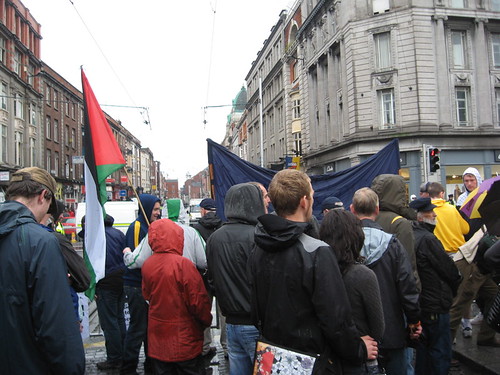 Some people protested against Mr Blair.
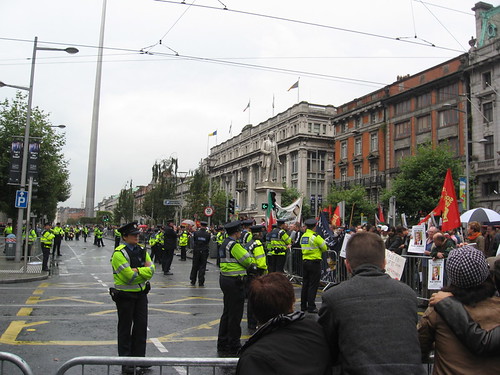 The Gardaí made sure that no one arrested or upset Mr Blair.
image source
02 September, 2010
Thanks Tony!
Tony Blair is coming to Dublin! The former British Prime Minister  has taken a well-deserved break from his bringing of peace to the Middle East in order to promote a book he has written about himself. He is going to be appearing on the Late Late Show tomorrow and in Eason's on Saturday morning at 11.00 am to promote his memoir. Many people will be along on both occasions to show their gratitude for everything he has done for Iraq and the Middle East generally. I understand that on Saturday people will be assembling at the Spire in advance of Mr Blair's appearance before queuing up to shake his hand.
image source
has taken a well-deserved break from his bringing of peace to the Middle East in order to promote a book he has written about himself. He is going to be appearing on the Late Late Show tomorrow and in Eason's on Saturday morning at 11.00 am to promote his memoir. Many people will be along on both occasions to show their gratitude for everything he has done for Iraq and the Middle East generally. I understand that on Saturday people will be assembling at the Spire in advance of Mr Blair's appearance before queuing up to shake his hand. image source
14 August, 2010
Help an old soldier?
 Got a few quid to spare? Then why not stump up some cash for the Lebanese Army. Lebanon's armed forces were until recently being part-funded by the United States of America, possibly in the hope that they could be used against Hezbollah. However, a recent armed clash between Israeli and Lebanese troops along their shared border raised fears in the USA that their money could be going to an army that would end up fighting Israel. So the money tap has been turned off. Now the country's army is a little bit short of cash. Defence Minister Elias Murr has responded by opening up a bank account into which people can donate money for the country's army. He is leading the charge by jointly chipping in some $670,000 with his dad.
More
12 July, 2010
Iranian hair
Here is an interesting article by Jon Leyne about hair in Iran. Usually when people write about hair in Middle Eastern countries, it is women's hair with which they are concerned – in particular with whether it is being hidden by the hijab or a more extreme type of veil. In this case, though, the primary focus is on men's hair. The article reports that outlandish male hairstyles have become very common in the Islamic Republic, and elements within the regime have decided that enough is enough – a list of appropriate male hairstyles have been published and the direst sanctions threatened against those men who keep their hair in styles deemed un-Islamic.
 Disappointingly, the article does not link off to gallery of Iranian men and their extravagant hairstyles. It also heads back to the more usual obsession of western journalists with the hijab and women's hair. Readers will be astonished to discover that many women in Iran dress as fashionably as they can, given the restrictions the regime enforces. A photo of some Iranian ladies with the most token veils reinforces the point.

One thing I wonder with the article is whether it can be assumed that having an outlandish hairstyle in Iran is really a token of resistance to the regime. Leyne mentions that there is a particular look associated with the regime and its paramilitary supporters, but I think it a bit of a leap to assume that every flamboyantly coiffed individual is using his hair to stick it to the man. People style their hair for any number of reasons, and extravagant male hair is not uncommon across the Middle East. Likewise, while unusual hairstyles might be a sign of youth rebellion, that could be the kind of unfocussed apolitical "rebellion" the youth in the West are famous for.
Disappointingly, the article does not link off to gallery of Iranian men and their extravagant hairstyles. It also heads back to the more usual obsession of western journalists with the hijab and women's hair. Readers will be astonished to discover that many women in Iran dress as fashionably as they can, given the restrictions the regime enforces. A photo of some Iranian ladies with the most token veils reinforces the point.One thing I wonder with the article is whether it can be assumed that having an outlandish hairstyle in Iran is really a token of resistance to the regime. Leyne mentions that there is a particular look associated with the regime and its paramilitary supporters, but I think it a bit of a leap to assume that every flamboyantly coiffed individual is using his hair to stick it to the man. People style their hair for any number of reasons, and extravagant male hair is not uncommon across the Middle East. Likewise, while unusual hairstyles might be a sign of youth rebellion, that could be the kind of unfocussed apolitical "rebellion" the youth in the West are famous for.
24 May, 2010
Blood Will Have Blood
The BBC has a rather grim report on a lynching that took place recently in the Lebanese village of Ketermaya. When three generations of one family were brutally murdered, the local police hauled in Muhammed Muslem, a foreigner living in the village; after a night of interrogation he confessed to the crime. Then somehow it was decided that he should be brought back to the scene of the crime and show the policemen how he did it. On seeing the apparent assailant, however, an outraged mob of villagers dragged him from the police (who seem not to have offered much resistance) and then stabbed him to death, before stringing up his body on a meathook. In an eerie echo of 20th century lynchings in the American Deep South, the murder of the alleged assailant (who seems only to have been incriminated by his foreignness and the confession extracted from him by the police) was photographed and filmed on mobile phones, with the footage now widely circulated around Lebanon.
The shocking incident is apparently indicative of the dysfunction in Lebanon’s police and justice system. In one respect it is a micro-level counterpart to the country’s complete inability to adequately investigate the mysterious explosions that have killed so many of its leading citizens over the last decades.
I was struck by one detail in the article. It mentioned that the original murder was, until then, the most brutal crime in Ketermaya in living memory. I have never been to that village, but I have visited the Chouf region in which it lies. When I was there, in 2002, it was a beautiful and peaceful countryside region, somewhere I would love to go back to. But the Chouf is also a place of horror. In the 1980s, it was home to murderous gangs who would stop cars and slit the throats of occupants from the wrong religious community, dumping their bodies in ditches. Previous bouts of bloody intercommunal feuding took place in 1860 and 1848. Do the dark deeds of the past leave a psychic miasma that affects people in the present?
The shocking incident is apparently indicative of the dysfunction in Lebanon’s police and justice system. In one respect it is a micro-level counterpart to the country’s complete inability to adequately investigate the mysterious explosions that have killed so many of its leading citizens over the last decades.
I was struck by one detail in the article. It mentioned that the original murder was, until then, the most brutal crime in Ketermaya in living memory. I have never been to that village, but I have visited the Chouf region in which it lies. When I was there, in 2002, it was a beautiful and peaceful countryside region, somewhere I would love to go back to. But the Chouf is also a place of horror. In the 1980s, it was home to murderous gangs who would stop cars and slit the throats of occupants from the wrong religious community, dumping their bodies in ditches. Previous bouts of bloody intercommunal feuding took place in 1860 and 1848. Do the dark deeds of the past leave a psychic miasma that affects people in the present?
23 May, 2010
“Illegal” Palestinian Homes Demolished
Here is a news report about some Palestinians who had their homes demolished on the pretext that they had been built illegally. This kind of thing happens all the time in Jerusalem, where new homes for Jewish Israelis are built all the time but Palestinians find themselves mysteriously unable to obtain planning permission. If they go ahead and build anyway then sooner or later the Israeli authorities show up with bulldozers.
The odd thing here is that these demolished homes are not in Jerusalem or in some other area under direct Israeli occupation, but rather in Rafah, at the southern end of the Gaza Strip. The homes were demolished by security forces working for the Hamas government that administers Gaza, on the basis that the land was government owned. That some of the people whose shacks were destroyed had previously been made homeless by Israel’s invasion in January 2009 seems not to have moved the Hamas cadres.
This is of course incredibly ironic, and not in a good way.
The odd thing here is that these demolished homes are not in Jerusalem or in some other area under direct Israeli occupation, but rather in Rafah, at the southern end of the Gaza Strip. The homes were demolished by security forces working for the Hamas government that administers Gaza, on the basis that the land was government owned. That some of the people whose shacks were destroyed had previously been made homeless by Israel’s invasion in January 2009 seems not to have moved the Hamas cadres.
This is of course incredibly ironic, and not in a good way.
22 May, 2010
What is happening in Thailand?
I cannot claim to be following events in Thailand too closely, but this is my understanding of what is happening there.
Basically, there is this entrenched power elite in Thailand who feel that it is their prerogative to run the country. Some years ago, however, this guy Thaksin Shinawatra became prime minister after his party won an election. Mr Thaksin came from outside the self-perpetuating power elite, but this does not make him some kind of progressive politician. As a rich businessman, his struggle with the Thai establishment is more like a conflict between different elite figures. His party is especially popular outside Bangkok, with his popularity representing something of a revolt by people who have felt themselves left behind by the country’s economic development.
Anyway, the Thai establishment did not like Thaksin and were able to get their pals in the army to stage a coup while he was out of the country. The new government were able to disbar him from public office on corruption charges. Unfortunately for them, every time since then that elections have been called in Thailand, Mr Thaksin’s allies have convincingly won them. This has caused consternation among the establishment. Rather than accept election results, they have periodically mobilised their supporters to take to the streets and force the resignation of pro-Thaksin governments. In an almost Orwellian turn, Thaksin’s opponents have given organised themselves as the People’s Alliance for Democracy, despite their commitment to overthrowing election results and plans to turn the Thai parliament into a largely unelected body stuffed with them and their cronies.
Recently, Thaksin’s supporters took to the streets of Bangkok to try and overthrow the current anti-Thaksin government. After a long stand-off, the authorities were finally able to get the army to clear them from the streets, with several dozen people being killed in the last week.
It is hard to say what the best way forward for Thailand might be. I reckon it would be a good first step if the currently dominant faction could be prevailed upon to accept that whoever wins elections has the right to form the government.
Basically, there is this entrenched power elite in Thailand who feel that it is their prerogative to run the country. Some years ago, however, this guy Thaksin Shinawatra became prime minister after his party won an election. Mr Thaksin came from outside the self-perpetuating power elite, but this does not make him some kind of progressive politician. As a rich businessman, his struggle with the Thai establishment is more like a conflict between different elite figures. His party is especially popular outside Bangkok, with his popularity representing something of a revolt by people who have felt themselves left behind by the country’s economic development.
Anyway, the Thai establishment did not like Thaksin and were able to get their pals in the army to stage a coup while he was out of the country. The new government were able to disbar him from public office on corruption charges. Unfortunately for them, every time since then that elections have been called in Thailand, Mr Thaksin’s allies have convincingly won them. This has caused consternation among the establishment. Rather than accept election results, they have periodically mobilised their supporters to take to the streets and force the resignation of pro-Thaksin governments. In an almost Orwellian turn, Thaksin’s opponents have given organised themselves as the People’s Alliance for Democracy, despite their commitment to overthrowing election results and plans to turn the Thai parliament into a largely unelected body stuffed with them and their cronies.
Recently, Thaksin’s supporters took to the streets of Bangkok to try and overthrow the current anti-Thaksin government. After a long stand-off, the authorities were finally able to get the army to clear them from the streets, with several dozen people being killed in the last week.
It is hard to say what the best way forward for Thailand might be. I reckon it would be a good first step if the currently dominant faction could be prevailed upon to accept that whoever wins elections has the right to form the government.
15 May, 2010
Confidence and Dissolution
The election campaign in the UK was very interesting. One thing I was struck by how was how disappointing the final result was for the three main UK parties. Labour received their worst drubbing since the early 1980s, while the Conservatives failed to win enough seats to be able to govern alone. The Liberal Democrats, meanwhile, failed to achieve the kind of breakthrough result that their early performance in the campaign promised. This is arguably a parliament of the defeated.
The new government is proposing to change the rules regarding when UK elections are called. At present, a prime minister can have an election called whenever he or she likes. A general election also typically follows if the government loses a confidence vote in the Houses of Commons. Under the new proposal, a dissolution would require a 55% vote of the House of Commons.
The proposed new rule for parliamentary dissolutions has attracted much comment, a lot of it ill-informed. Many commentators are seeing it as a plot by the Conservatives to keep themselves in power forever. This seems to arise from confusion between a vote of confidence in the government and a vote to dissolve parliament. Under the new rules, if Cameron loses his majority then he would have to resign as prime minister. It would then be up to someone else to have a crack at forming a government with majority support. If 55% of MPs felt that an election was desirable then they could force a dissolution, but otherwise it would be up to them to form a new government.
In Westminster, this kind of constitutional change is unusual, but it is common elsewhere. Many European parliaments sit for fixed terms, with it being very difficult to bring about an early dissolution. In the devolved parliaments of Scotland and Wales, it requires a two-thirds majority to trigger an election.
Given that fixed-term parliaments have been a core Liberal Democrat policy for decades, it is hard to see why people are so surprised by the new dissolution rules. There is a certain parochialism among those who assume that the pre-existing Westminster rules are the natural order of things, and a certain fuzzy thinking by those who confuse confidence votes and votes to call elections. But another factor seems to be that some people see the new UK government as fundamentally illegitimate, perhaps because it includes the Conservatives. They were perhaps hoping that the coalition would hang on for a couple of months before being ousted in a new election.
The new rules make it more likely that the government will last the full parliamentary term, because Cameron does not have the option of calling an election if he senses a momentary advantage. However, the Liberal Democrats are probably their real beneficiary. If irreconcilable differences emerge in the government, Cameron would be unable to call an election and hope that the electorate would punish his erstwhile partners. Instead, the Liberal Democrats would be able to open negotiations with Labour on the formation of a rainbow government, possibly including some of the minor and regional parties. An election could only be called if both Labour and the Conservatives wanted one. This is a fairly unlikely prospect, though it might happen if both thought they could wipe out the Liberals.
The new government is proposing to change the rules regarding when UK elections are called. At present, a prime minister can have an election called whenever he or she likes. A general election also typically follows if the government loses a confidence vote in the Houses of Commons. Under the new proposal, a dissolution would require a 55% vote of the House of Commons.
The proposed new rule for parliamentary dissolutions has attracted much comment, a lot of it ill-informed. Many commentators are seeing it as a plot by the Conservatives to keep themselves in power forever. This seems to arise from confusion between a vote of confidence in the government and a vote to dissolve parliament. Under the new rules, if Cameron loses his majority then he would have to resign as prime minister. It would then be up to someone else to have a crack at forming a government with majority support. If 55% of MPs felt that an election was desirable then they could force a dissolution, but otherwise it would be up to them to form a new government.
In Westminster, this kind of constitutional change is unusual, but it is common elsewhere. Many European parliaments sit for fixed terms, with it being very difficult to bring about an early dissolution. In the devolved parliaments of Scotland and Wales, it requires a two-thirds majority to trigger an election.
Given that fixed-term parliaments have been a core Liberal Democrat policy for decades, it is hard to see why people are so surprised by the new dissolution rules. There is a certain parochialism among those who assume that the pre-existing Westminster rules are the natural order of things, and a certain fuzzy thinking by those who confuse confidence votes and votes to call elections. But another factor seems to be that some people see the new UK government as fundamentally illegitimate, perhaps because it includes the Conservatives. They were perhaps hoping that the coalition would hang on for a couple of months before being ousted in a new election.
The new rules make it more likely that the government will last the full parliamentary term, because Cameron does not have the option of calling an election if he senses a momentary advantage. However, the Liberal Democrats are probably their real beneficiary. If irreconcilable differences emerge in the government, Cameron would be unable to call an election and hope that the electorate would punish his erstwhile partners. Instead, the Liberal Democrats would be able to open negotiations with Labour on the formation of a rainbow government, possibly including some of the minor and regional parties. An election could only be called if both Labour and the Conservatives wanted one. This is a fairly unlikely prospect, though it might happen if both thought they could wipe out the Liberals.
29 March, 2010
Third Time Lucky?
When the Al-Aqsa Intifada began in 2000, it was noticeable that the Israeli military responded quickly to Palestinian rioters with lethal force. The intention may have been to quickly quell the uprising, so as to prevent the long-running series of rolling riots and demonstrations that characterised the Intifada that began in the late 1980s. The Israeli military’s swift use of live bullets did indeed drive demonstrators and stone throwers off the streets, but their place was increasingly taken by gunmen and suicide bombers; in effect, the Israelis succeeded in militarising the Intifada. This is not to say that gunmen and suicide bombers did not exist already, but the driving of stone-throwers and demonstrators off the streets meant that the Intifada became one of guns and bombs (and later rockets); the Palestinian masses largely became spectators.
At the moment, tension in the West Bank and Palestinian areas of Jerusalem is riding high. There have been a series of demonstrations and riots that have seen stones thrown at Israeli troops. And we have also seen Palestinian youths killed by Israeli soldiers. Two youths were shot dead in a village near Nablus on the 20th March. On the following day, in the same village, two other youths were killed in the outskirts of Jerusalem, ostensibly while attempting to stab an Israeli soldier.
 The first of these two incidents is attracting some attention. Israeli military sources reported that the two teenagers were not hit by live rounds but instead were accidentally killed by rubber bullets. Doctors who treated the two are disputing this; an X-ray showing a bullet in the middle of one youth’s head does rather challenge the veracity of the Israeli army’s statement. This would not of course be the first time that the Israeli military have lied about the circumstances in which they killed Palestinians; it is not surprising that the circumstances in which the other two fellows were killed are also being challenged.
It will be interesting to see how things on the West Bank develop, and whether this is the beginning of a Third Intifada. If it is, its relationship to the main Palestinian political movements will be interesting. Fatah has largely given up on confronting Israel, and is instead pursuing an ineffectual strategy of negotiations with the occupying power. Hamas is ostensibly in favour of street politics, but its own fondness for military action makes its relationship with demonstrators and stone throwers problematic; the organisation required for launching rockets and despatching suicide bombers is intrinsically vanguardist and sits uneasily with mass action. So perhaps a Third Intifada will see mass action operating outside the control of the two dominant parties. Or maybe a resolute response by the Israeli military will drive the demonstrators off the streets and ensure a re-run of the Al-Aqsa Intifada.
Some links:
B'tselem says live bullets may have killed Palestinians (BBC)
Palestinians shot dead by Israeli troops near Nablus (Guardian)
Two Palestinians killed by Israeli troops after attack on soldier (Guardian)
At the moment, tension in the West Bank and Palestinian areas of Jerusalem is riding high. There have been a series of demonstrations and riots that have seen stones thrown at Israeli troops. And we have also seen Palestinian youths killed by Israeli soldiers. Two youths were shot dead in a village near Nablus on the 20th March. On the following day, in the same village, two other youths were killed in the outskirts of Jerusalem, ostensibly while attempting to stab an Israeli soldier.
The first of these two incidents is attracting some attention. Israeli military sources reported that the two teenagers were not hit by live rounds but instead were accidentally killed by rubber bullets. Doctors who treated the two are disputing this; an X-ray showing a bullet in the middle of one youth’s head does rather challenge the veracity of the Israeli army’s statement. This would not of course be the first time that the Israeli military have lied about the circumstances in which they killed Palestinians; it is not surprising that the circumstances in which the other two fellows were killed are also being challenged.It will be interesting to see how things on the West Bank develop, and whether this is the beginning of a Third Intifada. If it is, its relationship to the main Palestinian political movements will be interesting. Fatah has largely given up on confronting Israel, and is instead pursuing an ineffectual strategy of negotiations with the occupying power. Hamas is ostensibly in favour of street politics, but its own fondness for military action makes its relationship with demonstrators and stone throwers problematic; the organisation required for launching rockets and despatching suicide bombers is intrinsically vanguardist and sits uneasily with mass action. So perhaps a Third Intifada will see mass action operating outside the control of the two dominant parties. Or maybe a resolute response by the Israeli military will drive the demonstrators off the streets and ensure a re-run of the Al-Aqsa Intifada.
Some links:
B'tselem says live bullets may have killed Palestinians (BBC)
Palestinians shot dead by Israeli troops near Nablus (Guardian)
Two Palestinians killed by Israeli troops after attack on soldier (Guardian)
07 March, 2010
Hamas continues to hold journalist
Paul Martin is a British journalist and film-maker who has previously worked for the BBC and the Times. He is currently under arrest in Gaza, being held in administrative detention by the Hamas authorities there. Mr Martin’s detention is disturbing in a number of ways. First of all, his arrest marks the first imprisonment of a foreign journalist since Hamas took control of the Strip in 2007. But the circumstances of his arrest also have sinister implications. Mr Martin had been working on a documentary on Mohammad Abu Muailik, an activist linked to Fatah, the historically dominant Palestinian group with which Hamas is in conflict. Abu Muailik had fallen foul of Hamas and was himself on trial, accused of collaboration with Israel. Mr Martin had travelled to Gaza to give evidence on Abu Muailik’s behalf, but when he began to speak in court the prosecutor accused him of being an accessory and had him arrested. One must wonder why the Hamas government goes through the charade of running courts and pretending towards some kind of due process when its legal system is being run in this kind of farcical manner.
more (Guardian)
more (Guardian)
Institutional Entrepreneurs
I have been posting about electoral reform in Ireland. It seems like this is suddenly on the agenda in a way it has not been before. There also seems to be a generally higher interest in the topic of institutional change, with various people arguing that if we make their favoured changes to the constitutional setup then we can greatly improve politics in this country.
Now, is all this institutional reform chit-chat in Ireland a good or a bad thing? Looking at institutions and trying to improve them is always wise. It seems in Ireland, though, that a great many people are slipping into thinking that the country's problems could be solved by tinkering with various aspects of the institutional set up – as though changing the electoral system, or adopting a presidential constitution, or having ministers who weren't TDs, and so on would somehow magically lead to radically different political decisions being made. This is almost like a software developer's approach to politics, treating it as an engineering problem.
I think institutional change is dangerous, if reforms are implemented without being fully thought through. Given the hare-brained and almost crankish nature of many reforms I've seen proposed lately this is a real danger. Furthermore, many people overstate the ability of institutional change to transform the workings of politics. Ultimately it does not matter so much how we vote in governments if the electorate keeps voting in the same people.
Now, is all this institutional reform chit-chat in Ireland a good or a bad thing? Looking at institutions and trying to improve them is always wise. It seems in Ireland, though, that a great many people are slipping into thinking that the country's problems could be solved by tinkering with various aspects of the institutional set up – as though changing the electoral system, or adopting a presidential constitution, or having ministers who weren't TDs, and so on would somehow magically lead to radically different political decisions being made. This is almost like a software developer's approach to politics, treating it as an engineering problem.
I think institutional change is dangerous, if reforms are implemented without being fully thought through. Given the hare-brained and almost crankish nature of many reforms I've seen proposed lately this is a real danger. Furthermore, many people overstate the ability of institutional change to transform the workings of politics. Ultimately it does not matter so much how we vote in governments if the electorate keeps voting in the same people.
02 March, 2010
Electoral Reform in Ireland – Slight Return
This really is the last episode of my exciting series on electoral reform in Ireland. I was talking about how there is something to be said for introducing a mixed-member electoral system in Ireland, with my own eccentric suggestion being electing half the TDs by STV in large multi-member constituencies, the other half by closed national lists. One thing I did not really talk about is how mixed-member system operate in practice. I do not mean so much in terms of whether they are associated with "good" or "bad" political outcomes, more how the system itself tends to operate. This is not something I have read too much on*, but I understand that one common feature of mixed-member systems is that list MPs tend to cultivate particular localities with a view to becoming constituency MPs for that area. In this context, it is maybe interesting to note that Germany's chancellor is not head of the national CDU list, but is rather a constituency MP for somewhere in Mecklenburg-Vorprommen.
I am not entirely sure why the list MPs are so keen to become constituency MPs. Maybe the ones who are individually elected are seen as having greater legitimacy. Or it could be that being a constituency MP is seen as being more secure – a list candidate needs to keep in with the party hierarchy to ensure that they are being placed high enough up the list to get elected, while a local MP just needs to keep in with the local party grandees to ensure they get reselected, if they are in a safe seat. Or maybe some other factor is at play.
If a mixed-member system were rolled out in Ireland, it would not therefore be too surprising if it failed to vanish the genie of localism from Irish politics. We might end up with list TDs who neglect national issues and instead focus on local issues and look to become constituency TDs.
I will for the moment leave the topic of electoral reform, but not without throwing out a question. Talk on this issue is driven by the idea that a localist orientation in politics is bad. But is it really so dreadful? In many countries, people complain about politicians who are remote from the people who elect them. Maybe we should be glad that ours are always available to address our petty concerns.
*in this respect I am like a great many people who advocate profound institutional change.
I am not entirely sure why the list MPs are so keen to become constituency MPs. Maybe the ones who are individually elected are seen as having greater legitimacy. Or it could be that being a constituency MP is seen as being more secure – a list candidate needs to keep in with the party hierarchy to ensure that they are being placed high enough up the list to get elected, while a local MP just needs to keep in with the local party grandees to ensure they get reselected, if they are in a safe seat. Or maybe some other factor is at play.
If a mixed-member system were rolled out in Ireland, it would not therefore be too surprising if it failed to vanish the genie of localism from Irish politics. We might end up with list TDs who neglect national issues and instead focus on local issues and look to become constituency TDs.
I will for the moment leave the topic of electoral reform, but not without throwing out a question. Talk on this issue is driven by the idea that a localist orientation in politics is bad. But is it really so dreadful? In many countries, people complain about politicians who are remote from the people who elect them. Maybe we should be glad that ours are always available to address our petty concerns.
*in this respect I am like a great many people who advocate profound institutional change.
25 February, 2010
Electoral Reform in Ireland – Part 4: More mixed-member action
FINAL EPISODE! Last time I suggested that a mixed-member system – where some MPs are elected in constituencies and some by national lists – would be worth introducing in Ireland. Then I mentioned research undertaken for an Oireachtas committee, which found that if the German system (plurality voting in constituencies for half the members, closed national lists for the rest) were introduced here we would end up with Fianna Fáil sweeping the constituency seats and the other parties winning all the list seats. This skewed result did not appeal and the Oireachtas committee recommended against moving to a mixed-member system. So are mixed-member systems that rubbish? Well, no.
There was maybe a certain failure of imagination on the part of the people doing the research for the Oireachtas committee, in that they only seem to have considered an exact replica of the German system*. What would produce less extreme results would be a mixed-member system where half the TDs were elected by STV in multi-member constituencies, the other half by list. The multi-member constituencies would of necessity be very large, but we could reasonably expect that one party would not win all or even most of them. The likelihood is that candidates would still compete for these seats on something like the localist manner we are used to now. The other seats – the party list seats – would allow at least for the possibility that parties could win seats by campaigning on national issues. If there was some kind of hitherto unfulfilled drive for national politics then this would provide some chance that it could find expression.
There are a couple possible issues to this kind of system. One of them is that the STV constituencies would be so big that they would often have to include several counties. The likelihood would be that people from some of the less populous counties would have no constituency TD from their county. This is only a serious problem if you think that every county, no matter how underpopulated, needs to have at least one TD.
Another issue would be that if you have TDs elected in two different ways then one set of TDs might see themselves as having more legitimacy than the others. The constituency TDs, in particular, might scoff at the list TDs on the basis that they, as individuals, had never been chosen by the voters. In practice, though, politicians throw all kinds of brickbats at each other, and another set of insults should be easy enough to shrug off.
The downsides of mixed-member systems are manageable. The advantages are that the constituency elections allows people who like voting for individual TDs to keep doing so, while the list election makes it easier for a less locally oriented politics to emerge. Electing the constituency TDs by STV in multi-member constituencies prevents the unpleasantly skewed outcome a straight import of the German system could produce.
That, then, is my proposed new electoral system for Ireland. There is no great prospect of it being adopted, as I have never heard it suggested by anyone else as an alternative electoral system for Ireland. Even if my wonderful proposal was somehow adopted, we should be realistic about the likelihood of it actually effecting any great change to how politics works. I am highly sceptical of the power of institutional setups alone to transform politics, and experience suggests that the localist impetus in Irish politics is sufficiently strong that under any electoral system it will still dominate. Still, electing some TDs by party at a national level might just concentrate some electors' minds on the fact that elections are about picking people who will form a government.
*maybe I should look at their report and see if this is actually the case.
FINAL EPISODE! Last time I suggested that a mixed-member system – where some MPs are elected in constituencies and some by national lists – would be worth introducing in Ireland. Then I mentioned research undertaken for an Oireachtas committee, which found that if the German system (plurality voting in constituencies for half the members, closed national lists for the rest) were introduced here we would end up with Fianna Fáil sweeping the constituency seats and the other parties winning all the list seats. This skewed result did not appeal and the Oireachtas committee recommended against moving to a mixed-member system. So are mixed-member systems that rubbish? Well, no.
There was maybe a certain failure of imagination on the part of the people doing the research for the Oireachtas committee, in that they only seem to have considered an exact replica of the German system*. What would produce less extreme results would be a mixed-member system where half the TDs were elected by STV in multi-member constituencies, the other half by list. The multi-member constituencies would of necessity be very large, but we could reasonably expect that one party would not win all or even most of them. The likelihood is that candidates would still compete for these seats on something like the localist manner we are used to now. The other seats – the party list seats – would allow at least for the possibility that parties could win seats by campaigning on national issues. If there was some kind of hitherto unfulfilled drive for national politics then this would provide some chance that it could find expression.
There are a couple possible issues to this kind of system. One of them is that the STV constituencies would be so big that they would often have to include several counties. The likelihood would be that people from some of the less populous counties would have no constituency TD from their county. This is only a serious problem if you think that every county, no matter how underpopulated, needs to have at least one TD.
Another issue would be that if you have TDs elected in two different ways then one set of TDs might see themselves as having more legitimacy than the others. The constituency TDs, in particular, might scoff at the list TDs on the basis that they, as individuals, had never been chosen by the voters. In practice, though, politicians throw all kinds of brickbats at each other, and another set of insults should be easy enough to shrug off.
The downsides of mixed-member systems are manageable. The advantages are that the constituency elections allows people who like voting for individual TDs to keep doing so, while the list election makes it easier for a less locally oriented politics to emerge. Electing the constituency TDs by STV in multi-member constituencies prevents the unpleasantly skewed outcome a straight import of the German system could produce.
That, then, is my proposed new electoral system for Ireland. There is no great prospect of it being adopted, as I have never heard it suggested by anyone else as an alternative electoral system for Ireland. Even if my wonderful proposal was somehow adopted, we should be realistic about the likelihood of it actually effecting any great change to how politics works. I am highly sceptical of the power of institutional setups alone to transform politics, and experience suggests that the localist impetus in Irish politics is sufficiently strong that under any electoral system it will still dominate. Still, electing some TDs by party at a national level might just concentrate some electors' minds on the fact that elections are about picking people who will form a government.
*maybe I should look at their report and see if this is actually the case.
21 February, 2010
Electoral Reform in Ireland – Part 3: The magic of mixed-member systems
In the last post I made a case for electoral reform in Ireland, but then argued that a number of electoral systems people sometimes talk about moving to are a bit problematic. Astute readers may have noticed that I omitted any discussion of mixed-member systems, the subject of today's post.
Mixed-member systems are so called because they mix up how parliamentarians are elected, typically electing some of the MPs in local constituencies and some nationally by list. Germany is the great mixed-member poster child, with its adoption of the system in the Federal Republic's Basic Law often seen as one of the things that embedded democracy in (West) Germany after the Second World War. Germany elects half its MPs in constituencies, using Westminster-style plurality voting. The other half is elected from closed national lists. The list seats are allocated so as to ensure the overall proportionality of the Bundestag. There is also the 5% threshold – if a party wins less than 5% of the list vote then it wins no list seats.
The German Federal Republic has proved to be a rather successful country, especially given the travails it experienced under previous regimes. This means that people are always talking about borrowing aspects of its institutional setup. Advocates of electoral reform often talk about introducing mixed-member systems in their country. The advantages of the system are seen as being that it allows people to keep voting for a local representative while ensuring a proportional overall result. In Ireland's case, the list side of the election offers the possibility of voters' minds being focussed on national issues, while letting them continue to vote for individual politicians.
As it happens, a move to a mixed-member system here was considered not too long ago. Following a 1996 report by the Constitution Review Group that suggested mixed-member systems were worth looking at, an Oireachtas Committee commissioned further research on the issue, bringing forth a report in 2002. The research was not particularly favourable. Looking at how an exact replica of the German system in Ireland would operate, the report found that it would produce a very skewed allocation of seats between list and constituency members – basically, Fianna Fáil would win all (or almost all) of the constituency seats, with almost all of the list seats then going to the other parties*. The committee recommended against adopting a mixed-member system.
So is that it for mixed-member systems? Come back next time for the FINAL EPISODE and see.
*This was based on the relative levels of party support then applying. Fianna Fáil's support is currently much lower, and if a general election were to be conducted right now using the German system then it might not produce such a skewed result.
Mixed-member systems are so called because they mix up how parliamentarians are elected, typically electing some of the MPs in local constituencies and some nationally by list. Germany is the great mixed-member poster child, with its adoption of the system in the Federal Republic's Basic Law often seen as one of the things that embedded democracy in (West) Germany after the Second World War. Germany elects half its MPs in constituencies, using Westminster-style plurality voting. The other half is elected from closed national lists. The list seats are allocated so as to ensure the overall proportionality of the Bundestag. There is also the 5% threshold – if a party wins less than 5% of the list vote then it wins no list seats.
The German Federal Republic has proved to be a rather successful country, especially given the travails it experienced under previous regimes. This means that people are always talking about borrowing aspects of its institutional setup. Advocates of electoral reform often talk about introducing mixed-member systems in their country. The advantages of the system are seen as being that it allows people to keep voting for a local representative while ensuring a proportional overall result. In Ireland's case, the list side of the election offers the possibility of voters' minds being focussed on national issues, while letting them continue to vote for individual politicians.
As it happens, a move to a mixed-member system here was considered not too long ago. Following a 1996 report by the Constitution Review Group that suggested mixed-member systems were worth looking at, an Oireachtas Committee commissioned further research on the issue, bringing forth a report in 2002. The research was not particularly favourable. Looking at how an exact replica of the German system in Ireland would operate, the report found that it would produce a very skewed allocation of seats between list and constituency members – basically, Fianna Fáil would win all (or almost all) of the constituency seats, with almost all of the list seats then going to the other parties*. The committee recommended against adopting a mixed-member system.
So is that it for mixed-member systems? Come back next time for the FINAL EPISODE and see.
*This was based on the relative levels of party support then applying. Fianna Fáil's support is currently much lower, and if a general election were to be conducted right now using the German system then it might not produce such a skewed result.
15 February, 2010
Blue aliens protest against Israeli Wall
 People are always protesting against Israeli building of their big wall thing at Bilin on the West Bank in Palestine. Now they are dressing up as characters from the new James Cameron film Avatar. I have not seen the film, but I gather it is partly about people from an advanced society colonising natives, so there are obvious parallels.
One thing I am a bit confused by is why protests against the building of the Wall always take place at Bilin, and have been doing so for years. Surely the Israelis would have finished building that section of the Wall by now?
More

Subscribe to:
Posts (Atom)

