Croatia’s president Stipe Mesic has informed Bosnia’s Serbs that if they attempt to secede from Bosnia then he will despatch Croatian troops to crush them. At the moment, Bosnia is federated into two regions, one for ethnic Serbs and one for ethnic Croats and Bosniaks*, but the country remains grossly dysfunctional and still under international supervision. President Mesic of neighbouring Croatia seems to believe that the sulky Serbs of Bosnia plan to organise a referendum on secession, after which they will seek to unify with their pals in Serbia proper. Should they try such a thing, his plan is not to launch an all out war against them, but to send forces to cut the narrow corridor that links the two sub-units of the Bosnian Serb region.
Milorad Dodik, the prime minister of Bosnia’s Serb region, has reacted angrily to Mesic’s threat.
I do not know how likely the Bosnian Serbs are to declare independence, nor if Mesic is serious about intervening militarily against them. Mesic is coming to the end of his term of office, with his successor already elected, and he may be engaging in a bit of sabre rattling to give posterity something to remember him by. At the same time, Mesic has hitherto demonstrated an interest in maintaining the integrity of Bosnia, forcibly rebuffing the pretensions of Bosnian Croats who wished for a closer union with his country.
Even if the former Yugoslavia is not quite ready to descend into another bout of war, the incident also demonstrates the problematic nature of the Bosnian state. Its constitution seems based on a series of externally imposed compromises that ended the war of the early 1990s but did not create anything approximating to viable institutions of governance. How to get the country into some kind of shape that allows it to govern itself will be one of the great conundrums of the years ahead.
More
*you know, Bosnian Muslims
24 January, 2010


Beards and Ballots
 Right now I am reading The Lost Revolution: the Story of the Official IRA and the Workers' Party. This tales the tale of one side of the Provisional-Official split of the Republican movement in the early 1970s. The Officials took a leftward course that ultimately saw the Official IRA declare a ceasefire and disappear into the shadows while Official Sinn Féin became first Sinn Féin - The Workers' Party and then just the Workers' Party. It is a big book and it covers a lot of stuff. As a busy man, it will take me an age to read it, so rather than wait to write a long review of it, I will instead just throw out a few titbits as I go along.
At the moment, the book is covering the early 1970s and the immediate aftermath of the Provisional-Official split. I am struck by how badly the Provisionals come out of this. In some respects, this is not too surprising – the Provisionals tend to come off badly in anything not written by their apologists, and the book is based heavily on interviews with their Sticky* rivals. But even with that, the Provisional do come across as a bunch of reactionaries who split off because they wanted no truck with the leftward path of the Officials; after the split, the Provisionals seemed to have been blessed with a maniacal tendency that had a fondness for exploding no-warning car-bombs in central Belfast.
Several decades later, the Provisionals followed the Officials down the leftward path and declared their own IRA ceasefire. They also started taking seats in Irish elected assemblies, now sitting in government in a devolved Northern Irish government. One theme of Hanley and Millar's book is the way the Officials blazed a trail only belatedly followed by others, with this being a particularly striking example.
In fairness to my friends from the Provisional side of the split, the Officials (and their descendants in the Workers Party, Democratic Left, Labour and so on) do not come across as saints here either. It is worth remembering that many respected figures in Irish public life today cut their political teeth in an organisation that killed its political enemies and was funded by extortion. Still, there is sometimes something to be said for just forgetting the past.
image source (includes lefty review of the book)
*The Officials became known as the Stickies (or Sticks), because their badges were fastened by adhesive; the Provisionals used pin fasteners, but the name Pinheads never stuck
18 January, 2010
Who bombed Lockerbie?
I have previously mentioned the release from a Scottish jail of Abdelbaset Ali al-Megrahi. Mr al-Megrahi was convicted for causing the Lockerbie bombing. In my previous post I mentioned how the relatives of the British victims are much more open to the idea that Mr al-Megrahi was framed, while relatives of the American victims seem to be uniformly outraged at his release. I suggested this might be because of a series of high-profile miscarriages of justice, in which convictions for terrorist and other crimes were quashed, often after those falsely convicted had served many years in jail.
The solicitor Gareth Peirce played a major role in overturning those Britiish miscarriages of justice. Now she has written on the al-Megrahi case in the London Review of Books. She asserts that his conviction is a stitch-up and a travesty of due process. Forensic and eye-witness evidence were used to convict al-Megrahi. Peirce suggests these are both deeply flawed. The forensic evidence was largely prepared by the same dodgy scientists who produced the flawed evidence used in earlier miscarriages of justice. The eye-witness, meanwhile, initially failed to pick out al-Megrahi in an identity parade, but subsequently was miraculously able to do so and now is living in suddenly acquired affluence.
Peirce also points out that in the early stages of the Lockerbie investigation, the finger of suspicion was pointing at Iran. The Iranian regime had a motive – a US warship had just shot down an Iranian airliner, and then, grotesquely, the crew of that ship had been honoured by President Reagan. As the US regime started to engage with the Iranians to buy out its hostages in Lebanon, it became inconvenient to blame Iran for Lockerbie. Someone had to pick up the tab, with Peirce arguing that that someone ended up being Libya and Abdelbaset Ali al-Megrahi.
It is unfortunate that al-Megrahi was required to drop his appeal when he was released on compassionate grounds, as it would surely be better for everyone if these allegations could be addressed in an open court.
See also: 'Flaws' in key Lockerbie evidence (BBC)
11 January, 2010
Electoral Reform in Ireland – Part 1
Ireland uses an unusual electoral system – the Single Transferable Vote in multimember constituencies (STV). Only two other countries use STV for national elections, and of those one is very small and the other only uses it for the less important of its two parliamentary chambers.
Every so often someone proposes a move from STV to some other electoral system*. Whenever this proposal is mooted, it is argued that STV is a major cause of the political woes afflicting Ireland, so getting rid of it is necessary to improve the political climate. The argument basically works like this. As is, Irish TDs** spend most of their time on local issues – either directly servicing the needs of constituents or bringing home pork for their locality. This is seen as being because STV allows for competition for seats between politicians of the same party. To differentiate themselves from each other, they compete on their ability to service their constituency. Thus, the electoral system leads to the Dáil being full of locally oriented politicians who neglect national issues. Moving to some other electoral system would lead to a situation where parliamentarians are more engaged with national issues; the hope is then that the likes of the current economic crisis would never arise again.
A lot of this thinking is a bit woolly. The idea that it is intra-party competition that drives politicians’ localist orientation is somewhat problematic. It ignores the historical record, with it apparently being the case that politicians engaged in considerable amounts of constituency work before the foundation of the state, when a completely different electoral system was used. It also misses that TDs from parties that only field one candidate in their constituency still engage in plenty of constituency work. It does appear that there is something embedded in Irish political culture that drives politicians towards pork-barrelling and to work as direct service providers for their constituents.
International comparisons are also instructive. People here think of localist politicians as an exclusively Irish phenomenon, but looking further afield suggests differently. MPs in the UK, Canada, and France devote considerable energy to constituency work; none of these countries have electoral systems that not encourage intra-party competition. There are even examples of countries that use closed national lists to elect MPs seeing parliamentarians doing constituency work – despite not having to compete against party colleagues for votes and not even having constituents.
People also tend to forget that there are other electoral systems where candidates compete against members of their own party for the electorate’s favour. I am thinking here of the commonly used open list PR elections, where voters pick one candidate from a party’s list and the party’s seats are then allocated on the basis of which candidates have the most individual votes. In some of these cases, you see politicians engaging in a lot of constituency work, and in some you do not. My suspicion, therefore, is that constituency work is not solely driven by electoral systems, and so moving to another electoral system would not banish localism from Irish politics.
For all that, I think there is a case to be made for electoral reform in Ireland. Join me in part two for a discussion of what direction that reform should take.
*two examples, in articles that are also about other things: How inertia became the iron law of Irish politics & Opposition parties must tell electorate hard truths
**members of the Dáil, the lower and more important House of the Oireachtas
09 January, 2010
Iceland's President Acts
Iceland’s president, Olafur Ragnar Grimsson, has vetoed a controversial bill designed to compensate the UK and Netherlands for people who lost money when the Icelandic bank Landsbanki collapsed last year. A quarter of the country’s population had signed a petition opposing the Bill. President Grimsson is going to put the bill to a referendum.
This is fascinating on any number of levels. The compensation deal was negotiated by the Icelandic government with their British and Dutch counterparts, and it seems to be a pre-condition for the country receiving IMF loans. Backsliding on it would also kill Iceland’s hopes for rapid accession to the EU.
The veto is particularly interesting to the select band of people who take an interest in semi-presidential politics. Iceland’s president is directly elected, but fulfils a primarily ceremonial role. The power to refer proposed laws to a referendum was inherited from the reserve powers of the Danish crown when Iceland became independent in the 1940s, and has never hitherto been used. There is an idea in constitutional theory that an office’s unused powers atrophy and effectively become unusual, but in this case President Grimsson has shown that, in times of crisis, moribund powers can suddenly spring back into life.
More:
Iceland leader vetoes bank repayments bill (BBC)
Iceland president vetoes collapsed Icesave Bank's bill to UK (Guardian)
27 December, 2009
Ethiopian dissidents sentenced to death
A court in Ethiopia has sentenced to death people accused of plotting to stage a coup against the government. Among those sentenced was Melaku Tefera, a prominent opposition politician. The Ethiopian state has accused the plotters of being part of a sinister dissident group associated with the exiled former mayor of Addis Ababa, Berhanu Nega. The alleged coup plotters were partly convicted on the basis of confessions. Judge Adem Ibrahim rejected their claims that the confessions were extracted under torture. The accused are appealing their sentences and the verdicts.
Ethiopia retains the form of a multi-party democracy, but it has been assuming an increasingly overt authoritarian path over the last number of years. The last general elections in 2005 became a farce when the government announced victory before the votes could be counted, and then used lethal force to clear protesters from the street. Opposition leaders were then arrested and held in jail until they signed confessions admitting to fomenting riots. The government did allow the election of Berhanu Nega as mayor of Addis Ababa, but then arrested him, charged him with treason, and eventually obliged him to leave the country. Ethiopia is apparently going to be holding new elections in 2010. It will be interesting to see whether anyone bothers contesting them, given the government’s clear determination to remain in office no matter which way the vote goes.
That said, for all the incipient authoritarianism of the Ethiopian regime, they government do not seem to be the kind of Stalinist maniacs seen in neighbouring Eritrea. And for all that Ethiopia is desperately poor, its state sector does not seem to be as grotesquely dysfunctional as that of Somalia or even as obviously crooked as that of Kenya. That is partly what is so frustrating about Ethiopia – for all its poverty, the country has a lot going for it, but it seems unable to deliver the goods. At least part of the fault for this must be laid at the feet of the government, who seem more determined to perpetuate themselves in office rather than address the country’s problems.
More:
Ethiopia death sentences over assassination plot (BBC)
21 December, 2009
There's No Other Way
I was saying recently that a precondition for any real advance in the Israeli-Palestinian peace process is the USA being clearly willing to put real pressure on Israel. I do not think that is the only condition – some kind of resolution of the Palestinians' internal political issues is probably also required. By that I mean that some kind of unified Palestinian government (or negotiating team) is required, or that somehow a Palestinian negotiating team with the legitimacy* to make deals on behalf of the Palestinians is required (PA President Mahmoud Abbas does not have that legitimacy). But, even with the emergence of a credible Palestinian interlocutor, I still believe that no progress can be made if the USA is unwilling to play hard-ball Israel.
This is a fairly depressing view. Virtually unconditional support for Israel is effectively a core value of the United States, one that has persisted across any number of administrations. For all his big talk about reaching out to the Arab world, Barack Obama is now falling into the old patterns of putting minimal (if any) pressure on Israel. I do not think there is likely to be any change in the US position at any foreseeable point in the future.
So, does that mean that the Middle East peace process is doomed? If I am correct, then yes it does. But am I correct? Is there another way to advance the quest for a just and lasting settlement to the Israel-Palestine conflict? I throw this question to you and await your responses.
*I mean legitimacy to Palestinians. I do not think anyone else should be able to specify who talks on their behalf.
20 December, 2009
Montazeri dies
 If I followed Iran a bit more closely I could say interesting things about the death of Hoseyn Ali Montazeri. This Grand Ayatollah was a Shia scholar highly respected as a theologian and an early supporter of the Islamic Revolution, but he fell foul of the Ayatollah Khomeini in 1988 and has lived under house arrest ever since. Montazeri was interesting in that he represented a religious opposition to Khomeini's Republic of Faith, someone who had far more impressive religious credential than Khomeini's successor, the current supreme leader Ali Khamenei. Montazeri recently criticised the regime after the rigged presidential election earlier this year.
There are suggestions that reformists in Iran may use Montazeri's funeral as an opportunity to stage protests.
Montazeri obituary
Crowds gather to mourn reformist Iran cleric Montazeri
18 December, 2009
The Forbidden Laptop
 Israeli Border Police have shot the laptop of a visiting American student. Lily Sussman was travelling in from Egypt when she was stopped and subjected to a series of bizarre questions for several hours. The Kafka-esque approach of the Israeli Border Police will be familiar to anyone who has ever visited Israel, but blasting a few caps into a laptop (just to be on the safe side, presumably) seems a bit extreme, even for them.
More:
Police shoot U.S. student's laptop upon entry to Israel (Haaretz)
I’m sorry but we blew up your laptop (welcome to Israel) (Ms Sussman’s blog)
29 November, 2009
Power Corrupts
If I had more time, I would post something more considered on the just published report on child sexual abuse by priests in Dublin. In broad terms, I reckon that the clerical perpetrators of abuse did this because they could - in a society where the Church could sack government ministers, and where the institution looked after its own, some priests with paedophile urges must have realised that they could get away with anything, that nothing would happen to them if they molested children. It's a depressing business.
A Nation of Cockfarmers?
One bad thing about direct democracy is that you can't really blame anyone else when patently egregious decisions are made. In the light of Switzerland's referendum vote to ban minarets, it must be difficult for anyone from that country to argue that it is not a nation of cockfarmers.
09 November, 2009
Wall Fail
Wow, twenty years since the Wall came down. I have nothing exciting to say about this, but on my other blog I talk about East German music.
31 October, 2009
Sad Tony's EU Fail
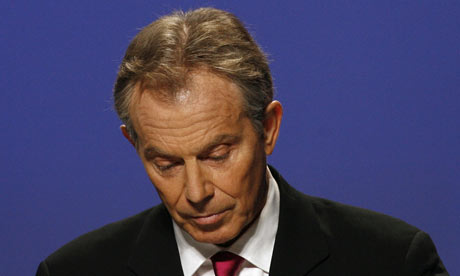 Tony Blair's attempt to become EU President has failed. President Sarkozy of France and Chancellor Merkel of Germany seem to have decided that they were never really in favour of his candidacy, leaving Gordon Brown and Italy's charming Silvio Berlusconi as Blair's only serious backers; Ireland's Brian Cowen had also lent his support. Tony Blair can now go back to his day job of sitting on boards of companies and giving speeches to American neo-cons. In his spare time he will be able to continue his good work bringing the Israel-Palestine conflict to a conclusion.
I am starting to wonder if this President Blair thing was all some kind of complicated joke. In retrospect, how could he ever have been a serious candidate? Aside from his being a cockfarmer, he headed a euro-sceptic government that kept Britain out of the Euro and negotiated opt-outs from everything for his country. This hardly makes him an attractive person to take on the job of being Mr EU.
19 October, 2009
A flawed and one-sided post about Israel's Gaza campaign
Do you remember last January, when the Israeli army was once more blowing up everything they could in the Gaza Strip? At the time, there was a lot of discussion about whether war crimes had been committed. Partly this arose from the Israeli army's indiscriminate shelling and the targeting of Gaza's infrastructure as a way of punishing everyone there for the actions of militants who fired rockets over the border. There were also reports of instances where Gazan civilians were herded into buildings by Israeli soldiers, only for these buildings to then be shelled. It was also suggested that actions by Hamas and other militant groups (firing un-aimed rockets at Israeli towns) were also contrary to the laws of war.
A United Nations fact finding mission, headed by Richard Goldstone, looked into the accusations of war crimes. Goldstone's team found that there had been extensive war crimes committed by Israeli forces, and recommended that the perpetrators be indicted for trial by an international court. The report also mentioned human rights abuses by Hamas and the other militant groups operating in Gaza, but the main thrust dealt with crimes by the Israelis.
Normally, when a UN report identifies people as having committed these kind of crimes, the wheels of international justice start turning, and people who have been accused of doing bad things find themselves on their way to trial in the Hague or before some other international tribunal. That is what happened with previous investigations with which Goldstone was involved. In this case, however, something different happened. The United States of America, and other allies of Israel (notably Germany and the United Kingdom), dismissed the report as flawed and one-sided, and procedural rules were used to prevent the report coming before the UN Security Council.
For many years now it has been the case that whenever some respected body issues a report on human rights abuses have been committed by Israel, the USA leaps in to condemn the report as "flawed" and "one-sided". Only Israel seems to receive this kind of protection, and when the same bodies issue reports on human rights abuses by other actors, the USA is happy to see them trigger an international response. That the new administration of Barack Obama is continuing in this tradition is depressing. It suggests that behind his shiny rhetoric, his government is continuing the same morally bankrupt policies of Bush and Clinton.
One argument that has been expressed for burying the Goldstone report is that it would set back the peace process if Israeli officers (and politicians?) find themselves in danger of arrest for war crimes. The idea here is that it is better to choose peace over justice, and to forget past crimes so that Israelis and Palestinians can move forward to a peaceful and happy future. This kind of argument might have some purchase in other conflict situations. In the Israel-Palestine situation, it is nonsense. There is no credible peace process at the moment. Furthermore, there is unlikely to be one until the USA demonstrates a willingness to rein in Israel. If the USA remains intent on sheltering Israeli criminals then it cannot hope to broker any kind of settlement.
Some more links:
Prospect of war crimes trials in Middle East alarms US diplomats (Irish Times, 30/9/2009)
Goldstone defends UN Gaza report (BBC, 30/9/2009)
Abbas seeks vote on Gaza report (BBC, 12/10/2009) The USA had leaned on Mahmoud Abbas, head of the Palestinian Authority, getting him to support the shelving of the Goldstone Report. As can be imagined, this played very badly within Palestine. In an effort to not look like a complete pawn of the West, he has now called for the UN Human Rights Council to vote on the report.
13 October, 2009
Turkey's Ironic Peace Statue

Here is a more human interest story about the Armenia-Turkey peace process. It is about Naif Alibeyogluin, the former mayor of Kars, in Turkey, who decided to build a monument to peace, showing two stylised figures on the brink of shaking hands. Although Kars is in Turkey, local geography means that when floodlit at night the statue is visible across the Armenian border, 40 kilometres away. The statue is meant to symbolise the Armenian and Turkish peoples overcoming their troubled past and joining together in friendship.
The fact that Mr Alibeyogluin is the former mayor of Kars is significant. Many people in Turkey are unconvinced by the desirability of friendship with Armenia. Local politician Oktay Aktas of the National Action Party asserted that one of the figures has their head bowed – taking this as signifying Turkish guilt over the Armenian genocide, an event that Turkish
law says never happened. Mr Aktas sees the statue as indicating an Armenian desire to take over eastern Turkey, and has vowed to demolish it. In recent elections, Mr Alibeyogluin found himself sidelined by his own Justice and Development party, with someone else taking the mayoral title.
The future of Mr Alibeyogluin's monument to peace remains uncertain.
see also
12 October, 2009
Turkey, Armenia, and the Armenian diaspora
Armenia and Turkey are two countries that have long had a fractious relationship, largely arising over the Armenian genocide of 1915, in which the Ottoman Empire massacred over a million ethnic Armenians. Recently, there have been moves towards some kind of rapprochement between the two countries. I do not know the details of the engagement between them, but it is interesting to note that the Armenian diaspora community (many of whom are descended from survivors of the genocide or of people who were expelled from Anatolia during it) seems to be very against the rapprochement.
Armenia's president, Serzh Sarkisian, has felt obliged to tour the Armenian diaspora, in an effort to head-off opposition to his Turkish policy. His success in this endeavour seems to be a bit mixed – earlier this week he had to be shielded by Lebanese cops from angry Lebanese-Armenian demonstrators. I do not know what exactly in the Armenia-Turkey engagement the diaspora are objecting to, but I find it interesting that the Armenian president finds it worth his while to try to secure the exile community's support for his policy. I am assuming that the Armenian diaspora does not get to vote in Armenian elections, but it still seems to be important for him to engage with them.
I am not sure if there has been any general research done on the role of diasporas in conflict situations. The other obvious one I can think of is the role of the exile Palestinian community in the Israel-Palestine conflict, but I understand that ethnic diasporas have been important factors in the Sri Lankan and Aceh conflicts. Working from first principles, I can imagine a strong diaspora to be a major complicating factor in the search for a settlement. On the one hand, they have relatively little to lose by the continuance of a conflict, while oftentimes they are not going to gain anything by its resolution. Diaspora interests will often diverge from those of the non-exile community, so a settlement that works for one community could not be acceptable to the other.
That is not to see diasporas as "bad", or as groups that have to be marginalised or blocked if a conflict is to be settled. If they are in a position to block settlements, then they should be engaged with as another actor in the conflict. Maybe it would be best to break the fiction of their sharing an identity of interests with the home community, and instead give them some kind of separate representation at negotiations. This might depend on the specifics of any conflict.
Stop press: Armenia and Turkey today signed an accord, though they were unable to agree a statement on it.
some random links:
ARMENIA: KARABAKH TALKS POSES BIG CHALLENGE FOR ARMENIAN-TURKISH RAPPROCHEMENT
Lebanon Armenians angry over planned Turkey deal
Armenians anxious over Turkish plan
07 October, 2009
Europe's Malaise
Ireland voted last Friday to ratify the Lisbon Treaty, having voted last year to reject it. My understanding is that Ireland is the only country that has voted on the Treaty, with tradition and constitutional quirks here meaning that we always get to vote on EU treaties that other countries nod through their national parliaments. One problem, of course, with referendums is that you can never be quite sure that people will vote the right way; this is the second time that the Irish electorate have not played ball, and the second time they were then obliged to troop out and vote on the issue again. Whatever about the substantive issue of whether the Lisbon Treaty is a good idea or not, the whole process leaves a nastily undemocratic taste in the mouth. What is the point of voting on something if only a Yes vote is accepted?
When Ireland voted against Lisbon last year, there was a suggestion in some quarters that we had become a nation of ingrates – trousering the EU cash that had lifted the country out of penury only to stick two fingers up when the organisation tried to streamline its decision-making procedures. There might be something to this, but it ignores one crucial fact – the poor track record of EU treaties at referendums in other countries. Whenever the citizens of EU countries are given the opportunity to vote on any EU treaty, or the EU constitution, they have a marked tendency to vote No. If rejecting EU treaties is a mark of Euro-scepticism then the Irish people are no more Euro-sceptic than anyone else.
Too much can maybe be read into people's willingness to block EU treaties. Oftentimes the public seems to vote on the basis of things that have nothing to do with the treaty at hand – last time round, some Irish people rejected Lisbon out of a false belief that it would institute conscription here, while some French voters reputedly voted down the EU Constitution in 2005 thinking that it would lead to Turkey joining the Union. But still, the willingness of people to vote against EU treaties based on things that are not in them betokens a fundamental lack of trust in EU institutions and their leaders. This is a serious problem, but I am not sure what can be done about it.
One thing that is sometimes thrown out about the EU is its lack of democratic accountability. This argument is somewhat overstated – it is often said or implied that some shadowy Elders of Brussels make all EU decisions, when the main EU decisions are taken by the Council of Ministers or the European Council. These both comprising people who represent the governments that took office in the member states after democratic elections. Many of their decisions have to be approved by the European Parliament, but that body is an interesting example of how a body can be directly elected and yet still have little or no democratic legitimacy. With the European Council and Council of Ministers, we are looking at people who got where they are as a result of elections, but is still a bit remote from the public will.
One example of how remote the EU decision making apparatus is from the public is the case of a new office created by the Lisbon Treaty – the president of the European Council. The actual powers of this office have been left a bit vague, and the president's main role will be to chair Council meetings (as is, the chair of the European Council rotates every six months). It has been reported that the favourite for this new office is none other than Tony Blair. This is, frankly, an astonishing development. It defies all common sense that Bush's warmongering sock puppet should be given any role by the European Union, let alone one that could lead to people calling him the President of Europe. There is, furthermore, Blair's status as the former head of a rejectionist government who refused to join either Schengen or the Euro. Yet, it is not clear at all how concerned European citizens could go about blocking Blair's accession, or how they could vote to prevent it.
Again, it is difficult to see institutional changes would make things better here. A directly elected president of the Council would be a bad idea, and would in any case piss off those people who moan about the EU going all federal on us. If the president of the European Council does nothing more than chair council meetings then arguably the members of the council should be the ones to pick who holds the office, as they are the ones who have to put up with their choice. But it still seems outrageous that Blair could end up with such a prestigious EU post, even if it is not clear what institutional changes could prevent it. This is maybe the problem with EU institutions in a nutshell – their faults are obvious, but what would improve them is less so.
28 September, 2009
Ireland decides, again
 This whole post is basically an excuse to post the lovely picture above. Foreign readers may find it a bit confusing, so here is some context. Last year Ireland held a referendum on the Lisbon Treaty, an agreement reached between European Union heads of government. The Treaty was rejected by Irish voters, causing a sensation throughout Europe.
Next Friday we are going to be voting on the Treaty again. There are a couple of justifications for having another referendum. First of all, many people last year claimed to be confused by the whole Lisbon Treaty business, so maybe with the passage of time they will have made some effort to inform themselves. Secondly, the EU heads of government have made some non-binding guarantees on some of the concerns of the Irish voters. Thirdly, the astonishing deterioration of the Irish economy since the last vote suggests that now might not be the time to piss off our powerful European friends.
The pro-Treaty side in the referendum are basically the entire Irish political establishment, in so far as they are from almost all the parties that people actually vote for in elections. The implicit main plank of their campaign is that the country will go down the plughole if Lisbon is rejected, though they have never been quite so crude as to explicitly state this on election posters.
The anti-Treaty side mine a broad vein of disaffection. There is a tendency in some quarters to divide the antis into right-wingers (typically worried that the EU will force everyone to have abortions) and left-wingers (typically worried that the EU will draft everyone into an EU army or make everyone slaves of large corporations). I think, though, that more unites the antis than this kind of analysis suggests. They all distrust mainstream Irish politicians. They all fear that Lisbon represents a terrible and irrevocable loss of sovereignty, a transfer of power to some sinister and shadowy EU elite; the only difference is in what they think the EU overlords will do with that power.
Cóir are one of the players on the No side. I have heard it said that they spring from the same stream that gave us Republican Sinn Féin (a fringe Republican movement who reject the Good Friday Agreement and almost everything else) and Youth Defence (a hardline anti-abortion movement). I'm not going to link to their website, but if you go there you will get a flavour of their campaign against Lisbon – slogans suggesting that Lisbon would reduce the minimum wage to around two Euro, that Lisbon would eliminate the freedoms for which our country's founding fathers died, or that Lisbon would lead to an inrush of foreigners to this sceptred isle. The above image is a parody of one of their posters*. It is rather like shooting fish in a barrel, as the petty concerns of Cóir are godsends to people who support Lisbon.
A spice burger is a fast food product that bears some mysterious relationship to meat. "Away with you, you wife swapping sodomites!" was the celebrated response of a Catholic conservative to the passing of the referendum that legalised divorce.
Parody posters seem to be quite a thing this time round. Another Cóir parody I have seen points out that 98% of Europeans are foreign. On the other side, a subtly ironic poster has Adolf Hitler urging a Yes vote.
Meanwhile, here is a home-made election poster, probably not a parody:
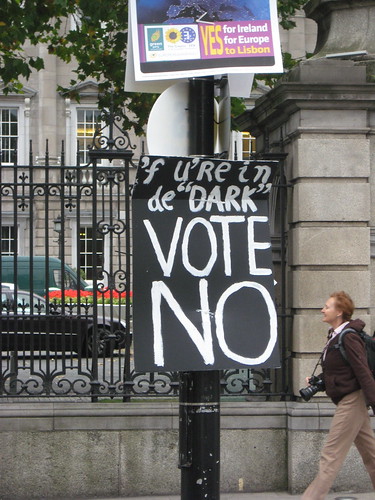
*I apologise to Irish readers for stating the obvious to an almost Wikipedia-esque extent.
12 September, 2009
Fiji latest
Fiji is a Pacific island nation whose dysfunctional politics keep it in the news. The other day it was a visit by a Commonwealth envoy, who was there to discuss a possible return to democracy with the country's military ruler. It was previously part of the British Empire, and in that period many people from India came to the island, eventually playing a major role in the economic life of the island. After independence, the institutions of the state were initially dominated by ethnic Fijians. Over time, a politics based almost entirely on ethnicity surfaced in the country, with parties for ethnic Fijians squaring up against ones for ethnic Indians. In the 1980s, a coup by the ethnic Fijian dominated army blocked a government of mainly ethnic Indian parties (but to be led by an ethnic Fijian) from taking office.
Mahendra Chaudhry succeeded in taking office as the country's first ethnic Indian prime minister in 1999, but in 2000 he was imprisoned in a bizarre coup attempt by failed local businessman George Speight. Speight's coup failed, but the fall-out from it lives on. One consequence was that many ethnic Indians have given up on Fiji. They had constituted c. 50% of the population, but the manifest unwillingness of many ethnic Fijians to accept a prime minister from their community led many ethnic Indians to take the hint and leave the country.
Another consequence of Speight's coup is that it exposed fissures within the ethnic Fijian community. The 1980s coup against the instatement of an ethnic Indian prime minister was staged by the army, with that body seeming to maintain a formidable degree of cohesion as it acted to advance the interests of ethnic Fijians. Speight's coup, however, was staged by a failed businessman and his cronies. The army performed badly in the coup – its leaders (ethnic Fijians, like the rank and file; ethnic Indians seem to have better things to do than join the armed forces) declared for the constitutional government, but many of the rank and file seem to have sympathised with Speight.
Speight's ability to break the army's cohesion seems to have rankled with Commodore Frank Bainimarama, the army's commander in chief. My impression is that much of Fiji's politics since Speight's coup attempt is explicable by Bainimarama's personal animus towards Speight. To Bainimarama, Speight is responsible for the army's humiliation during his coup. It was moves by Prime Minister Laisenia Qarase to pardon Speight and his pals that saw Bainimarama stage a coup in 2006 that has brought democracy in Fiji to an end.
Bainimarama has promised elections at some stage in the future, but no one is holding their breath. His regime has reputedly become increasingly dictatorial, arresting and harassing its opponents. It nevertheless represents an interesting development – an authoritarian government of ethnic Fijians justifying itself by fears of how a democratic regime would lead to political oppression of ethnic Indians. Bainimarama might simply be paying lip-service to the lofty goals of inter-communal fairness as a way of seizing power for himself. Even so, the army's advancing of its own corporate interest cuts across the ethnic issues that torment Fiji.
Increasing cross-community opposition to Bainimarama is, paradoxically, another positive consequence of his coup. This might be a sign that Fijians are hoping for some kind of more normal politics, one based on constitutions and rules as opposed to poisonous inter-ethnic competition and coups every couple of years.
09 September, 2009
Trouble in Somaliland
Somaliland is the unrecognised country comprising the northern bit of Somalia. Compared to the rest of Somalia, it is an oasis of calm. Unfortunately, the country's tranquillity was on Monday shattered by its parliamentarians. When officials announced that a motion to impeach Dahir Riyale Kahin, the country's president, could be debated, a bar-room brawl erupted, with rival politicians exchanging punches. There are reports of one MP brandishing a fire-arm, though no shots were fired. Police had to enter the chamber to restore order.
Unlike the rest of Somalia, Somaliland has a functioning political system, with a president, an elected parliamentary chamber (where the brawl broke out), and an upper house comprising elders of the country's various clans. Tensions have apparently been rising recently over the timing of a presidential election and a disputed register of electors.
It would probably be premature to see all this as a sign that Somaliland is about to slip into the chaos of the rest of Somalia. Parliamentary fist-fights are always good for a laugh, but they do not necessarily presage democratic collapse. That this was just a fist-fight suggests that things in Somaliland are nothing like as bad as they could be.
The disputes over the presidential election are maybe more worrying. One danger facing Somaliland is a slide into Somalia-style anarchy. Another, though, is a transition to the kind of authoritarianism that bedevils many of its neighbours. If the disputes over the electoral register and the election's timing are symptoms of a power-grab by the president then people should be concerned. As Somaliland's independence is unrecognised, it may well be the case that the international observers who scrutinise elections elsewhere will not engage with the country's electoral process. This is unfortunate; in a potentially shaky situation, external oversight could deter either electoral chicanery by the government or vexatious claims of fraud by bad losers.
more
Subscribe to:
Posts (Atom)

