The BBC reports that when he steps down as president, Vladimir Putin is going to run for the Russian parliament and that he aspires to become the country's prime minister. The BBC reports this as a shocking new development, though I had read this suggested in the academic literature on Russian semi-presidentialism. People have been wondering for some time whether Putin was really going to step down as president, given his obvious enjoyment of being the top dog in Russian politics. The switch to prime minister allows him to remain at the centre of politics without having to change the constitution to allow him to run for another term; and prime ministers are not bound by inconvenient term limits.
At the moment, the constitution makes the Russian prime minister clearly subservient to the president, and the BBC quotes one Andrei Ryabov of the Carnegie Moscow Center as saying that the consitution will need to be changed to allow Putin to remain the country's leader. This may or may not be the case. One thing you often see with semi-presidential systems is that the primacy of the premiership and presidency is decided not by the constitutional prerogatives of the offices, but by who occupies them. In Russia's case, Putin as prime minister will remain the man around whom politics has rotated for the last seven years. It is still not clear who Putin favours as his successor, but it should not be impossible for him to find a pliant yes-man to run for the job.
01 October, 2007


27 September, 2007
Links and Categories
If you are reading Hunting Monsters, look to the right. I have tidied the categories somewhat and updated my links.
Regarding links, I have decided to delete all links to blogs that do not have serious IR content, even if they link to me. Some of the ones there are only just hanging in, but as Hunting Monsters does not really have a major IR content these days I can afford to be generous.
Regarding links, I have decided to delete all links to blogs that do not have serious IR content, even if they link to me. Some of the ones there are only just hanging in, but as Hunting Monsters does not really have a major IR content these days I can afford to be generous.
It's later than you think
Student harangues politician; student is then dragged from the meeting by policemen, subjected to electrical shocks, and charged with trying to incite a riot.
This was in the United States of America. The incident is reminiscent of the bundling out of a Labour Party conference in 2005 of a delegate who heckled the then foreign secretary (and his subsequent detention under anti-terrorism legislation when he tried to re-enter the hall).
This was in the United States of America. The incident is reminiscent of the bundling out of a Labour Party conference in 2005 of a delegate who heckled the then foreign secretary (and his subsequent detention under anti-terrorism legislation when he tried to re-enter the hall).
12 September, 2007
My Inner Librarian
I have attached keyword labels to all Hunting Monsters posts, and put these labels to the right on the Hunting Monsters front page. The next step is to rationalise these keywords.
Pot. Kettle.
"He's a man who is a propagandist and is not a scholar."
Thus speaks Alan Dershowitz, who when not advocating the legalisation of torture, is a man always ready to heap vitriol on anyone with whom he disagrees. He was commenting on the recent resignation from DePaul University of Norman Finkelstein. DePaul had previously denied Finkelstein tenure, following a campaign against him by Dershowitz. The Dershowitz-Finkelstein love-in has being going on for a while now, with Finkelstein's recent book Beyond Chutzpah being largely a riposte to Dershowitz's The Case For Israel. Part of Finkelstein's claim was that Dershowitz had plagiarised elements of his book from Joan Peters' From Time Immemorial; Finkelstein had originally made his representation by exposing that book as fraudulent and plagiarised.
I can't claim any great familiarity with Finkelstein's work, nor can I comment in an informed manner on his suitability for tenure in DePaul. My suspicion, though, is that Finkelstein is being punished not for unscholarly writing but for taking on one of the giants of his profession, and that he was denied tenure not on academic grounds but because he was trouble.
Thus speaks Alan Dershowitz, who when not advocating the legalisation of torture, is a man always ready to heap vitriol on anyone with whom he disagrees. He was commenting on the recent resignation from DePaul University of Norman Finkelstein. DePaul had previously denied Finkelstein tenure, following a campaign against him by Dershowitz. The Dershowitz-Finkelstein love-in has being going on for a while now, with Finkelstein's recent book Beyond Chutzpah being largely a riposte to Dershowitz's The Case For Israel. Part of Finkelstein's claim was that Dershowitz had plagiarised elements of his book from Joan Peters' From Time Immemorial; Finkelstein had originally made his representation by exposing that book as fraudulent and plagiarised.
I can't claim any great familiarity with Finkelstein's work, nor can I comment in an informed manner on his suitability for tenure in DePaul. My suspicion, though, is that Finkelstein is being punished not for unscholarly writing but for taking on one of the giants of his profession, and that he was denied tenure not on academic grounds but because he was trouble.
Roundup
Roundup is a potentially interesting new blog, in which some Tracer Hand fellow comments on stuff going on in the world. I will add it to Hunting Monsters' links if it does not prove timewaster.
The most recent post is about Pantsyr... I wonder are they anything to do with Manpads?
The most recent post is about Pantsyr... I wonder are they anything to do with Manpads?
08 September, 2007
Farewell Spy School
I have handed in my thesis.
 Now I just need to find a job with one of the world's more forward thinking intelligence services.
 Now I just need to find a job with one of the world's more forward thinking intelligence services.
02 September, 2007
Lolcountry
More on Belgium: Belgium doomed?. Nicholas reckons that Belgium will survive the current crisis but has possibly terminal problems in the long run, as all the old hands from pre-federal days who broker compromises are coming to the end of their lives.
One great thing about Belgium is that the country has an east-west orientation, but the national divide runs on a north-south axis. So if Belgium splits in two we will be left with two long and thin comedy countries.
I hope Belgium does not split up, as I have a sentimental fondness for the place, based on it being a country of comics, rich food, and tasty beer. Its weirdo dysfunctionality is also appealing in an I'm-glad-I-don't-live-there kind of way. I also like the way Belgians are all very clear that regardless of what language they speak, they are neither Dutch nor French. I wish its leaders would cop themselves on... can't they just get along?
One great thing about Belgium is that the country has an east-west orientation, but the national divide runs on a north-south axis. So if Belgium splits in two we will be left with two long and thin comedy countries.
I hope Belgium does not split up, as I have a sentimental fondness for the place, based on it being a country of comics, rich food, and tasty beer. Its weirdo dysfunctionality is also appealing in an I'm-glad-I-don't-live-there kind of way. I also like the way Belgians are all very clear that regardless of what language they speak, they are neither Dutch nor French. I wish its leaders would cop themselves on... can't they just get along?
I need to get out more
I am reading this book by Amin Maalouf called "The Crusades Through Arab Eyes". Last night I had a great anxiety dream, about how my thesis needs a last minute change to discuss the impact of the fall of the Abbasid Caliphate on Palestinian semi-presidentialism.
01 September, 2007
Belgium To Split?
I have been reading on blogs that Belgium is about to split in two or something. Maybe they will have a huge war and FRONT 242 will reform and release a concept album about it all, just like LAIBACH did with the former Yugoslavia.
Polish elections
There are elections taking place in Poland later this year. The last elections were held only two years ago. These early elections have been triggered by the collapse of the governing coalition, with Self-Defence and The League of Polish Families dropping out of the coalition dominated by the Law & Justice party (Law & Justice is often abbreviated in English to its Polish initials, PiS).
The last round of elections saw parliamentary and presidential elections take place in a short space of time. They produced the unusual result whereby two twin brothers came to dominate Poland's politics, with Lech Kaczynski becoming the country's president and Jaroslaw Kaczynski the leader of the largest government party (and subsequently the prime minister). The Kaczynskis then proceeded to govern in a manner that appealed strongly to their natural supporters, while simultanaeously convincing many other observers of the country's politics that they are a pair of boorish fuckwits.
It is funny noticing how international sentiment turned against the twins. Around the time of their elevation, a lot of international commentators were saying things like "they may be a pair of ultra-catholic weirdos, but they do seem to be serious about stamping out the corruption and cronyism that have bedevilled Poland since the transition". Since then, these commentators have been increasingly struck by the Kaczynskis' love of picking fights with international actors (Germany, the EU, Russia) for no obvious gain except to make populist appeals to Polish public opinion. A certain amount of schadenfreude has greeted the collapse of the governing coalition and the calling of early electons, with people expecting that this will mean an end to the terrible twins. Expectations of the twins' political demise are perhaps premature. There is an interesting article by Derek Scally in today's Irish Times, suggesting that the Kaczynskis remain popular with a large section of the Polish population. PiS could still poll strongly in the election, particularly if the vote turns into a highly polarised contest between PiS and a coalition led by the country's former communists. Even if PiS is hammered in the elections and a new "left" government takes office, we will not have seen the last of the Kaczynskis. Jaroslaw will no longer be prime minister, but Lech will remain as president. Polish presidents have considerable powers, and it would be interesting to see how President Kaczynski manages to deal with a hostile government.
The last round of elections saw parliamentary and presidential elections take place in a short space of time. They produced the unusual result whereby two twin brothers came to dominate Poland's politics, with Lech Kaczynski becoming the country's president and Jaroslaw Kaczynski the leader of the largest government party (and subsequently the prime minister). The Kaczynskis then proceeded to govern in a manner that appealed strongly to their natural supporters, while simultanaeously convincing many other observers of the country's politics that they are a pair of boorish fuckwits.
It is funny noticing how international sentiment turned against the twins. Around the time of their elevation, a lot of international commentators were saying things like "they may be a pair of ultra-catholic weirdos, but they do seem to be serious about stamping out the corruption and cronyism that have bedevilled Poland since the transition". Since then, these commentators have been increasingly struck by the Kaczynskis' love of picking fights with international actors (Germany, the EU, Russia) for no obvious gain except to make populist appeals to Polish public opinion. A certain amount of schadenfreude has greeted the collapse of the governing coalition and the calling of early electons, with people expecting that this will mean an end to the terrible twins. Expectations of the twins' political demise are perhaps premature. There is an interesting article by Derek Scally in today's Irish Times, suggesting that the Kaczynskis remain popular with a large section of the Polish population. PiS could still poll strongly in the election, particularly if the vote turns into a highly polarised contest between PiS and a coalition led by the country's former communists. Even if PiS is hammered in the elections and a new "left" government takes office, we will not have seen the last of the Kaczynskis. Jaroslaw will no longer be prime minister, but Lech will remain as president. Polish presidents have considerable powers, and it would be interesting to see how President Kaczynski manages to deal with a hostile government.
Open Democracy
People have been bigging up Open Democracy. It is one of those websites which carries articles by noted people about stuff happening in the world.
Some recent articles include:
Cyprus’s risky stalemate by Fred Halliday, a handy primer to what's been happening over the last while in Cyprus, reminding me yet again that letting (Southern) Cyprus join the EU in advance of a deal on the island was an act of most dreadful folly.
Arab Christians: a lost modernity by Tarek Osman, on the retreat of Arab Christians from the mainstream of their countries. People tend to forget how many Christians there are in the Middle East, with Egypt having a Christian population of some 15% and Syria, Palestine, Iraq, and Lebanon all having substantial and ancient Christian communities of their own.
Indonesia: the biofuel blowback by James Painter. All that biofuel shite is leading to farmers in Indonesia being kicked off their land so that car people in Europe and North America can keep on driving. Mentioned in passing is the threat to the Orangutang's continued existence by the turning of jungle into palm oil plantations.
The recurring anniversary of wilderness by Jim Gabour, an evocative article on what New Orleans is getting up to these days.
Open Democracy has its own RSS feed: http://www.opendemocracy.net/xml/rss/home/index.xml
Some recent articles include:
Cyprus’s risky stalemate by Fred Halliday, a handy primer to what's been happening over the last while in Cyprus, reminding me yet again that letting (Southern) Cyprus join the EU in advance of a deal on the island was an act of most dreadful folly.
Arab Christians: a lost modernity by Tarek Osman, on the retreat of Arab Christians from the mainstream of their countries. People tend to forget how many Christians there are in the Middle East, with Egypt having a Christian population of some 15% and Syria, Palestine, Iraq, and Lebanon all having substantial and ancient Christian communities of their own.
Indonesia: the biofuel blowback by James Painter. All that biofuel shite is leading to farmers in Indonesia being kicked off their land so that car people in Europe and North America can keep on driving. Mentioned in passing is the threat to the Orangutang's continued existence by the turning of jungle into palm oil plantations.
The recurring anniversary of wilderness by Jim Gabour, an evocative article on what New Orleans is getting up to these days.
Open Democracy has its own RSS feed: http://www.opendemocracy.net/xml/rss/home/index.xml
30 August, 2007
Who makes the Nazis?
Am I reading this right? The Irish Times are reporting the Department of Justice as saying that "non-EU spouses of EU citizens must live in another member state before residing here." So, like, if an Irish person were to go and live in a non-EU country, meet and fall in love with one of the locals, and marry them, they would not be able to come back and live here in Ireland?
29 August, 2007
Human Knowledge Continues To Advance
I've just finished my third chapter. So now I just need to write a conclusion and heavily revise my three chapters and my amazingly fascinating thesis will be ready for submission.
27 August, 2007
Lolthesis
I've been reading loads of BBC news stories about internal Palestinian politics, to fix actual events that I can refer to in my thesis. Yes, I know, I should have done this months ago. Anyway, many of the news reports are quite entertaining, particularly if you can maintain a degree of ironic detachment from the macho shaping that seems to be a big feature of this sort of thing. One great story was about a demonstration by a load of masked men firing machine guns into the air; they were demanding that the Palestinian Authority be put on a firm institutional basis and that it organise a law and order crackdown. Sadly, I have no URL for that, but I do have one for:
 "SHOOT-OUT AT PALESTINIAN MINISTRY
"Bodyguards of the Hamas health minister have exchanged fire with gunmen at the health ministry in Gaza City. [...] It seems the gunmen were seeking better treatment for a hospital patient, a BBC correspondent says."
 "SHOOT-OUT AT PALESTINIAN MINISTRY
"Bodyguards of the Hamas health minister have exchanged fire with gunmen at the health ministry in Gaza City. [...] It seems the gunmen were seeking better treatment for a hospital patient, a BBC correspondent says."
20 August, 2007
Palestine's Post-Modern Future
You may or may not have heard of Professor Alan Dershowitz. When he is not calling for the legalisation of torture, he is doing his bit to help solve the Israeli-Palestinian dispute. He has in mind the emergence of a Palestinian independent state that will be comprised of the Gaza Strip and a number of non-contiguous blocks of territory on the West Bank. This might sound like a recipe for bantustanisation, but Professor Dershowitz thinks otherwise. Rather in this world of instant communications and cheap and fast travel non-contiguity need not be a barrier to the creation of a viable state. Or so a review of Dershowitz's "The Case for Peace" reports that he says.
19 August, 2007
Links
The Links on this blog are a bit hopeless, including stuff like me mate Bildto's never updated blog. I hope at some stage to update the links by breaking them into ones pointing to useful International Relations related sites and then to blogs with a serious IR content (bad news for linked-to blogs without serious IR content). It will probably take me forever to get round to doing this. In the meantime, if you know any interesting blogs that deal with world political themes or such like, let me know the URL.
Apartheid College Upgrades Self To University
Ariel College is a good candidate for being the least politically correct institute of higher education in the world. It is located in the West Bank settlement of Ariel, built on stolen Palestinian land. The college lies roughly half way between the towns of Ramallah and Tulkaram, relatively near to both Qalqilyah and Nablus, but appears to have no Palestinian students from the West Bank (though roughly 5% of its student body are Palestinians from within Israel proper).
Ariel College used to call itself the "College of Judea and Samaria in Ariel", but it has decided that henceforth it shall be known as "Ariel University Center of Samaria".
Ariel College used to call itself the "College of Judea and Samaria in Ariel", but it has decided that henceforth it shall be known as "Ariel University Center of Samaria".
18 August, 2007
12 August, 2007
Freedom
I've been reading a lot about the recent breakdown of constitutional government in the Palestinian Authority, with Hamas establishing an unrecognised regime in the Gaza Strip while President Abbas set up an illegal government in the unoccupied bits of the West Bank. The International Crisis Group have an interesting report on the whole business, entitled After Gaza. Its recommendations are of the "Can't you guys just get along?" school of liberal internationalism, but there are some fascinating details in it on how the Gaza takeover happened (and how the Fatah militias there collapsed). One thing they and other commentators draw attention to is the vast improvement in the security situation in Gaza - where people previously lived in fear of crime gangs, armed clans, and corrupt state security agencies, now Hamas activists have swept these people off the streets and ensured a basic level of personal security for all Gaza residents. The release of BBC journalist Alan Johnston is the great exemplar of the Hamas new broom, with the rescue of Sabrina the Lioness a close second.
There is unfortunately a dark side to all this. It would perhaps be an exaggeration to say that Hamas have instituted a reign of terror in the Gaza Strip, but commentators have noted that the openness of discussion that characterised Palestinian life has been somewhat curtailed in the area under Hamas control. People are reported to now be guarded about expressing opinions, in a way they would apparently not have been previously even in the most authoritarian days of the Arafat administration. There have also been reports of people being tortured while in Hamas custody. The Israeli newspaper Ha'aretz carries an interesting story (partly from AP) illustrating this, about a hospital doctor in Gaza who was sacked from his job and then arrested after reporting that his hospital was running short of medicines. Dr. Jomma Saka is apparently a Fatah loyalist, but the Dr. Bassem Naim, the health minister in the Gaza jurisdiction denied that Dr. Saka was arrested because of his political affiliation: "The decision to send Dr. Saka for investigations stemmed from many reasons, including giving false information that has intimidated the public"
There is unfortunately a dark side to all this. It would perhaps be an exaggeration to say that Hamas have instituted a reign of terror in the Gaza Strip, but commentators have noted that the openness of discussion that characterised Palestinian life has been somewhat curtailed in the area under Hamas control. People are reported to now be guarded about expressing opinions, in a way they would apparently not have been previously even in the most authoritarian days of the Arafat administration. There have also been reports of people being tortured while in Hamas custody. The Israeli newspaper Ha'aretz carries an interesting story (partly from AP) illustrating this, about a hospital doctor in Gaza who was sacked from his job and then arrested after reporting that his hospital was running short of medicines. Dr. Jomma Saka is apparently a Fatah loyalist, but the Dr. Bassem Naim, the health minister in the Gaza jurisdiction denied that Dr. Saka was arrested because of his political affiliation: "The decision to send Dr. Saka for investigations stemmed from many reasons, including giving false information that has intimidated the public"
Semi-presidential politics in Timor-Leste… slight return
This is another post about semi-presidentialism, triggered by a comment to my last post on Timor-Leste. I understand that many people are not so fascinated by semi-presidentialism that they want to hear more about it, but I am a slave to those who pose me questions.
A mysterious commenter identifying him or herself only as Rhunzzz mentioned the concepts of premier-presidentialism and president-parliamentarism, originally formulated by scholars Shugart & Carey. My recollection is that they took a dislike to the term semi-presidentialism and attempted to coin new terms they felt were more descriptive. Their terms seem to have caught on to some extent, but mainly as explicit subtypes of semi-presidential regimes. The premier-presidential type sees more power in the relationship going to the prime minister, but with the elected president still doing more than nothing, while their definition of a president-parliamentary regime is one where the president can sack the prime minister or individual ministers (but I think with their replacements still being subject to parliamentary approval).
As is the way of the human world, it is difficult to precisely assign semi-presidential countries into one or other regime type. French presidents, say, often act as though they can sack ministers and prime ministers, but they do not actually have the constitutional power to do this; they can force ministerial resignations if they are the head of the government party or coalition, but not if the Assembly's majority is united against them. For all that people do use the premier-presidential v. presidential-parliamentary distinction, it all seesm a bit hair-splitty in practice.
In the Palestinian Authority, the president can sack a prime minister, but the sacked prime minister remains in office in a caretaker capacity with their government until the Palestinian parliament chooses a successor. It is not obvious to me that the president can sack individual ministers, which reminds me that I need to download the Basic Law of the Palestinian Authority. I think that it the president can only sack the prime minister but not individual ministers then we are in premier-presidential territory. For more on the prerogatives of PA presidents and prime ministers, I refer you to Nathan J. Brown's "What can Abu Mazin do?".
In Timor-Leste, the constitutional powers of the president are pretty limited, which is probably one reason why Xanana Gusmao has chosen to move from the presidency to the premiership. Gusmao as president was nevertheless able to use his personal prestige and massive electoral mandate to assume a more than ceremonial role in the country's politics, playing a part in forcing Prime Minister Alkatiri from office.
A mysterious commenter identifying him or herself only as Rhunzzz mentioned the concepts of premier-presidentialism and president-parliamentarism, originally formulated by scholars Shugart & Carey. My recollection is that they took a dislike to the term semi-presidentialism and attempted to coin new terms they felt were more descriptive. Their terms seem to have caught on to some extent, but mainly as explicit subtypes of semi-presidential regimes. The premier-presidential type sees more power in the relationship going to the prime minister, but with the elected president still doing more than nothing, while their definition of a president-parliamentary regime is one where the president can sack the prime minister or individual ministers (but I think with their replacements still being subject to parliamentary approval).
As is the way of the human world, it is difficult to precisely assign semi-presidential countries into one or other regime type. French presidents, say, often act as though they can sack ministers and prime ministers, but they do not actually have the constitutional power to do this; they can force ministerial resignations if they are the head of the government party or coalition, but not if the Assembly's majority is united against them. For all that people do use the premier-presidential v. presidential-parliamentary distinction, it all seesm a bit hair-splitty in practice.
In the Palestinian Authority, the president can sack a prime minister, but the sacked prime minister remains in office in a caretaker capacity with their government until the Palestinian parliament chooses a successor. It is not obvious to me that the president can sack individual ministers, which reminds me that I need to download the Basic Law of the Palestinian Authority. I think that it the president can only sack the prime minister but not individual ministers then we are in premier-presidential territory. For more on the prerogatives of PA presidents and prime ministers, I refer you to Nathan J. Brown's "What can Abu Mazin do?".
In Timor-Leste, the constitutional powers of the president are pretty limited, which is probably one reason why Xanana Gusmao has chosen to move from the presidency to the premiership. Gusmao as president was nevertheless able to use his personal prestige and massive electoral mandate to assume a more than ceremonial role in the country's politics, playing a part in forcing Prime Minister Alkatiri from office.
11 August, 2007
Semi-presidential definitions
This is a long reply to a question posed by Nicholas Whyte in a comment to my last post. He asked whether Cyprus and former Soviet states count as semi-presidential or not. This leads me into a discussion of what constitutes a semi-presidential regime. Unfortunately, there are several definitions of semi-presidentialism, so the answer has to be "it depends". The first English language definition by French scholar Maurice Duverger talked of countries being semi-presidential if they had a popularly elected president who had "considerable powers" but how faced a prime minister who led a government that was responsible to an elected assembly. The "considerable powers" business then leads to considerable debate as to whether a given president in a given country has considerable powers or not. It can also be difficult in practice to identify what powers a president actually has, given the divergence that can occur between a president's constitutionally granted powers and the powers they wield in practice (compare the limited powers of the French president in the constitution with the powers they have actually exercised). Nevertheless, despite these problems, Duverger's definition and definitions derived from it are probably still dominant.
Robert Elgie attempted to produce a semi-presidentialism definition that allows for a more precise determination of whether a country is semi-presidential or not. He skips all that considerable powers stuff by saying that a regime is semi-presidential if it has a popularly elected president and a prime minister responsible to parliament. Using this definition, a semi-presidential country can have a very powerful president, or one who spends his or her time playing golf. Some find this kind of definition problematic, as it includes countries which in practice have politics so similar to parliamentary regimes as to make no difference; if you think the idea of bifurcated power structures is crucial to any discussion of semi-presidentialism as a regime type then Elgie's definition is not for you. However, even with that, a thing you do see in country's with figurehead directly elected presidents is that sometimes they can leverage their status as someone chosen by the people as a whole to exert pressure on the government in a manner bearing little relation to their paper powers. So even a figurehead president might be able to restrain a prime minister, in certain circumstances. Arguably, this kind of happened in Timor-Leste, where President Gusmao announced that he had lost confidence of Prime Minister Alkatiri, increasing the pressure on the latter that ultimately led to his resignation.
And so to the countries Nicholas Whyte mentions. I can't speak for Cyprus, as I don't know too much about how day-to-day politics works in either jurisdiction there. With the countries of the former Soviet Union, political systems there vary greatly. Many of the USSR's successor states are straightforwardly dictatorships. However, most of the ones that do still have some kind of democratic politics in place count as semi-presidential, with the regime-type being apparently more common in former communist countries than either straight presidential or parliamentary regimes. Or so I have read. I have my doubts with some of the countries. Take Russia – it has the prime minister and president you associate with semi-presidentialism, but the prime minister is only responsible to parliament in the most notional of manners. In practice (and probably in the constitution as well, given that it was written by a president who then had it passed at gun point) the prime minister is the president's bitch, someone he gets to look after tawdry day-to-day stuff for him.
Ukraine is more like a classic semi-presidential regime, where the prime minister and president are both powerful, but the prime minister is genuinely responsible to parliament; I think the relationship betweern the offices has changed over time, and the presidency lost a lot of its powers recently as part of the deal that saw Viktor Yushchenko elected to it. I gather that Lithuania is more the kind of country that scrapes into the semi-presidential category only if you use the Elgie definition, as its president is directly elected but aloof from actual politics. I think the rest of the democratic ex-USSR states are at least Elgie semi-presidential, except for Latvia and Estonia, which I believe to have adopted parliamentary regimes at independence, and Moldova, whose parliament changed it to a fully parliamentary regime, much to the chagrin of the then president who wanted things moved in a more fully presidential direction.
Robert Elgie attempted to produce a semi-presidentialism definition that allows for a more precise determination of whether a country is semi-presidential or not. He skips all that considerable powers stuff by saying that a regime is semi-presidential if it has a popularly elected president and a prime minister responsible to parliament. Using this definition, a semi-presidential country can have a very powerful president, or one who spends his or her time playing golf. Some find this kind of definition problematic, as it includes countries which in practice have politics so similar to parliamentary regimes as to make no difference; if you think the idea of bifurcated power structures is crucial to any discussion of semi-presidentialism as a regime type then Elgie's definition is not for you. However, even with that, a thing you do see in country's with figurehead directly elected presidents is that sometimes they can leverage their status as someone chosen by the people as a whole to exert pressure on the government in a manner bearing little relation to their paper powers. So even a figurehead president might be able to restrain a prime minister, in certain circumstances. Arguably, this kind of happened in Timor-Leste, where President Gusmao announced that he had lost confidence of Prime Minister Alkatiri, increasing the pressure on the latter that ultimately led to his resignation.
And so to the countries Nicholas Whyte mentions. I can't speak for Cyprus, as I don't know too much about how day-to-day politics works in either jurisdiction there. With the countries of the former Soviet Union, political systems there vary greatly. Many of the USSR's successor states are straightforwardly dictatorships. However, most of the ones that do still have some kind of democratic politics in place count as semi-presidential, with the regime-type being apparently more common in former communist countries than either straight presidential or parliamentary regimes. Or so I have read. I have my doubts with some of the countries. Take Russia – it has the prime minister and president you associate with semi-presidentialism, but the prime minister is only responsible to parliament in the most notional of manners. In practice (and probably in the constitution as well, given that it was written by a president who then had it passed at gun point) the prime minister is the president's bitch, someone he gets to look after tawdry day-to-day stuff for him.
Ukraine is more like a classic semi-presidential regime, where the prime minister and president are both powerful, but the prime minister is genuinely responsible to parliament; I think the relationship betweern the offices has changed over time, and the presidency lost a lot of its powers recently as part of the deal that saw Viktor Yushchenko elected to it. I gather that Lithuania is more the kind of country that scrapes into the semi-presidential category only if you use the Elgie definition, as its president is directly elected but aloof from actual politics. I think the rest of the democratic ex-USSR states are at least Elgie semi-presidential, except for Latvia and Estonia, which I believe to have adopted parliamentary regimes at independence, and Moldova, whose parliament changed it to a fully parliamentary regime, much to the chagrin of the then president who wanted things moved in a more fully presidential direction.
09 August, 2007
Semi-presidential politics in Timor-Leste
One great thing about the reading around my thesis is that I have got to read about loads of countries I previously did not too much about. This arises because in trying to form a comparative framework in which to place a study of semi-presidentialism in Palestine I need to look at other countries with a similar kind of institutional setup. I may well pad out this blog for years to come with fascinating facts about semi-presidential countries from around the world.
Today it is the turn of Timor-Leste, as the former Portuguese colony of East Timor know prefers to be called. While the country was ruled by Indonesia the place became something of a cause celèbre, partly resulting from the thuggish and near genocidal rule of the Indonesian military. With independence, the country largely dropped off the world's radar, or at least it did off mine, apart from a sense that the country's post-independence politics had all proved a bit tawdry and disappointing.
My very limited reading about Timor-Leste suggests some interesting things about the country's politics. Indonesian rule was resisted both militarily and politically, as is often the case in occupied countries. What one sometimes see in such situations is that if the national struggle is ever successfully concluded then a tension erupts between the political and military side of the nationalist movement. Analysis tends to depict the political side of any ensuing conflict as the good guys, in that they are the ones who will do politics (run for elections, form governments, make the kind of political compromises that are needed in a democratic society). In contrast, the militarists are seen as the bad guys – while they may have proved useful during the freedom struggle, the kind of mindset honed by warfare is inimical to democratic politics. Militarists are seen as hostile to compromise and having a belief in discipline and hierarchy that meshes badly with the give and take of pluralist politics. That, as I say, is the default position on such matters, or maybe I am just generalising too much from the history of my own country.
Timor-Leste seems to run counter to that default position. There, the political wing of the national struggle seems to have produced a party (FRETILIN) with a closed, illiberal, and crypto-authoritarian outlook, one that sees itself as the sole legitimate representation of Timor-Leste's people. In contrast, the military wing of the movement produced in Xanana Gusmao a leader who seems far keener to reach out across Timor-Lestean society and to respect democratic norms; during the Indonesian occupation he transformed the guerrilla army from being a FRETILIN militia to being a more broadly based outside the party's control. It is maybe easy to see why FRETILIN turned out the way it did – the party early on adopted a Marxist-Leninist ideology that lends itself to vanguardism, and the party cultivated close links to authoritarian leftist regimes in Africa from whom shady ideas could be picked up. Gusmao's non-bonapartism is maybe a bit harder to explain, but I will leave that to people who know more about the country to engage with.
As a semi-presidential regime, Timor-Leste has also bucked the trend. In these kind of countries, particularly when they are newly democratising, there is a tendency to see the president as embodying authoritarian tendencies, with the parliamentary side of things serving as a democratic brake. After Timor-Leste's first presidential and parliamentary elections the country was pitched into cohabitation, with the parliament choosing a prime minister hostile to the president. However, it was nasty, authoritarian FRETILIN who picked the prime minister, while President Gusmao ended up serving as a brake on their crypto-authoritarianism. The country's divisions, reflected by the split executive, saw the country becoming increasingly destabilised, with a series of riots and army mutinies leading to the smashing up of any infrastructure the Indonesians had not wrecked before they pulled out. Elections this year saw Gusmao ally (and Nobel laureate) Jose Ramos-Horta elected to the presidency while Gusmao has just become prime minister at the head of a coalition government. Maybe this united executive will be able to stabilise the country's politics, though the pro-FRETILIN riots that greeted Gusmao's appointment suggest they have a way to go yet. Still, a coalition government, even one that excludes FRETILIN, is probably a good thing for the country at this point, certainly better than the FRETILIN dominated parliament it had before the elections.
One caveat on all this – I have actually read so little on Timor-Leste that I could be passing on a very skewed impression of the country's politics. It is only really one scholarly article* from which I picked up the idea of Gusmao-good FRETILIN-bad position, so if that was written by someone with tendentious views then I could be seriously misleading you. However, the fact that Mara Alkatiri, the FRETILIN leader, has denounced the current government as illegal, despite its parliamentary majority, suggests that his party's commitment to democratic electoral outcomes is a bit tenuous.
*Shoesmith, Dennis (2003) 'Timor-Leste: divided leadership in a semi-presidential system' Asian Survey, 43 (2), 231-252
Today it is the turn of Timor-Leste, as the former Portuguese colony of East Timor know prefers to be called. While the country was ruled by Indonesia the place became something of a cause celèbre, partly resulting from the thuggish and near genocidal rule of the Indonesian military. With independence, the country largely dropped off the world's radar, or at least it did off mine, apart from a sense that the country's post-independence politics had all proved a bit tawdry and disappointing.
My very limited reading about Timor-Leste suggests some interesting things about the country's politics. Indonesian rule was resisted both militarily and politically, as is often the case in occupied countries. What one sometimes see in such situations is that if the national struggle is ever successfully concluded then a tension erupts between the political and military side of the nationalist movement. Analysis tends to depict the political side of any ensuing conflict as the good guys, in that they are the ones who will do politics (run for elections, form governments, make the kind of political compromises that are needed in a democratic society). In contrast, the militarists are seen as the bad guys – while they may have proved useful during the freedom struggle, the kind of mindset honed by warfare is inimical to democratic politics. Militarists are seen as hostile to compromise and having a belief in discipline and hierarchy that meshes badly with the give and take of pluralist politics. That, as I say, is the default position on such matters, or maybe I am just generalising too much from the history of my own country.
Timor-Leste seems to run counter to that default position. There, the political wing of the national struggle seems to have produced a party (FRETILIN) with a closed, illiberal, and crypto-authoritarian outlook, one that sees itself as the sole legitimate representation of Timor-Leste's people. In contrast, the military wing of the movement produced in Xanana Gusmao a leader who seems far keener to reach out across Timor-Lestean society and to respect democratic norms; during the Indonesian occupation he transformed the guerrilla army from being a FRETILIN militia to being a more broadly based outside the party's control. It is maybe easy to see why FRETILIN turned out the way it did – the party early on adopted a Marxist-Leninist ideology that lends itself to vanguardism, and the party cultivated close links to authoritarian leftist regimes in Africa from whom shady ideas could be picked up. Gusmao's non-bonapartism is maybe a bit harder to explain, but I will leave that to people who know more about the country to engage with.
As a semi-presidential regime, Timor-Leste has also bucked the trend. In these kind of countries, particularly when they are newly democratising, there is a tendency to see the president as embodying authoritarian tendencies, with the parliamentary side of things serving as a democratic brake. After Timor-Leste's first presidential and parliamentary elections the country was pitched into cohabitation, with the parliament choosing a prime minister hostile to the president. However, it was nasty, authoritarian FRETILIN who picked the prime minister, while President Gusmao ended up serving as a brake on their crypto-authoritarianism. The country's divisions, reflected by the split executive, saw the country becoming increasingly destabilised, with a series of riots and army mutinies leading to the smashing up of any infrastructure the Indonesians had not wrecked before they pulled out. Elections this year saw Gusmao ally (and Nobel laureate) Jose Ramos-Horta elected to the presidency while Gusmao has just become prime minister at the head of a coalition government. Maybe this united executive will be able to stabilise the country's politics, though the pro-FRETILIN riots that greeted Gusmao's appointment suggest they have a way to go yet. Still, a coalition government, even one that excludes FRETILIN, is probably a good thing for the country at this point, certainly better than the FRETILIN dominated parliament it had before the elections.
One caveat on all this – I have actually read so little on Timor-Leste that I could be passing on a very skewed impression of the country's politics. It is only really one scholarly article* from which I picked up the idea of Gusmao-good FRETILIN-bad position, so if that was written by someone with tendentious views then I could be seriously misleading you. However, the fact that Mara Alkatiri, the FRETILIN leader, has denounced the current government as illegal, despite its parliamentary majority, suggests that his party's commitment to democratic electoral outcomes is a bit tenuous.
*Shoesmith, Dennis (2003) 'Timor-Leste: divided leadership in a semi-presidential system' Asian Survey, 43 (2), 231-252
06 August, 2007
Soft Power
I read an interesting piece from 2003 by Mariam Shahin, on external attempts to influence Palestinian politics. When in that year the post of prime minister fell vacant, US diplomats lobbied all the members of the Palestinian parliament, informing them that if they did not elect Mahmud Abbas they would be delivering a personal insult to US President George W. Bush.
The Palestinian parliament then elected Ahmed Qureia as prime minister.
The Palestinian parliament then elected Ahmed Qureia as prime minister.
29 July, 2007
Thesis Latest!
One chapter finished!
(by "finished" I mean that I have written a chapter, that it has not been proofread, that it is a rambling piece of ye liveliest awfulnesse, and that it has loads of XXXXs where citations ought to be; but sure Rome was not built in a day)
(by "finished" I mean that I have written a chapter, that it has not been proofread, that it is a rambling piece of ye liveliest awfulnesse, and that it has loads of XXXXs where citations ought to be; but sure Rome was not built in a day)
28 July, 2007
An East European Oddity
I have read a fascinating blog article on Latveria, one of the more unusual Eastern European countries: Latveria's Future. Alone among its immediate neighbours, Latveria escaped involvement in the Second World War and incorporation into the Soviet Bloc alliance system, though it did nevertheless succumb to authoritarian rule. It enjoyed a brief transition to democracy in the early 1990s, but authoritarian forces were able to stage a comeback; it is now something of an anomaly, the only self-declared non-democracy in Europe outside the former Soviet Union. The article discusses how the rolling forces of globalisation are starting to impact on this isolationist country and its eccentric ruler.
UPDATE: my old friend and quaffing partner Nicholas Whyte offers his own thoughts on the Latverian question, based on his own visits to the country and suchlike: Latveria and the EU
UPDATE: my old friend and quaffing partner Nicholas Whyte offers his own thoughts on the Latverian question, based on his own visits to the country and suchlike: Latveria and the EU
25 July, 2007
20 July, 2007
"The Battle of Algiers"
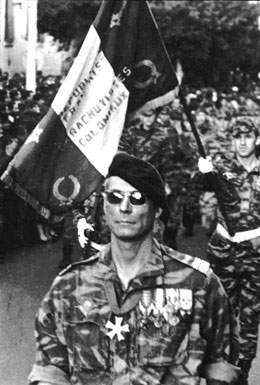 I saw well-known film The Battle of Algiers again recently. This is a piece of political cinema about the Algerian war against the French, focusing on events in Algiers. It is in two parts – firstly the FLN rebels begin their campaign, effectively taking over the old city of Algiers and striking outside it against French military, police, and civilian targets. The second part shows the French response – the Paratroopers are deployed to crush the rebellion with the most uncompromising of methods. It is often said of fictional things that the villains are more interesting than the heroes; that is certainly true of this one, as the commander of the paras is by far the most charismatic and fascinating character in the film, and probably the one who gets the most individual screen time. This is not to denigrate the FLN characters, but merely to emphasise how the colonel gets all the best lines.
People often talk about how there are parallels between the Algerian war's uncompromising savagery and current events in Palestine and Iraq. As a result this film has enjoyed a new lease of life, reputedly being watched by Pentagon officials and US military types as a counter-insurgency training film (presumably they forget that the French lost in Algeria). If you have ever been to Hebron or, particularly, Jerusalem, the film will have resonances for you, if only for the look of the streets and their almost chthonic feeling.

I wonder sometimes, though, whether people learn the wrong lessons from the film. I particular think this of the left, or of people broadly supportive of Palestinian militancy and the various insurgencies in Iraq. The Battle of Algiers is very sympathetic to the FLN's armed struggle, not merely when it is directed against the security apparatus of the French, but also when French civilians are being targeted. The film presents the blowing up of cafés, airline offices, and teen hangouts as unfortunate and distressing, but also necessary as a means to terrorise the French into granting independence to the Algerians. Yet, as someone on ILX points out, the FLN's violent campaign is revealed by the film to be a complete failure. It provokes a massive response by the authorities, who break the FLN as a military force, killing or arresting their activists. What finally breaks French will is not more terrorism, but an outbreak of mass agitation against colonial rule. I feel that this is something that people in Palestine could reflect on.
The discourse around the Palestinian struggle is often based on the idea that the imbalance of forces between Israel and Palestine is such that asymmetric war against Israeli civilians is the Palestinians' only option. This analysis never steps back to pondering whether killing Israeli civilians actually advances the cause of Palestinian freedom? I think not – if anything it retards it, providing a smoke screen for the Israelis to justify greater repression and land theft in the name of security. In any case, the Israelis, like the French, have succeeded in more or less totally defeating the Palestinian militants. The ability of Palestinians to strike at Israeli targets is now extremely limited, apart from those targets within rocket range of the Gaza strip. I cannot but think that like with Algeria, it is necessary for the Palestinians to try something else.
There is a poignant bit in the film where two FLN activists are talking. One says to the other "The real struggle begins when we achieve independence". Given Algeria's miserable post independence history, it is hard not to think "Jesus, you FLN guys really fucked that one up".
09 July, 2007
The Palestinian Prime Minister
 The BBC reported today that Israel's foreign minister has met the Palestinian Prime Minister. The odd thing about this is that she has met a Mr Salam Fayyad, and not Mr Ismail Haniyeh. Mr Haniyeh was chosen as the Palestinian Authority by the Palestinian parliament after elections last year. The Basic Law of the Palestinian Authority states that the parliament elects the prime minister, who remains responsible to it. While the president can sack the prime minister, any new prime minister must be appointed by the parliament. Until this happens, the sacked prime minister remains in office in a caretaker capacity.
  If you want to know more about the constitutional prerogatives of various office holders in the Palestinian Authority, check out this document: What Can Abu Mazin Do?
Hamas: agents of freedom?
 As you know, Hamas fighters recently cleared the Gaza Strip of security officials loyal to Fatah boss Mohammed Dahlan. Since then a degree of law and order seems to have been imposed on this troubled territory. It is early days yet, and it is always possible that the less friendly face of Hamas might soon be seen by residents of the strip. Hamas nevertheless have scored a number of propaganda coups lately. Firstly, they organised the release of Alan Johnston by the fringe militant/criminal group holding him. And today they managed to rescue a prisoner who has been held by criminals for nearly two years. Sabrina the Lioness was abudcted from Gaza Zoo by criminals who were apparently charged people 50p a time to be photgraphed beside her. Sabrina is apparently very happy to be reunited with her brother Sakher in the zoo.
The Israelis are getting in on this rescuing animals lark. Two golden eagles were busted out of a pet shop in Hebron by paratroopers last week.
02 July, 2007
Secrets

Mordechai Vanunu used to work in the Dimona nuclear plant in Israel. Then he quit his job and travelled to Europe, where he sold a story to the Sunday Times about how Dimona was a nuclear bomb factory. The Israeli secret services kidnapped him from Italy and transported him back to Israel, where he was thrown in jail. He was eventually to serve some eighteen years, much of it in solitary. I am not aware of the Italian authorities taking much interest in tracking down his kidnappers.
Vanunu was released in 2004, but under draconian conditions. He was not allowed to talk to foreigners, not allowed to approach foreign embassies, and not allowed to leave the state of Israel. He did not talk to me when I was staying in the guest house where he lived in 2005, but he apparently has been having some chats with some non-Israelis, and has now been thrown back in jail for another six months.
Vanunu apparently knows astonishing secrets on whose suppression the state of Israel depends for its security. It is fascinating to speculate as to what these might be, given that his initial disclosures (backed up by his kidnapping) revealed Israel to be nuclear power.
Links:
Vanunu sentenced to new jail term
Israel jails Vanunu over foreign contacts
Mordechai Vanunu's own website (he probably does not update it himself, as accessing the Internet is another thing he is not allowed to do)

24 June, 2007
HI DERE I BOROW BOOK
These are the books I currently have on loan from the Spy School library.
Palestine in Crisis: the Struggle for Peace and Political Independence after Oslo, by Graham Usher
Notwithstanding the bombastic first part of the title, this seems to be a book about the development of the Palestinian Authority and Palestinian society after the signing of the Oslo accords. I am currently interested in the institutional history of the PA, so this book is right up my alley.
"Palestine in Crisis" is the kind of title any book on Palestine written in the last 60 years could have.
When States Fail: Causes and Consequences, edited by Robert I. Rotberg
I have borrowed this because I am interested in the theoretical end of how countries go badly wrong, even if I find the "failed state" model somewhat problematic.
State Formation in Palestine: Viability and Governance during a Social Transformation, edited by Mushtaq Husain Khan (with George Glacaman and Inge Amundsen)
I think this covers similar ground to Usher's book, but is a bit more academicy, being a series of papers on different aspects of the "crisis-ridden progress in Palestinian state formation". Looking at the blurb again it seems like it is going to outline and critique the idea that the PA's collapse results from largely internal factors. Deadly, these guys are writing my thesis for me!
The Politics of the Palestinian Authority: from Oslo to al-Aqsa, by Nigel Parsons
This seems to cover similar ground to Usher's book, but looks more academic and was written more recently (after the start of the Al-Aqsa Intifada).
Semi-Presidentialism in Europe, edited by Robert Elgie
I just can't get enough of that semi-presidentialism.
Palestine in Crisis: the Struggle for Peace and Political Independence after Oslo, by Graham Usher
Notwithstanding the bombastic first part of the title, this seems to be a book about the development of the Palestinian Authority and Palestinian society after the signing of the Oslo accords. I am currently interested in the institutional history of the PA, so this book is right up my alley.
"Palestine in Crisis" is the kind of title any book on Palestine written in the last 60 years could have.
When States Fail: Causes and Consequences, edited by Robert I. Rotberg
I have borrowed this because I am interested in the theoretical end of how countries go badly wrong, even if I find the "failed state" model somewhat problematic.
State Formation in Palestine: Viability and Governance during a Social Transformation, edited by Mushtaq Husain Khan (with George Glacaman and Inge Amundsen)
I think this covers similar ground to Usher's book, but is a bit more academicy, being a series of papers on different aspects of the "crisis-ridden progress in Palestinian state formation". Looking at the blurb again it seems like it is going to outline and critique the idea that the PA's collapse results from largely internal factors. Deadly, these guys are writing my thesis for me!
The Politics of the Palestinian Authority: from Oslo to al-Aqsa, by Nigel Parsons
This seems to cover similar ground to Usher's book, but looks more academic and was written more recently (after the start of the Al-Aqsa Intifada).
Semi-Presidentialism in Europe, edited by Robert Elgie
I just can't get enough of that semi-presidentialism.
17 June, 2007
They have a word for it
There are some foreign words that should be used more in English, because they can express concepts with a conciseness only renderable in English with great cumbersomeness. I will now introduce you to two... pay attention, as I will be using them again without explanation.
1. Autogolpe
This is a Spanish word that in literal translation means "self coup". It's what you get when the existing government of a country decides they do not like the consitution, so they just tear it up and shoot or throw in jail anyone who kicks up about it. I first heard the word in connnection with Peru, where President Alberto Fujimori in 1992 decided that he did not like the powers the constitution gave to the country's parliament, so he just annulled the constitution and wrote a new one, consisting of one article: "1. Whatever President Fujimori says goes". Another celebrated autogolpe was when in 1993 Russia's President Yeltsin got fed up with his country's parliament voting against his proposed laws, so he sent in tanks to kill them. Wikipedia helpfully explains that Chancellor Palpatine's elevation of himself to the Imperial throne also constitutes an auogolpe.
2. Mukhabarat
I first came across this word in a Robert Fisk book, where he referred to the Syrian intelligence service as the Mukhabarat, making me think that this was its actual name (in the same way that the East German state security agency was the Stasi, South Africa's BOSS, Israel's MOSSAD and Shin Bet, etc.). It turns out that mukhabarat is just an Arab word for intelligence, in that "military intelligence" kind of way; some of the Syrian state security agencies do indeed have the word in their name, but none of them is THE Mukhabarat, at least not in that sense. The thing I have come to realise since then, though, is that mukhabarat is a very useful and handily snappy general umbrella term for the state security agencies of a country. That is how it is used with Arab states, anyway, but I think it could do with being applied more generally. So, in talking about the UK, we might refer to MI5, MI6, the Special Branch, GCHQ, and certain other shady agencies collectively as being Britain's mukhabarat. I suppose ECHELON might be a kind of globalised mukhabarat for the free world.
1. Autogolpe
This is a Spanish word that in literal translation means "self coup". It's what you get when the existing government of a country decides they do not like the consitution, so they just tear it up and shoot or throw in jail anyone who kicks up about it. I first heard the word in connnection with Peru, where President Alberto Fujimori in 1992 decided that he did not like the powers the constitution gave to the country's parliament, so he just annulled the constitution and wrote a new one, consisting of one article: "1. Whatever President Fujimori says goes". Another celebrated autogolpe was when in 1993 Russia's President Yeltsin got fed up with his country's parliament voting against his proposed laws, so he sent in tanks to kill them. Wikipedia helpfully explains that Chancellor Palpatine's elevation of himself to the Imperial throne also constitutes an auogolpe.
2. Mukhabarat
I first came across this word in a Robert Fisk book, where he referred to the Syrian intelligence service as the Mukhabarat, making me think that this was its actual name (in the same way that the East German state security agency was the Stasi, South Africa's BOSS, Israel's MOSSAD and Shin Bet, etc.). It turns out that mukhabarat is just an Arab word for intelligence, in that "military intelligence" kind of way; some of the Syrian state security agencies do indeed have the word in their name, but none of them is THE Mukhabarat, at least not in that sense. The thing I have come to realise since then, though, is that mukhabarat is a very useful and handily snappy general umbrella term for the state security agencies of a country. That is how it is used with Arab states, anyway, but I think it could do with being applied more generally. So, in talking about the UK, we might refer to MI5, MI6, the Special Branch, GCHQ, and certain other shady agencies collectively as being Britain's mukhabarat. I suppose ECHELON might be a kind of globalised mukhabarat for the free world.
14 June, 2007
A little peace
Today's headline in the Times talked about how Hamas are basically creating an Islamist mini-state in the Gaza strip. The paper sees this as a bad thing, and talked ominously of how this is likely to throw the Middle East peace process into crisis. I found this somewhat amusing, as it implies that there is a Middle East peace process.
13 June, 2007
Palestinian Semi-Presidentialism and Counterfactuals
I am always guided by inertia. In choosing a thesis topic for Spy School I have ended up combining my supervisor's own academic interest in semi-presidentialism with my own general interest in Palestine to produce a thesis topic based around semi-presidentialism in Palestine. In terms of thesis questions, I will be asking whether the Palestinian Authority's semi-presidential regime is a significant cause of its current collapse; my answer will probably be "no".
Just to recap, semi-presidentialism is what you have when a directly elected president faces off against a premier responsible to a parliamentary assembly. Depending on which definition you are rolling with, the president might need to have considerable powers, or they might not. My supervisor, who could stake a good claim to being Mr Semi-Presidentialism, favours a procedural definition whereby the president merely needs to be popularly elected for a regime to be semi-presidential.
Some people do not like semi-presidentialism. Either it turns into a de facto presidential regime (with empirical research suggesting that presidential regimes tend towards rubbishness) or else the dual authority problem (a directly elected president facing off against a premier responsible to a directly elected parliament) exacerbates political tensions and leads to gridlock, political paralysis, or worse. In newly democratising regimes where the norms of democratic behaviour have not been internalised, there is the fear that tensions between the president and premier will be resolved in a non-constitutional manner (see recent events in Ukraine)
And so to Palestine. One interesting thing about the Palestinian Authority is that its continued existence currently looks very shaky, with a real likelihood that it will no longer exist by the time I have completed my thesis. This may or may not be a bad thing for the Palestinians, but it is great for me, as it means I will not have to make any awkward predictions about the regime's future. The PA has had a semi-presidential setup for the last couple of years and there has been escalating tension between the president and prime minister's parties, spilling over into armed conflict. So you could argue that that semi-presidentialism has been a cause of instability there. You would however probably be wrong to see it as a major factor. Instead, three things are more salient. Firstly, the political parties are armed, with their cadres quite willing to turn their guns on each other should things get nasty. Secondly, the PA is weakly institutionalised; while it has a notionally impressive security apparatus, the various security agencies are largely autonomous from the political elite and are in any case controlled by placemen of the Fatah party who are resistant to being moved. Thirdly, the PA is largely dependent on external sources of funding, but its donors have an animus towards the Hamas party; thus, since Hamas entered the government, the PA has been starved of funds, leading to a collapse in its administrative capability and much sulkiness by unpaid security personnel inclined to blame their personal travails on the Hamas administration.
Some counterfactuals are maybe interesting as a way of considering whether different institutional setups would see different outcomes following the Hamas victory in last year's legislature elections. Firstly, consider if the PA had a purely presidential regime. Hamas gaining a majority in the legislature would not cause serious problems for President Abbas, as he would retain control of executive functions in a political entity that does not do much in the way of passing laws. Abbas would probably be able to play the situation to his advantage, playing the PHEAR TEH ISLAMIST card to the international community to justify cracking down on his political enemies and postponing anything approximating to free presidential elections to the distant future for fear that this would see Hamas take over the PA; he would probably receive a pat on the back if he staged an autogolpe and shut down the parliament. Maybe the Israelis would throw Abbas a few scraps to make him look good compared to his internal challengers, but as Abbas' role is to be their Palestinian gang-boss he should not expect too much. Abbas might or might not face a revolt from Hamas down the line, but given their ambivalence about the PA in the first place they might not challenge for its ownership. So this is still possibly the highest scoring outcome for the Palestinians – although it is bedtime for democracy and they find themselves with a regime plainly subservient to the Israelis, they are maybe spared the chronic internal strife they face in the real world.
Secondly, imagine the PA had an entirely parliamentary regime. When Hamas unexpectedly wins the 2006 elections, things happen pretty much as they do with us – they form a government, the international community pulls the plug, the mukhabarat bosses resist being brought under Hamas control and start kicking up over not being paid, the armed parties start trading pot-shots, and the PA collapses into civil war.
Whichever way you set up the institutions, the outcome for the PA seems a bit poor. If I was them, I would want to play a different game.
Just to recap, semi-presidentialism is what you have when a directly elected president faces off against a premier responsible to a parliamentary assembly. Depending on which definition you are rolling with, the president might need to have considerable powers, or they might not. My supervisor, who could stake a good claim to being Mr Semi-Presidentialism, favours a procedural definition whereby the president merely needs to be popularly elected for a regime to be semi-presidential.
Some people do not like semi-presidentialism. Either it turns into a de facto presidential regime (with empirical research suggesting that presidential regimes tend towards rubbishness) or else the dual authority problem (a directly elected president facing off against a premier responsible to a directly elected parliament) exacerbates political tensions and leads to gridlock, political paralysis, or worse. In newly democratising regimes where the norms of democratic behaviour have not been internalised, there is the fear that tensions between the president and premier will be resolved in a non-constitutional manner (see recent events in Ukraine)
And so to Palestine. One interesting thing about the Palestinian Authority is that its continued existence currently looks very shaky, with a real likelihood that it will no longer exist by the time I have completed my thesis. This may or may not be a bad thing for the Palestinians, but it is great for me, as it means I will not have to make any awkward predictions about the regime's future. The PA has had a semi-presidential setup for the last couple of years and there has been escalating tension between the president and prime minister's parties, spilling over into armed conflict. So you could argue that that semi-presidentialism has been a cause of instability there. You would however probably be wrong to see it as a major factor. Instead, three things are more salient. Firstly, the political parties are armed, with their cadres quite willing to turn their guns on each other should things get nasty. Secondly, the PA is weakly institutionalised; while it has a notionally impressive security apparatus, the various security agencies are largely autonomous from the political elite and are in any case controlled by placemen of the Fatah party who are resistant to being moved. Thirdly, the PA is largely dependent on external sources of funding, but its donors have an animus towards the Hamas party; thus, since Hamas entered the government, the PA has been starved of funds, leading to a collapse in its administrative capability and much sulkiness by unpaid security personnel inclined to blame their personal travails on the Hamas administration.
Some counterfactuals are maybe interesting as a way of considering whether different institutional setups would see different outcomes following the Hamas victory in last year's legislature elections. Firstly, consider if the PA had a purely presidential regime. Hamas gaining a majority in the legislature would not cause serious problems for President Abbas, as he would retain control of executive functions in a political entity that does not do much in the way of passing laws. Abbas would probably be able to play the situation to his advantage, playing the PHEAR TEH ISLAMIST card to the international community to justify cracking down on his political enemies and postponing anything approximating to free presidential elections to the distant future for fear that this would see Hamas take over the PA; he would probably receive a pat on the back if he staged an autogolpe and shut down the parliament. Maybe the Israelis would throw Abbas a few scraps to make him look good compared to his internal challengers, but as Abbas' role is to be their Palestinian gang-boss he should not expect too much. Abbas might or might not face a revolt from Hamas down the line, but given their ambivalence about the PA in the first place they might not challenge for its ownership. So this is still possibly the highest scoring outcome for the Palestinians – although it is bedtime for democracy and they find themselves with a regime plainly subservient to the Israelis, they are maybe spared the chronic internal strife they face in the real world.
Secondly, imagine the PA had an entirely parliamentary regime. When Hamas unexpectedly wins the 2006 elections, things happen pretty much as they do with us – they form a government, the international community pulls the plug, the mukhabarat bosses resist being brought under Hamas control and start kicking up over not being paid, the armed parties start trading pot-shots, and the PA collapses into civil war.
Whichever way you set up the institutions, the outcome for the PA seems a bit poor. If I was them, I would want to play a different game.
10 June, 2007
Another 1967
This year, last year, and next year have some interesting anniversaries. Last year was the fiftieth anniversary of the Suez caper, in which the UK and France teamed up with Israel only to discover that they were no longer major world powers. Next year will mark sixty years since the foundation of the state of Israel, or sixty years since al-Nakba, the catastrophe that saw several hundred thousand Palestinians forced from their homes. This year, meanwhile, sees the fortieth anniversary of the Six Day War, in which the Israelis stuffed the combined armies of Jordan, Syria, and Egypt.
The Six Day War is still seen a major turning point in the affairs of the Middle East. I suppose at one level it changed the rules of the game - it was no longer possible for anyone to claim that Israel's military defeat was possible, and Israel's neighbours implicitly or explicitly switched to more modest goals. More crucially for Israel itself, the country found itself in possession of all of mandate Palestine (as well as Syrian and Egyptian territories), and a much enlarged population of sulky non-Jews. Shortly after the conquest of the West Bank, Israeli settlers began to move in there, in an effort to tie the land to Israel forever. The acceleration of their programme in the 1990s plays a major role in preventing resolution of the conflict between Israelis and Palestinians.
Given that 1967 was such a turning point, it is interesting to imagine how things might have turned out differently then. The war is an interesting illustration of the importance of contingency in human affairs, with the various actors in the struggle having real choices that were important determinants of what eventually happened. I gather from my old pals in Points of Divergence, an alternate history APA, that there are more than no pieces in which people imagine the consequences of an Arab victory in 1967. Given the imbalance of forces at the time, and the actual totally rubbish performance of the Egyptian and Syrian armies, this would be a rather fanciful outcome and not one that could seriously be considered. More interesting, though, is a speculative piece by Doron Rosenblum that appeared in Ha'aretz last week. Rosenblum imagines what might have ensued had Israel's civilian leadership faced down the militarists who were calling for a first strike on Egypt. In some ways the piece is a triumph of the plus-ça-change,-plus-c'est-la-même-chose school of alternate history, where you make a big change but then have everything turning out more or less the same. Nevertheless, the piece is interesting in terms of suggesting how things could have turned out differently, with Israel being spared the moral corrosion that ensues from the occupation of the West Bank and Gaza.
You could of course imagine any number of other alternate 1967s - what if Nasser had pursued a less risky strategy, what if Jordan had stayed out of the war, what if the Egyptian army was not completely rubbish (or at least had leaders who played to its strengths rather than its weaknesses), what if the USS Liberty incident had provoked extreme US sulkiness, and so on. We of course do not get to live in these imagined worlds, but merely thinking about them should be enough to make us appreciate the importance of human agency and reject gonzoid determinism.
The Six Day War is still seen a major turning point in the affairs of the Middle East. I suppose at one level it changed the rules of the game - it was no longer possible for anyone to claim that Israel's military defeat was possible, and Israel's neighbours implicitly or explicitly switched to more modest goals. More crucially for Israel itself, the country found itself in possession of all of mandate Palestine (as well as Syrian and Egyptian territories), and a much enlarged population of sulky non-Jews. Shortly after the conquest of the West Bank, Israeli settlers began to move in there, in an effort to tie the land to Israel forever. The acceleration of their programme in the 1990s plays a major role in preventing resolution of the conflict between Israelis and Palestinians.
Given that 1967 was such a turning point, it is interesting to imagine how things might have turned out differently then. The war is an interesting illustration of the importance of contingency in human affairs, with the various actors in the struggle having real choices that were important determinants of what eventually happened. I gather from my old pals in Points of Divergence, an alternate history APA, that there are more than no pieces in which people imagine the consequences of an Arab victory in 1967. Given the imbalance of forces at the time, and the actual totally rubbish performance of the Egyptian and Syrian armies, this would be a rather fanciful outcome and not one that could seriously be considered. More interesting, though, is a speculative piece by Doron Rosenblum that appeared in Ha'aretz last week. Rosenblum imagines what might have ensued had Israel's civilian leadership faced down the militarists who were calling for a first strike on Egypt. In some ways the piece is a triumph of the plus-ça-change,-plus-c'est-la-même-chose school of alternate history, where you make a big change but then have everything turning out more or less the same. Nevertheless, the piece is interesting in terms of suggesting how things could have turned out differently, with Israel being spared the moral corrosion that ensues from the occupation of the West Bank and Gaza.
You could of course imagine any number of other alternate 1967s - what if Nasser had pursued a less risky strategy, what if Jordan had stayed out of the war, what if the Egyptian army was not completely rubbish (or at least had leaders who played to its strengths rather than its weaknesses), what if the USS Liberty incident had provoked extreme US sulkiness, and so on. We of course do not get to live in these imagined worlds, but merely thinking about them should be enough to make us appreciate the importance of human agency and reject gonzoid determinism.
Moral turpitude
I wrote the other day about an Italian court case, where Italian and American security personnel are on trial for kidnapping a man and transporting him to Mubarak's torturers in Egypt. Since then, the Council of Europe has released a report on the extraordinary rendition system, in particular talking about the secret gulag the CIA ran (or runs) in Eastern Europe. You can download it in PDF format here.
I find it disturbing what a minor news story this is, and how little outrage at a political or popular level it seems to excite. We are not talking about strange faraway countries here, but countries and airports in the European Union. Secret prisons, people being flown off to dictatorships' torturers, people being kidnapped on the streets of constitutional states and spirited off to Mubarak's thugs, a government obstructing a kidnap trial to maintain good relations with the kidnappers - if all this is not a major story, what is?
I find it disturbing what a minor news story this is, and how little outrage at a political or popular level it seems to excite. We are not talking about strange faraway countries here, but countries and airports in the European Union. Secret prisons, people being flown off to dictatorships' torturers, people being kidnapped on the streets of constitutional states and spirited off to Mubarak's thugs, a government obstructing a kidnap trial to maintain good relations with the kidnappers - if all this is not a major story, what is?
Albania welcomes George Bush!
 US President George Bush has received a hero's welcome in Albania - in marked contrast to the protests that dog his progress in other countries. It's always nice to have a friend. More BBC pictures here.
09 June, 2007
Tough on crime. Tough on the causes of crime.
In Italy a number of people are on trial for kidnapping one Mr Abu Omar and arranging for his transportation out of the country to an Egyptian torture camp. Some of the indicted kidnappers are being tried in absentia, having skipped the country. The Italian government has said that it will not seek their extradition; a senior official of the country sheltering these alleged criminals has said that they would in any case never be sent to face trial.
06 June, 2007
All politicians are the same
There are those who say that it does not matter who becomes President of the USA, as whoever gets the job will always pursue the interests of the US power elite.
It is, however, only Republican candidates for the nomination who are at this juncture talking about nuclear strikes on Iran.
It is, however, only Republican candidates for the nomination who are at this juncture talking about nuclear strikes on Iran.
01 June, 2007
Academic Boycotts
British lecturers vote to boycott Israeli academic institutions.
Iranian government directs Iranian lecturers to boycott all non-Iranian academic institutions.
Meanwhile, Spy School is effectively boycotting me thanks to its libary's restrictive summer opening hours.
Iranian government directs Iranian lecturers to boycott all non-Iranian academic institutions.
Meanwhile, Spy School is effectively boycotting me thanks to its libary's restrictive summer opening hours.
28 May, 2007
Evin Prison
Iran is one of the more democratic states in its region. Criticisms of its regime are often made cynically by those looking for excuses to invade it. As a result, it is easy to forget what complete cockfarmers the rulers of Iran are. It is sometimes said that liberal democratic states have a self-perpetuating power elite that exercises real control despite the facade of elections. In Iran, the self-perpetuating power elite's role is written into the constitution.
With the real organs of state power largely outside the remit of the elected bits of Iran's government, it is no surprise that they behave in the most thuggish and nakedly authoritarian manner. At the moment Ms Haleh Esfandiari, a visiting academic, languishes in the terrifying Evin Prison, accused of being part of an international revolutionary syndicate led by George Soros; Iran is one of few countries where Soros' civil society organisation could be considered some kind of subversive organisation. Last year Mr Akbar Mohammadi died mysteriously in the same prison; he was serving a fifteen year jail term for organising student protests, and while in Evin he had suffered a spinal injury before allegedly dying of a heart attack. In 2005 Ms Zahra Kazemi, a Canadian photojournalist, was raped and tortured to death in Evin. These are obviously just the most famous victims of these seemingly unaccountable gangsters.
 Somewhat ironically, perhaps, Evin Prison was famously used as a jail and torture centre by the Shah; the likelihood has to be that some of the regime's current stalwarts enjoyed its hospitality before the revolution. It is apparently situated next to an attractive park and tea house, both of which attract visitors to the area. If you find yourself there, be careful with any camera you have, lest you suffer the fate of Ms Kazemi (although Ms Fariba Amina seems to have got away with it; photos from her article on Payvand News of Iran)
With the real organs of state power largely outside the remit of the elected bits of Iran's government, it is no surprise that they behave in the most thuggish and nakedly authoritarian manner. At the moment Ms Haleh Esfandiari, a visiting academic, languishes in the terrifying Evin Prison, accused of being part of an international revolutionary syndicate led by George Soros; Iran is one of few countries where Soros' civil society organisation could be considered some kind of subversive organisation. Last year Mr Akbar Mohammadi died mysteriously in the same prison; he was serving a fifteen year jail term for organising student protests, and while in Evin he had suffered a spinal injury before allegedly dying of a heart attack. In 2005 Ms Zahra Kazemi, a Canadian photojournalist, was raped and tortured to death in Evin. These are obviously just the most famous victims of these seemingly unaccountable gangsters.
 Somewhat ironically, perhaps, Evin Prison was famously used as a jail and torture centre by the Shah; the likelihood has to be that some of the regime's current stalwarts enjoyed its hospitality before the revolution. It is apparently situated next to an attractive park and tea house, both of which attract visitors to the area. If you find yourself there, be careful with any camera you have, lest you suffer the fate of Ms Kazemi (although Ms Fariba Amina seems to have got away with it; photos from her article on Payvand News of Iran)
Poland & Russia v. the homosexuals
 The Polish government is currently in the hands of two eccentric twin brothers who delight in ignoring the real issues and instead prefer to engage in puerile cultural politics. Consequently it should be no surprise to learn that a senior official has ordered an investigation into whether popular TV programme The Teletubbies promotes a gay lifestyle. "I noticed he was carrying a handbag", reports the confused official, "At first I didn't realise he was a boy". The official is actually a woman, Ms Ewa Sowinska, but it is more fun to imagine the line being said by a Polish Alan Partridge.
 In Russia, they take a more direct approach to these matters. In Moscow yesterday, 100% heterosexual ultra-nationalists laid into a gay pride demonstration, punching British gay rights activist Peter Tatchell's face in and dishing out similar treatment to Richard Fairbrass of Right Said Fred. The cops initially stood by, but then intervened to arrest Tatchell, Fairbrass, several members of the European Parliament, and numerous gay rights activists. Curiously, the various ultra-nationalist thugs seem to have been left alone by the forces of law and order.
 The incident reminds me that it's been too long since I listened to my RSF record. The one positive aspect of this whole story is learning that they still have a career in music.
 Links:
Gay Activists Beaten And Arrested In Russia
Arrests at Russian gay protests
Moscow anti-gay attack condemned
24 May, 2007
Democracy in action - the final crop
A vote for Lucan
Make the local woman your TD
Think change
Building an Ireland of equals
For a strong caring voice
Left-Wing government? NO thanks!
Ireland is an island - NOT a continent
Your vote for children
Taking action - getting results
Getting places faster
A real performer!
Ireland is a country - not a continent.
Make the local woman your TD
Think change
Building an Ireland of equals
For a strong caring voice
Left-Wing government? NO thanks!
Ireland is an island - NOT a continent
Your vote for children
Taking action - getting results
Getting places faster
A real performer!
Ireland is a country - not a continent.
21 May, 2007
The Final Programme
I have submitted my last essay to Spy School.
Now I just have to write a thesis and then I will be a qualified Spy.
Now I just have to write a thesis and then I will be a qualified Spy.
09 May, 2007
Democracy in action, part 2
It's time
Fighting for you
Ready for government
Everybody matters
Enough is enough
Putting Dublin North in safe hands
Invest in progress
Make a difference
Make the change
Fighting for you
Ready for government
Everybody matters
Enough is enough
Putting Dublin North in safe hands
Invest in progress
Make a difference
Make the change
07 May, 2007
Democratising the Middle East
I had my last ever lecture in Spy School on Friday. It was about US attempts to democratise the Arab world. By an astonishing coincidence, the BBC ran an article on this kind of thing last week: Has the US ditched Mid-East reform?
I have already mentioned the prevalence of authoritarian rule in the Middle East. Part of the picture here is the historic fondness of the USA for friendly Arab dictators or kings. This assisted various shady Arab world leaders in the repression of their people. After 9-11, though, elements within the US administration began to wonder if this strategy had essentially failed – something designed to advance US security is hardly achieved if maniacs take to flying aircraft into New York skyscrapers. So the US regime started talking about how it was vitally important that the Arab world move towards democracy. The use of democratisation as part of the justification for invading Iraq was part of this, but the piling of pressure on US clients was another. Egypt's Hosni Mubarak had long been one of the USA's most reliable allies in the region, but suddenly he found himself being put under real pressure to introduce democratic reforms to his country.
Fortunately for Mubarak, the USA lost interest in Arab democratisation, and the Egyptian regime found itself free to throw civil rights activists and bloggers into jail without any problematic statements from the Americans. The reason for this is simple enough – democracy is a mysterious business, and you can never be sure that the guys you like will win. The Palestinian Authority elections in 2006 were a worrying reminder of what can happen when people are allowed to vote – despite the high education of Palestinians, their extensive links to a worldwide diaspora, and all the money the USA has pumped into the country, the Palestinian ingrates chose to vote for Hamas, the evil Islamist party. After that the US administration decided that actually the friendly dictators and monarchs were not so bad after all, and they have been subjected to only the most token pressures towards democracy.
You could say, therefore, that the clock has turned full circle and the USA is back to letting security concerns dictate its agenda with respect to Middle Eastern regimes. Unfortunately, the pro-democracy interlude has the effect of greatly strengthening the dictators, as they (and their opposition) can now reasonably predict that if the Americans pile on the pressure for democracy then this will simply be a short-lived fad to which they are not really committed. There is also the damage to US credibility – if you start saying that Egypt needs to democratise and then a couple of years later revert to a failed policy of boosting Mubarak then you look like a bit of an idiot, and a hypocritical one at that.
I have already mentioned the prevalence of authoritarian rule in the Middle East. Part of the picture here is the historic fondness of the USA for friendly Arab dictators or kings. This assisted various shady Arab world leaders in the repression of their people. After 9-11, though, elements within the US administration began to wonder if this strategy had essentially failed – something designed to advance US security is hardly achieved if maniacs take to flying aircraft into New York skyscrapers. So the US regime started talking about how it was vitally important that the Arab world move towards democracy. The use of democratisation as part of the justification for invading Iraq was part of this, but the piling of pressure on US clients was another. Egypt's Hosni Mubarak had long been one of the USA's most reliable allies in the region, but suddenly he found himself being put under real pressure to introduce democratic reforms to his country.
Fortunately for Mubarak, the USA lost interest in Arab democratisation, and the Egyptian regime found itself free to throw civil rights activists and bloggers into jail without any problematic statements from the Americans. The reason for this is simple enough – democracy is a mysterious business, and you can never be sure that the guys you like will win. The Palestinian Authority elections in 2006 were a worrying reminder of what can happen when people are allowed to vote – despite the high education of Palestinians, their extensive links to a worldwide diaspora, and all the money the USA has pumped into the country, the Palestinian ingrates chose to vote for Hamas, the evil Islamist party. After that the US administration decided that actually the friendly dictators and monarchs were not so bad after all, and they have been subjected to only the most token pressures towards democracy.
You could say, therefore, that the clock has turned full circle and the USA is back to letting security concerns dictate its agenda with respect to Middle Eastern regimes. Unfortunately, the pro-democracy interlude has the effect of greatly strengthening the dictators, as they (and their opposition) can now reasonably predict that if the Americans pile on the pressure for democracy then this will simply be a short-lived fad to which they are not really committed. There is also the damage to US credibility – if you start saying that Egypt needs to democratise and then a couple of years later revert to a failed policy of boosting Mubarak then you look like a bit of an idiot, and a hypocritical one at that.
05 May, 2007
Democracy in action
The best is yet to come
Don't throw it all away
On your side
Others promise. We deliver
Working for you. Working with you
I have a dream
Help me to help you
Now, the next steps
Your voice, your issues
Delivering results consistently
Working locally… delivering locally
Your Ireland. Your future
New generation. New candidate. New Dáil.
We'll work for you.
Teamwork gets results.
Honest politics. Real results.
Don't throw it all away
On your side
Others promise. We deliver
Working for you. Working with you
I have a dream
Help me to help you
Now, the next steps
Your voice, your issues
Delivering results consistently
Working locally… delivering locally
Your Ireland. Your future
New generation. New candidate. New Dáil.
We'll work for you.
Teamwork gets results.
Honest politics. Real results.
Scotland Votes
As does Wales and some of England. Aside from the whole "SNP - raving lunatics or the new friendly face of Scotland" debate, I was struck by how the UK was considering embracing a ridiculous voting system on the basis of their spurious modernity, a move that mirrors Ireland's failed embrace of electronic voting a couple of years ago. In particular there seem to have been plans to adopt internet and mobile telephone voting in elections, as part of an attempt to turn the choosing of people to run the country into a parody of Big Brother. This seems to have been cancelled at the last minute because of security issues with the software: Government cancelled e-vote schemes amid security fears
The whole business is very strange and says a lot about our times - the state initially thought it was a good idea to replace a perfectly functional technology with something that did not work reliably simply because it looked more shiny and modern. Even aside from the software security issues, people need to realise that internet and phone voting is fundamentally flawed and should be rejected by all democratic societies. A key feature of democracy is that a person's vote is inalienable - they must not be able to pass it on to someone else for money or other consideration. With remote electronic voting it is practically impossible to guarantee that people will not allow others to vote for them.
The whole business is very strange and says a lot about our times - the state initially thought it was a good idea to replace a perfectly functional technology with something that did not work reliably simply because it looked more shiny and modern. Even aside from the software security issues, people need to realise that internet and phone voting is fundamentally flawed and should be rejected by all democratic societies. A key feature of democracy is that a person's vote is inalienable - they must not be able to pass it on to someone else for money or other consideration. With remote electronic voting it is practically impossible to guarantee that people will not allow others to vote for them.
The Biter Bit
I have been reading about electoral systems in the Middle East. These are typically used by regimes to mimimise the amount of seats won by the opposition in elections (usually in conjunction with other measures, like throwing opposition activists or candidates in jail, banning some of the opposition parties, or straightforwardly rigging the election results). My current favourite regime manoeuvre is one used in Egypt at one point. They had a list system of proportional representation, but with a high threshold of 8% - any party getting less than that proportion of the vote got no seats in the parliament (this at a time when the opposition was rather fragmented). The stroke of genius was a ruling that any votes for parties getting less than the threshold were to be counted as votes for the goverrning party.
Turkey either is or is not in the Middle East, depending on who you talk to. They are having some interesting political stuff at the moment. The Turkish Prime Minister Recep Tayyip Erdogan wants to make Abdullah Gul, one of his party colleagues the country's president. As the president is chosen by the parliament, and as Erdogan's Justice & Development party has a handsome parliamentary majority, there should be no problem here... except that Justice & Development is an Islamist party, and Turkey's army does not like the idea of an Islamist president and prime minister.
Some have apparently taken to complaining that although the governing party has a massive majority in parliament, they achieved this on on something puny like only 30% of the popular vote. Amusingly, they managed this because the country has a comedic electoral system specifically designed to weaken the Islamists.
Turkey either is or is not in the Middle East, depending on who you talk to. They are having some interesting political stuff at the moment. The Turkish Prime Minister Recep Tayyip Erdogan wants to make Abdullah Gul, one of his party colleagues the country's president. As the president is chosen by the parliament, and as Erdogan's Justice & Development party has a handsome parliamentary majority, there should be no problem here... except that Justice & Development is an Islamist party, and Turkey's army does not like the idea of an Islamist president and prime minister.
Some have apparently taken to complaining that although the governing party has a massive majority in parliament, they achieved this on on something puny like only 30% of the popular vote. Amusingly, they managed this because the country has a comedic electoral system specifically designed to weaken the Islamists.
24 April, 2007
More Morocco action!
There is an interesting enough article about Morocco on the Guardian website, which I think appeared in the most recent Observer: Morocco's turning tide
It does the usual PHEAR TEH ISLAMISTS thing of questioning the pro-democratic bona fides of the Morocco's largest and semi-banned Islamist party while asserting that they are seen by 'many' as "potentially very dangerous". Meanwhile, the journo gets on famously with a minister of the supposedly pro-democratic government that does not allow free elections.
The one great thing I have learned about Morocco in Spy School is that the country has really serious problems about which not much is being done, with their being a real likelihood that the country is going to blow up in the next couple of years. Deadly stuff.
It does the usual PHEAR TEH ISLAMISTS thing of questioning the pro-democratic bona fides of the Morocco's largest and semi-banned Islamist party while asserting that they are seen by 'many' as "potentially very dangerous". Meanwhile, the journo gets on famously with a minister of the supposedly pro-democratic government that does not allow free elections.
The one great thing I have learned about Morocco in Spy School is that the country has really serious problems about which not much is being done, with their being a real likelihood that the country is going to blow up in the next couple of years. Deadly stuff.
Boris Yeltsin - the Judgement of History

My impression is that Boris Yeltsin will go down in history as a fun-loving boozer who loved to party, who also climbed on a tank to end Communism. I wish there were more world leaders like him (so long as they are not in charge of nuclear weapons or any country I live in or near).

13 April, 2007
Join the fight against corruption!
 The World Bank has an anti-corruption hotline. The number is 1-800-831-0463. I reckon that is one of those USA numbers, so you may need to put some kind of prefix before it. Anyway, if you are aware of any senior officials engaging in corrupt behaviour, such as ordering a $60,930 tax free pay rise for their girlfriend, then give the World Bank a call.
27 March, 2007
I know all about Syria

Lately I have been reading a lot about Syria. As you know, Syria is a key country in an important region, and much is written about its relationships with its neighbours and with other countries around the world. My interest, though, is in Syrian domestic politics, and on this there is much less to read. In part this is because the Syrian regime is very repressive, making it difficult for researchers to cover what is going on there. I think, though, that Syria's importance as a player in international relations makes people concentrate on its external rather than internal affairs. I suppose this might be because the regime is far more focussed on foreign policy than most other Arab world regimes, in that it has long engaged in an attempt to achieve hegemony over one neighbour and is keen to recover territory by war or chit chat from another (and has a simmering boundary dispute with yet another, and is a player in the ongoing Kurdish conundrum). And unlike the rest of the Arab world, whatever else you might accuse the regime of, being lackeys of the West is not one of them. So, whereas with Egypt or Tunisia, say, discussion of the country is based on the regime's struggle against domestic opponents, in Syria people look at how the country plays the great game against Israel and its obstreperous neighbours in Lebanon, or whether Bush is going to invade it.
The general focus on Syrian foreign policy means that in attempting to research its domestic politics I read the same things over and over again. I will now state them, and then you will essentially know all about Syria's internal affairs.
1. Syria used to be very unstable with coups and counter-coups occurring with astonishing frequency. These coups often saw one wing of the Syrian Ba'ath party oust another.
2. Then in 1970, Hafez al-Assad, a military Ba'athist, staged a "corrective movement" (not a coup), remaining in power for the next thirty years. Assad accomplished this by crushing anyone who opposed him.
3. But Assad was a member of the Alawite sect, considered heretical by many orthodox Sunni Muslims. And his regime was actively secularist. In 1978, the Muslim Brotherhood began an insurrectionary campaign against the regime.
 4. In 1982, sensing that their time had come, the Muslim Brotherhood took over the city of Hamah and declared a general uprising against the regime. But Assad reacted forcefully, deploying tanks and helicopter gunships, reducing the city to rubble. The Brothers were crushed.
 5. After that nothing much happened for twenty years.
6. In June 2000, Hafez al-Assad died. His son, Bashar al-Assad, became president. Previously an ophthalmologist working in the UK, there were suggestions that Bashar intended to liberalise the regime. A "Damascus Spring" began in which Syria's intelligentsia began to engage in increasingly free-ranging discussion about the country's social and economic problems.
7. The regime decided that they weren't having that, and put a stop to it. Leading intellectuals were arrested and chucked in jail, sometimes following show trials.
And that's that. I hope my inquiries will discover more detailed information, or my next essay for Spy School could be a bit thin.
25 March, 2007
In war, there are no winners - only losers
However, according to something called the Human Security Report, there has been a marked decline in war over the last two decades, meaning there are a lot less losers out there. Apparently there are way fewer of both inter-state and civil wars than there used to be during the Cold War. The BBC have also ran an article about it.
[I wrote this over a year ago but saved it as a draft... maybe I had a reason for not publishing it then, but I will nevertheless make it available now]
[I wrote this over a year ago but saved it as a draft... maybe I had a reason for not publishing it then, but I will nevertheless make it available now]
22 March, 2007
À qui le Maroc?
 I am reading about Morocco at the moment, to prepare for an assignment from Spy School. In particular, I have been reading about the Justice and Charity group, a political party blocked from taking part in the country's comedic electoral process. They are an Islamist group, led by the septuagenarian Sheikh Abd Assalam Yassine, a former Sufi mystic. He seems like an interesting fellow (and has a great beard). If you want to get a sense of his ideas, you could do worse than read his Memorandum to him who is concerned, an open letter issued in 1999 to the then newly enthroned King Mohammed VI of Morocco.
 If you are reading Yassine's letter and are not too familiar with Moroccan affairs, here is some context:
1. The previous king, Hassan II, was an authoritarian cockfarmer (who had Yassine confined to a lunatic asylum for writing a similar letter to him in 1974).
2. The Makhzen referred to in the letter are the cronies of Hassan II - the regime's old guard.
3. Tazmamart was a horrific jail in the desert into which Hassan dumped his regime's enemies, leaving them to rot in spectacularly horrendous conditions.
4. The government of alternance referred to is a spectacular coup of Hassan - he managed to co-opt some hitherto oppositional forces and form them into a supposedly oppositional government, though of course the king retained the right to appoint and sack key ministers and control the broad directions of state policy. Under Mohammed VI the alternance has remained in place, conveniently attracting hostility that might otherwise go towards the king.
Back to the Memorandum. Yassine skilfully attempts a reverse cooption, saying to Mohammed "You seem like a nice fellow, unlike your late cockfather. Here is what you would do if you really are as nice a fellow as you seem". Like most open letters, it is intended for general consumption as much as reading by its addressee. The implicit message is that if the king does not act as outlined, then he is in fact no more than a creature of the Makhzen or a chip off Hassan II's block.
What Yassine actually requests of Mohammed VI is the usual - sacking the Makhzen, cleansing the regime of its corruption (identified by the sheikh as a major barrier to attracting foreign investment), and instituting serious democratic change. Yassine also contrasts the enormous foreign debt with the massive personal wealth of the king (Hassan had essentially set up the crown at the centre of the state's economy, sucking its proceeds into his private coffers in a weird parody of Arab socialism). Noting that the king's personal wealth is roughly equivalent to the foreign debt, Yassine hits on a handy solution to the problem - let the king pay the debt out of his own funds!

This is perhaps the most problematic part of Yassine's programme. The king's wealth is not in the form of gold bars or on deposit with the gnomes of Zurich, but instead exists as a business empire spanning Morocco. While this wealth belongs to the king rather than the people, in practice the king's investments are the equivalent of a series of state industries. And were these enterprises sold off to raise monies to pay the debt, Morocco would doubtless find that domestic savings were completely insufficient to purchase them. Instead, foreign investors would be the only people who could afford to buy them, even at the depressed prices this kind of fire sale would command. Yassine is basically offering international finance control of the Moroccan economy in return for immediate repayment of the debt.
That aside, Yassine comes across as a serious and thoughtful figure with a rather droll sense of humour. His views on the Western Sahara seem considerably more flexible than the Moroccan establishment's mainstream. Although he is implicitly in favour of that occupied country remaining part of a radically reformed Morocco, he can countenance their leaving should the corrupt ancien regime remain in place.
Yassine leads the largest party in Morocco, albeit one blocked from participation in the official political process. As Islamists, they are easily presented as The Enemy to the governments of Europe and North America, who have difficult understanding that not all Islamists like to fly planes into buildings. While it would be naïve to expect to much of the Americans, it is still shocking that the European Union is still unable to engage with parties like Yassine's which are almost always the most popular in their countries. There is of course some dialogue between the "think-tank community" and and North African Islamists, and a former EU commissioner last week talked of the need for constructive engagement with Hamas in Palestine, but official Europe is still not interested in official communication with the Islamists. Official Europe looks likely to continue to bolster authoritarian regimes rather than support democratic elections that would put Yassine and his analogues in power. In the long run, this is probably unwise. The current Arab regimes (monarchies and republics) are so lacking in legitimacy that their rotting from within and collapsing in a 1989 style disintegration has to be seen as likely, if not inevitable. Europe could help promote democracy among its southern neighbours. Or it could have a lot of explaining to do when the ancien regimes are swept away
One final fascinating fact that I have not been able to integrate into the preceding concerns Yassine's daughter, Nadia. She is seen as likely candidate to succeed him as the Justice & Charity group's leader when he dies or steps down. She was recently arrested under some weird Moroccan state security law after she suggested that maybe the country did not have to be a monarchy in the future.
19 March, 2007
Tanya Reinhart
You may not have heard of Tanya Reinhart. She was an academic linguist by profession, but probably better known as an internal critic of Israel's political establishment and its occupation of the West Bank and the Gaza Strip. Together with Ilan Pappe, she was one of the leading Israeli advocates of the boycott of Israeli academia (e.g. see 'Why The World Should Boycott Israeli Academic Institutions'). Ha'aretz reports that she died on saturday in New York.
I saw Reinhart speak twice in Dublin, a couple of years ago an then again late last year. I was struck on the most recent occasion by how much older she looked, and thought that it was the stress associated with her decision to leave Israel for good.
I saw Reinhart speak twice in Dublin, a couple of years ago an then again late last year. I was struck on the most recent occasion by how much older she looked, and thought that it was the stress associated with her decision to leave Israel for good.
Jean Baudrillard
You may recall that I was working through the world of International Relations theories. This process is currently in hiatus, but eventually I hope to discuss what post-modernists have to say on the subject. Jean Baudrillard was one of the leading figures in this area, and you may have noticed that he died recently. Or maybe, he has not died but ascended into a realm of pure representation, like that Barry O'Blivion guy in Cronenburg's Videodrome (I am surely not the first person to make the comparison).
Momus comments on the difference between English and French language obituaries of Baudrillard, with the francophone world engaging with his ideas and anglophone obituaries focussing on his largely misunderstood claim that the first Gulf War had not taken place and on his apparently being the inspiration for well-known film The Matrix. The latter point is particularly comedic, suggesting that Baudrillard ran around in leather coats wearing wrap around shades and forgetting the obvious point, made by Baudrillard himself, that the film is a rather facile distillation and adaptation of his views. This is life.
On the first point, about the Gulf War not happening: my recollection is that Baudrillard, like many post-modernists, reckoned that in our hypermediated age events are less significant than their representation. Therefore, the endless rolling news reportage of the war becomes what counts, not the war itself. While I see what he is getting at here, I do not quite remember what he means by saying that the War did not happen (as opposed to it being of less significance than its media portrayal). Maybe the point is intended rhetorically. It does though call to mind a very real problem with the writings of Baudrillard (and of post-modernists generally): they are by and large written in a largely impenetrable manner. Baudrillard does at least have the excuse of foreignness - he cannot answer for the opacity of his translations. Having read other English-language post-modernist writers, however, it does appear that there is a post-modern writing style, one that Baudrillard's translators have captured well.
To see what I mean, check out Baudrillard's 'The Mask Of War', a nice short piece that appeared in some book called 1000 Days of Theory. It is a while since I read it closely, but my recollection is that there is an interesting point in there somewhere, but I cannot see it now.
Momus comments on the difference between English and French language obituaries of Baudrillard, with the francophone world engaging with his ideas and anglophone obituaries focussing on his largely misunderstood claim that the first Gulf War had not taken place and on his apparently being the inspiration for well-known film The Matrix. The latter point is particularly comedic, suggesting that Baudrillard ran around in leather coats wearing wrap around shades and forgetting the obvious point, made by Baudrillard himself, that the film is a rather facile distillation and adaptation of his views. This is life.
On the first point, about the Gulf War not happening: my recollection is that Baudrillard, like many post-modernists, reckoned that in our hypermediated age events are less significant than their representation. Therefore, the endless rolling news reportage of the war becomes what counts, not the war itself. While I see what he is getting at here, I do not quite remember what he means by saying that the War did not happen (as opposed to it being of less significance than its media portrayal). Maybe the point is intended rhetorically. It does though call to mind a very real problem with the writings of Baudrillard (and of post-modernists generally): they are by and large written in a largely impenetrable manner. Baudrillard does at least have the excuse of foreignness - he cannot answer for the opacity of his translations. Having read other English-language post-modernist writers, however, it does appear that there is a post-modern writing style, one that Baudrillard's translators have captured well.
To see what I mean, check out Baudrillard's 'The Mask Of War', a nice short piece that appeared in some book called 1000 Days of Theory. It is a while since I read it closely, but my recollection is that there is an interesting point in there somewhere, but I cannot see it now.
16 March, 2007
Milestones
 Out in Spy School today, our lecturer was talking about how well-known Islamist thinker Sayyid Qutb reckoned that in the coming ideal Islamist society men and women would be equal. "But what about those countries were women aren't allowed to drive?" inquired a student.
I don't think anyone should be allowed to drive.
20 February, 2007
The Islamists - our new friends?
I posted over on the Dublin School about something I read in an online newsletter, which was relevant to both the Spy School course on Political Islam some of us are taking and also, by extension, my last post. I suspect that even less people read the Dublin School than read Hunting Monsters, so I am going to redo the post here.
Basically, I read the latest issue of the CEPS European Neighbourhood Watch newsletter, put out by the Centre for European Policy Studies. The editorial discusses an emerging dialogue between Europe and Islamists of the Middle East & North Africa. On both sides the governments are being bypassed, with oppositional Islamist groups from the Arab world talking to think tanks and policy oriented NGOs. The discussions seem interesting, partly because they are happening at all, indicating that in coming years the Arab authoritarians will find it harder to prop themselves up with European support. At the same time, it is striking how frank the parties to this dialogue are about the fundamental differences in outlook that divide them.
The article also reproduces a piece by Dr. Saad el-Deen al-Katany, the parliamentary leader of the Muslim Brotherhood in Egypt, in which he sets forth the need for dialogue between Islamists and the West. I found this interesting because Dr. Al-Katany is attempting to drive a wedge between the West and the Arab world dictators it backs, calling on us prove we are not lying when we say we love democracy. Again, it looks like the Islamists are seeing the advantages of talking our language back to us.
There is also a reprinted interview with Belarus President, Alexander Lukashenko, one of the world's great scary leaders.
You can download the newsletter or subscribe to updates here: CEPS European Neighbourhood Watch
Basically, I read the latest issue of the CEPS European Neighbourhood Watch newsletter, put out by the Centre for European Policy Studies. The editorial discusses an emerging dialogue between Europe and Islamists of the Middle East & North Africa. On both sides the governments are being bypassed, with oppositional Islamist groups from the Arab world talking to think tanks and policy oriented NGOs. The discussions seem interesting, partly because they are happening at all, indicating that in coming years the Arab authoritarians will find it harder to prop themselves up with European support. At the same time, it is striking how frank the parties to this dialogue are about the fundamental differences in outlook that divide them.
The article also reproduces a piece by Dr. Saad el-Deen al-Katany, the parliamentary leader of the Muslim Brotherhood in Egypt, in which he sets forth the need for dialogue between Islamists and the West. I found this interesting because Dr. Al-Katany is attempting to drive a wedge between the West and the Arab world dictators it backs, calling on us prove we are not lying when we say we love democracy. Again, it looks like the Islamists are seeing the advantages of talking our language back to us.
There is also a reprinted interview with Belarus President, Alexander Lukashenko, one of the world's great scary leaders.
You can download the newsletter or subscribe to updates here: CEPS European Neighbourhood Watch
18 February, 2007
Arab World Despotism

So these days I am taking this course on Political Islam, with the course focussing on Islamist movements in the Middle East and North Africa, an arc stretching from Morocco to Iran*. Thus far it seems quite interesting. I am doing it more because I am interested in the politics of the Arab World rather than in Islamism as such.
 One thing that came up in the last class was the subject of how undemocratic the regimes in the region are. If you look at the area covered, almost all of the countries are places where ultimate political power resides with unaccountable elites. This is in contrast with the world generally, where democratic politics of some sort or another is considerably more common. In the world generally there is an association between rising national income levels and democratic regimes, but the Middle East and North Africa is far less democratic than its income levels would predict, with the richest countries in the region being as comedically undemocratic as the poorest.
  There are, of course, a couple of regimes with democratic elements. The Palestinian Authority seems to run elections that meet the highest international standards and see turnover of office holding, but it is not a state and its elected leaders do not actually rule anything of substance. Lebanon has elections all the time, but its consociational setup means that the same clique of family bosses are always in power. Turkey in many ways looks like it has democratic politics, though there is the unfortunate question of Kurdish oppression and the fact that the army still sees itself as having the right to sack the government, even if it has not chose to do so for a while. Israel has a lot of the features one expects for a democratic regime - parties, elections, free press, robust political argument, etc. - but it has its own democratic problems: firstly, the country rules over a huge subject population to whom it gives no political rights, and secondly, within its own citizenry those not from the dominant ethnic-religious group are subject to degrees of discrimination and marginalisation.
 It is interesting to consider why the Middle East and North Africa seem so prone to authoritarian rule. One has to be careful of lazy explanations, particularly when you consider the differences between the countries (oil rich Qatar with its tiny population, oil poor Egypt with its teeming masses) and the different regimes that rule the countries. One possible cause can be discounted - there does not seem to be in practice a general Muslim problem with democracy. If you exclude the Middle East and North Africa the countries of the Islamic world are apparently more democratic than their income levels would suggest.
 So, what has kept the authoritarian regimes in power, in a world where since 1989 there has been considerable pressure to move to democracy? Our lecturer suggests that the regimes have maintained themselves by playing their opponents off against each other. Some oppositional figures are simply bought off with plush government jobs or hard cash, but more subtly the regimes can throw minor concessions to their more old-school liberal-secular-nationalist opponents as a way of turning them into allies against the Islamists. Meanwhile, with the Islamists the main opposition forces, the regimes can always face down Western pressure to democratise by scaring the West with the prospect of democratic elections leading to mad bearded clerics occupying the Presidential palace and organising the country for Jihad against Israel, Europe, the USA, and anyone they take a dislike to.
 I find this theory interesting, as it suggests that it is Western disdain for the region's main oppositional force that keeps the authoritarians in power. Certainly, when the generals in Algeria annulled their country's last free election and banned the party that won it, the world community somehow managed to see the election winners, and not the generals, as the enemies of democracy.
I am curious as to how this kind of thing will progress in the future. Maybe the mainstream Islamists will try to create a new friendly image for themselves and to cultivate alliances with the secular opposition while trying to reassure the West that they are not maniacs. Or maybe they will continue to grow their popularity in society at large to such an extent that the authoritarian regimes simply cannot sustain themselves any longer and collapse in a manner reminiscent of the Shah's. Or maybe the current situation is indefinitely sustainable. Time will tell.

*as you and I know, Arab countries do not make up all of those in the Middle East and North Africa. Iran is not an Arab country (though it has a small Arab minority). Neither is Turkey. Israel and the territory it rules has a large Arab population but a (declining) non-Arab majority.
Subscribe to:
Posts (Atom)


