08 September, 2008

The Democratic Republic of the Congo: From Dictatorship to Anarchy

In the last post, we saw how the Congo suffered under colonialism. In the late 1950s the Belgian colonisers decided to end their formal rule, and abruptly handed the country its independence. Whatever game the Belgians were playing, the Congo came under the rule of the charismatic and radical sounding Patrice Lumumba. The Congo's big problem, though, was that it was a large and sprawling country created at the 1888 Congress of Berlin, with no pre-colonial history as an even semi-unified entity. Many people in the Congo had little or no association or identification with their new country, leading to secessionist and particularist sentiment across the country. The rich province of Katanga attempted to secede from the country, perhaps prodded by Belgium or the CIA. This revolt was crushed, partly with the aid of UN troops (including some from Ireland). However, its macabre sequel was the overthrow and murder of Lumumba by his own armed forces. The sinister Joseph Mobutu seized power, appointing the former leader of the Katangan separatists to a senior position in his government.

Mobutu ruled the country until the 1990s. His regime has been described as a kleptocracy, and was marked by the naked exploitation and brutalisation of the country's people by its leader and his circle. Mobutu renamed the country Zaire, perhaps to avoid confusion with the other Congo*. He also played the Cold War game well, aligning himself with the USA and acting against Soviet interests in his neighbours. This external support of the USA protected him from any pressures coming his way from any do-gooders concerned by his appalling human rights records.

It would however be unfair to entirely damn the Mobutu years. For all the regime's rapaciousness, the country and particularly its capital Kinshasa saw the emergence and development of a vibrant mass musical culture, based initially on bouncing ideas backwards and forward across the Atlantic to Cuba. More recently, this scene gave birth to the Congotronics music beloved of hipsters everywhere. Mobutu's role in fostering any of this was, of course, minimal.

Mobutu's regime may have been exploitative, but for many years it was also rock-solid, and the dictator was able to see off any internal threats. Mobutu's mercenaries crushed an insurgency by Cuban supported rebels in the later 1960s, and thereafter the regime faced no serious challenges. However, in the 1990s, following the Rwandan genocide, time ran out for Mobutu. After the Rwandan genocide, many Rwandan Hutus (including perpetrators of the genocide) fled to Zaire, and began to launch raids across the border at the new post-genocide Rwandan government. The Rwandan regime struck back by invading Zaire, in alliance with rebels clustered around long-time Mobutu opponent Laurent Kabila. Mobutu's armies disintegrated in the face of this threat, and his regime collapsed. Laurent Kabila became the country's president, renaming it the Democratic Republic of Congo, but his reign saw the eruption of ethnic insurgencies and civil war, while armies from Rwanda, Uganda, & Zimbabwe invaded in furtherance of their governments' own perceived interests. The DRC fell into a period of protracted violence of a scale recalling Germany's Thirty Years War in the 17th century. The death toll has been estimated as lying in the millions.

And that is it for now. President Kabila was murdered in a failed coup, and replaced by his son Joseph. He remains little more than a chess-board king of a country with a largely imaginary national administration. The Congo did manage to hold elections a few years back, but disputes over their fairness were settled by gun-battles in the capital. The bar-room-brawl civil war rises and falls in intensity. People keep dying, and the Congo remains emblematic of everything that has gone wrong in Africa.

image source


*A former French colony, often known as Congo-Brazzaville (after its capital) to distinguish it from The Congo.

07 September, 2008

So Not Gonna Happen

Rajendra Pachauri, a senior UN scientist, has suggested that people might want to eat less meat, if they are seriously concerned about global warming. This is something of a no-brainer - people eating less meat means less cows pumping methane into the atmosphere. It also means less pressure on CO2 absorbing rainforests from cattle ranchers. I suspect, though, that meat people would sooner cut their left hand off than eat less meat, so I don't know why Dr Pachauri is bothering.

BBC News report

Guardian report

Pakistan and semi-presidentialism

Pakistan's constitutional setup is somewhat interesting. Executive power lies with a prime minister who is responsible to a parliament, but the country also boasts a powerful presidency. The president can sack the prime minister and call elections, and is also head of the country's armed forces. Crucially, perhaps, it is not the prime minister but the president who controls Pakistan's nuclear arsenal.

The Pakistani president is not directly elected. Rather, it is the country's parliament who elect the president. This makes Pakistan a bit of a taxonomical anomaly. It is not semi-presidential, because every definition of semi-presidentialism requires the president to be popularly elected. But it seems problematic to think of the country as a parliamentary system, given the power over parliament exercised by the president*. And while the powers of Pakistan's appointed president are perhaps unusually high, the country is not unique in having an unelected president who is a serious player in the country's politics. Off the top of my head, the Czech Republic, Israel, and (to an extent) Italy spring to mind as countries where the president is appointed by parliament but plays more than a purely ceremonial part in national politics.

Definitions of semi-presidentialism focus on the direct election of the president**. This leads to the lumping together of countries with powerful activist presidents and ones where the president has a purely symbolic role. This is not necessarily that problematic, as you can then go on to ask interesting questions about why one directly elected president is powerless while another is the centre of their country's politics. But maybe in another way it misses something. Power is surely the currency of politics, and what makes semi-presidential systems interesting is the (real or potential) presence of two loci of power. By focusing on how presidents are appointed, semi-presidentialists look at one type of dual-executive set-up but ignore others. This does seem problematic, as you can end up analytically separating political systems that end up closely resembling each other.

If I was in the business of further academic research, one thing I would consider looking at would be some kind of comparison of presidents in countries where they are elected and countries where they are appointed by parliament. One thing I have picked up is that there has been relatively little academic research on appointed presidencies, even where these are players in their countries' politics, and this strikes me as an obvious gap that needs filling.


*this is aside from Pakistan's status as a country of questionable democratic credentials, where real power is exercised by a variety of entrenched yet dysfunctional elites immune from electoral accountability

**and their being faced by a prime minister responsible to parliament, obv.

06 September, 2008

Pakistan: The Lolz Continue

Asif Ali Zardari has today been elected president of Pakistan. Zardari is head of the Pakistan People's Party and, famously, the widower of Benazir Bhutto. He is also a man who has attracted numerous accusations of corruption. The Pakistani presidency is a powerful office, with control of the armed forces and the country's nuclear arsenal, as well as direct responsibility for the tribal areas that border Afghanistan and the power to sack the prime minister and dissolve parliament. Pakistan's president is not directly elected, but chosen by the country's parliament (where Zardari's party currently has a majority) when the post falls vacant.

Zardari's decision to appoint himself to the top job has caused the governing coalition to break. Nawaz Sharif, leader of the smaller Pakistan Muslim League – Nawaz party wanted a compromise candidate, but Zardari ignored him and Sharif took the PML-N out of government. Zardari's party can govern without the PML-N, but the rupture is unfortunate, as it represents the breaking of the pro-democracy coalition that eased dictator Pervez Musharaf from power.

Since leaving the government, Sharif has suddenly found himself facing an indictment on corruption charges. No one is convinced by claims that the timing is purely coincidental. Like many Pakistani politicians, Sharif's hands may well have dipped into the till from time to time, but his indictment now is plainly an attempt by Zardari to crush a potentially dangerous rival. Zardari is fortunate in that he is covered by an amnesty issued by Musharaf for all corruption charges against him and Benazir Bhutto. The legality of this amnesty is questionable, but the comedy supreme court appointed by Musharaf remains in office. While in government, Sharif had campaigned for the reinstatement of the supreme court illegally sacked by Musharaf. Zardari was careful to block this move, lest the judges strike down his amnesty. So now Zardari is coasting to the top job in Pakistani politics, immune from investigation of his shady past, while corruption charges bury his rival.

Zardari is apparently considered sound on the War on Terror, so it is unlikely that any harsh words will come his way from Washington.

05 September, 2008

The Democratic Republic of the Congo: From Colony to Independence

I have to find out all about the Democratic Republic of the Congo (DRC), because I am hoping to enter an essay writing competition* on that country. In the next two posts, I will quickly state the current sketchy understanding of the country's development. Prior to undertaking actual research, this is everything I know about the Congo.

The Democratic Republic of the Congo gets its name from the Congo river. So does its neighbour, the Republic of the Congo. When people talk about The Congo as a country, they invariably mean the DRC, given the country's much larger size and position in the heart of Africa. Like most of Africa, the Congo was colonised, but whereas other parts of the continent were taken over by European countries, the Congo in the late 19th century became the private empire of one man, King Leopold of Belgium. Leopold managed to persuade the leading European nations of the world to let him create the Congo Free State as his personal domain, seized for him by the Belgian army. The profits of controlling the Congo flowed solely into his pockets. And the profits were considerable, as Leopold turned the Congo into one of the greatest slave states the world has ever seen. In so doing he disrupted the fabric of established communities and may have inadvertently caused HIV to jump from chimpanzees to humans, but he became very rich indeed.

It is worth considering just how bestial Leopold's rule over the Congo was. Thomas Pakenham's The Scramble for Africa contains a picture taken in the Congo Free State. A Belgian official stands with two Africans. Initially, it looks like a scene from any African colony, but then you see what the Africans are holding in their hands. They are holding hands, severed hands. Leopold's Congolese quislings would cut the hands off any of their compatriots who were not working hard enough for their European master. It is small wonder, then, that some estimate Leopold's African Auschwitz-Birkenau to have halved in population during his rule, through a combination of the locals being exterminated or fleeing into neighbouring countries.

Eventually, though, do-gooders like Edmund Morel and Roger Casement alerted the world to the horrors that Leopold was perpetrating in the Congo, and people like Joseph Conrad wrote novels about the Belgian King's African Gulag. People were shocked, with many feeling that Leopold was giving colonialism a bad name. The Belgian government moved in to wrest control of the Congo from their monarch. What was his empire now became the Belgian Congo, and was run as a colony something like the other colonies then covering Africa. This meant that, in a purely notional sense, the Belgians were committed to "civilising" the Congolese, but in practice they were interested solely in exploiting them, just in a less shocking manner than Leopold. The Belgians took care to provide the Congolese with only the most rudimentary of educations and to keep them as insulated as possible from modernity, lest they develop troubling notions of the equality of all human peoples. The Congolese were naturally excluded from any say in how their country was run.

The European powers were weakened by the Second World War, and many of their African colonies saw the emergence of nationalist agitation in the post-war period. This led to an increasingly number of African countries becoming independent. Or maybe the colonists decided to replace direct rule by indirect control of newly "independent" states through local stooges. The Belgians sought to insulate the Congo from nationalist sentiment, but in the late 1950s the colony was rocked by the sudden and unexpected appearance of anti-colonial unrest. The Belgians did not have the stomach for a war against the nationalists, so they beat a sudden retreat, giving their colony an independence that few had expected it to achieve so quickly. Or perhaps the Belgians hoped that a hasty withdrawal would leave an independent Congo so weak that its inexperienced leaders could be easily manipulated from Brussels.

image source

The story continues in part two of this exciting series.

EDIT: I've been looking at Adam Hochschild's book on Leopold's African Empire, and the white guy in the picture above is actually an English missionary. I reckon the picture was probably taken by humanitarian Christians, to draw attention to Leopold's depraved regime in the Congo.

*I could post details of this competition here, but I do not want any Hunting Monsters readers entering the competition and stealing the prize that will rightfully be mine. However, keen users of Internet search engines will have no problem finding the competition's details.

24 August, 2008

More Georgia action

And here is an interesting article on Open Democracy by veteran sensible person Neal Ascherson: After the war: recognising reality in Abkhazia and Georgia

He reckons Georgia would be better off cutting its losses on Abkhazia and South Ossetia, and accepting their permanent separation from the Georgian state. South Ossetia is probably doomed to absorption into the Russian federation (not necessarily a disastrous outcome for many South Ossetians, obv.), but Ascherson reckons that Abkhazia could ultimately go it alone. It was a separate republic within the USSR for a bit, and the place apparently has a good climate for tourism and high value agricultural production.

One thing Ascherson points out is that the Georgian authorities seem to have a fondness for cackhanded attempts to resolve secessionist conflicts by force. In 1993, Georgia's President Shevardnadze launched an offensive to crush the Abkhazian separatists, but Russian intervention tipped the balance. Saakashvili experimented with a more creative approach to his country's separatist regions when he recruited Boney M to headline a free concert that was meant to persuade South Ossetians that things would be better for them within Georgia. In launching his recent military offensive against them, Saakashvili seems to be reverting to more normal behaviour for Georgian leaders.

It is a shame that Russia's disproportionate response to Georgia's initial offensive has led to this conflict being largely covered as one of Russian aggression against a weak neighbour. The Irish Times is at least to be saluted for carrying an article suggesting that Saakashvili will soon be coming under increasing domestic pressure to resign, with many Georgians likely to blame him for bringing disaster upon the country through his reckless gamble against the separatists.

17 August, 2008

Phantom Countries: South Ossetia

A topical one this time! To have one phantom country occupying your claimed national territory would be unfortunate, to have two looks rather suspicious. This is the situation in which Georgia finds itself, with South Ossetia being the second of its secessionist regions. Like Abkhazia, South Ossetian secessionism has an ethnic base, with the region having many people who apparently consider themselves ethnic Ossetians. Stalin had drawn the internal borders of the USSR such that South Ossetia was part of Georgia (while neighbouring North Ossetia was in the Russian Federation). I have a vague memory of there being some trouble in South Ossetia even before the break-up of the Soviet Union, but it was when Georgia became independent that things seriously deteriorated. A war between South Ossetian separatists and the Georgian centre erupted in the 1990s, ending with an unrecognised regime being established in the enclave and Russian troops deployed there as "peace-keepers" to protect it. Until the start of the current unpleasantness, the conflict has remained frozen.

I can't tell you too much about the nature of the South Ossetian regime, or whether its leaders aspire to full independence or to joining their North Ossetian friends as part of Russia. The region looks chunky enough on a map, but from media reports I gather that its population (before the current unfortunate events) was pretty small, so maybe independence is not a realistic aspiration. It looks also like the South Ossetian regime is so dependent on Russia for protection from Georgia that it is hard to imagine it ever trying to pursue a fully independent course.

And so to current events. The rights and wrongs of the situation depend on your view of whether sub-regions of a state have a right to secede, and whether a state has the right to use force against secessionists. My impression is that international law hates secessionists, but then international law is written by national governments so this is not too surprising. Whatever about the morality of the situation, Georgia's president, Mikheil Saakashvili, comes across as something of a clown. The first rule of statecraft is never start a war you can’t win. Georgia had previously tried to undermine South Ossetian separatism using the disco power of Boney M, but then earlier this month Saakashvili escalated the frozen conflict, launching an offensive against the separatists and bombarding their capital. Maybe he thought that his US-trained army could over-run South Ossetia before the Russians reacted. Unfortunately for him, the Russian response was rapid and Israel-like in its disproportion to the initial Georgian attacks. Georgian forces were rapidly shattered and Russian soldiers moved beyond South Ossetia into Georgia-proper while Russian jets ranged at will over the country. If Saakashvili thought that his American pals would bail him out then he must now be cruelly disappointed; Bush and Rice issued statements about how concerned they are, but they are plainly not going to risk a direct confrontation with Russia.

For South Ossetia, I reckon that the net effect of Saakashvili's rash offensive is to make that region forever outside effective Georgian control, with its future destiny likely to be in ever closer links to Russia. The same is probably true of Abkhazia. For Georgia itself, I reckon its chances of joining NATO are now dead. If the country was in NATO now, then the alliance would be at war with Russia. Anyone with half a brain will not want the alliance expanded to include a country led by adventurists who could embroil them in a third world war at the drop of a hat. The Georgians themselves might be wise to replace Saakashvili with someone with a more realistic appreciation of their country's capabilities and a less reckless approach to conflict resolution. Ironically, Putin and Medvedev's declared unwillingness to deal with Saakashvili might just be enough to keep him in office, as no one likes an external actor telling you whom to have as your leader.

image source

22 July, 2008

Book: "100 Myths About the Middle East" by Fred Halliday

Are you the kind of person who likes to begin everything you say with "Actually, I think you'll find…"? Then this is the book for you, because in it Fred Halliday takes and repudiates a hundred widely held propositions about the Middle East. Halliday does all this with an acerbic writing style that displays a contempt for lazy formulas or uncritical thought processes, but he does this without drifting into the kind of facile contrarianism of someone like Christopher Hitchens. Halliday seems less to be saying that stupid people believe his 100 myths, but that anyone who pays attention and applies thought to these questions should be able to see through them. This book is very critical of the kind of duckspeak that masquerades for analysis on the part of the War on Terror's supporters, but he is equally dismissive of the knee-jerk positions of many Islamists and those on the political left. I would still nevertheless class this book as belonging in broad terms to the world of the left, if only because of its evisceration of arguments and propositions advanced by Bush and the neo-cons.

One thing that is striking in this book is Halliday's dismissal of arguments based on the claimed essential natures of the various Middle Eastern religions, or on the idea of peoples in the Middle East having fixed national characters or their being locked into permanent and timeless conflicts. Rather, Halliday sees the nature of a religion or a "national character" as being moulded and shaped by contemporary circumstances and objective conditions. This kind of analysis is broadly Marxist, in the sense of seeing culture as being a dependent variable rather than the other way round. It seems nevertheless to fit well with any kind of serious analysis of the region and the religions that came from there, given that one can see how all of these have changed and behaved differently in separate historical periods. Perhaps arising from this kind of viewpoint, Halliday seems especially hostile to the idea that a solution to the problems of the world is for the leaders of the middle-eastern religions to engage in some kind of interfaith dialogue. While this kind of ecumenical get together sounds entirely laudable (and is not without its merits), seeing it as the main way forward is to give a load of self-appointed bearded fuckwits* the right to speak for everyone else, excluding the voices of the secular or those of heterodox religious ideas.

The book also comes with a useful and somewhat ironic list of terms used to discuss either the Middle East or the War on Terror. And just in case you are wondering who this Fred Halliday chap is, he is an International Relations academic who focuses on stuff to do with the Cold War, the Middle East, and International Relations theory.

This is not the third in my troika of books about the Middle East, but it can be approached as one of the other useful books about that region.


*OK, so not all leaders of the three great monotheistic faiths are bearded or fuckwits, but you get the idea.

20 July, 2008

Phantom Countries: The Secret Life of Abkhazia

CAVEAT: I can't claim to know too much about Abkhazia, so I am willing to take corrections from my many readers on any factual inaccuracies contained here.

Abkhazia is a separatist region of Georgia, the country in the Caucausus that used to be part of the Union of Soviet Socialist Republics. In the past, the region had a degree of autonomy within Georgia, but when the Soviet Union broke up a separatist movement came into being. Perhaps the Abkhaz separatists feared that their distinct ethnic identity would be swamped in an independent Georgia, or perhaps there were more sinister forces at work. Either way, the Abkhaz separatists successfully fought off Georgian armed forces and established a de facto regime in the former autonomous region. This achievement is all the more impressive when one recalls that ethnic Abkhazians were apparently only a minority of people in the Abkhaz autonomous region.

Since the war (which took place at some point in the 1990s), Russian troops have been deployed in Abkhazia, supposedly as peacekeepers between the separatists and the Georgians. It is widely believed, however, that the Russian troops are primarily there to protect the separatist regime and prevent the re-absorption of Abkhazia into Georgia. There are even those who see the whole business of Abkhaz separatism as a scheme of the Kremlin to weaken Georgia and undermine its independence, a proposition supported by the astonishingly well-armed and trained forces the Abkhaz separatists were able to deploy against the Georgian state. Further evidence of Russian partiality was seen recently when the Georgian flew an unmanned drone over the separatist region, only for it to be shot down by an unidentified jet. The Abkhazians do have their own air force (largely consisting of First World War biplanes and balsa wood aircraft powered by rubber bands), but the unidentified jet had the kind of twin tail-fin only seen in the latest Russian air force interceptors.

I am not clear on whether the Abkhaz separatists wish to set up their enclave as a little independent state, or whether they would ultimately prefer to merge it into Russia. Given the apparent links between Abkhaz separatism and the Russian state, it is perhaps not really appropriate to think in terms of the separatists as having any actual autonomous goals and desires – they may well be simply creatures of the Kremlin, people whose goals are defined by Russian political interest.

Picture from Wikipedia

13 July, 2008

Meanwhile in Mongolia...

Talking of semi-presidentialism, Mongolia has been seen as something of a success story for that institutional setup, with writers like M. Steven Fish crediting the bifurcating power structure with helping to embed democracy and protect Mongolia from dominance by either of its larger and more populous neighbours. Recently, however, the country has seen disputed elections and a state of emergency declared following riots accusations of electoral fraud against the ruling Mongolian People's Revolutionary Party (the country's former communists). Perhaps not even semi-presidentialism can save Mongolia from sliding down the road towards the authoritarianism of other post-communist steppe countries like Uzbekistan, Kazakhstan, Turkemenistan, etc.. I don't know that much about Mongolia, but I wonder if this kind of thing suggests a triumph of objective social conditions over institutions - supporting quasi-marxist ideas about institutions being fluff that sits on top of the real economic determinants of socio-politicals life.

Hey, nice blog!

If you have ever wanted to follow the latest semi-presidential action in blog form, then check out THE SEMI-PRESIDENTIAL ONE. As you know, a country is semi-presidential if its president is directly elected and it has a prime minister responsible to parliament, with presidential powers added to taste.

17 June, 2008

Hamas, Israel, and the European Union

I have been reading lately that Israel and Hamas have agreed a truce. However, I have also read that Israel decided to start the truce by killing six Palestinian militants, leading a Hamas spokesman to vow revenge. So which is it guys, truce or war?

In other news, the European Union is apparently about to upgrade its ties with Israel. In some notional sense, EU links to Israel are tied to Israel's human rights record, but the EU never feels that actions by Israel (such as, you know, killing people or building walls through their country) warrant any invocation of penalty clauses. At a time when even the USA's Condoleeza Rice is making vague noises about Israeli settlement expansion not being such a good idea, the EU is happy to deepen its links to that country.

15 June, 2008

Ireland's Berlusconi?

As you know, the Lisbon Treaty has been rejected by Irish voters in a referendum. This has happened despite the treaty being backed by something like 90% of the members of the Dáil, Ireland's directly elected parliamentary chamber. European treaty referendums have always seen a higher proportion of No voters than votes in the Dáil. This disconnect is even more apparent now that the treaty has been soundly rejected in a referendum with a relatively high turn-out.

One thing that was suggested about the No vote on Thursday was that people were expressing their distrust of the Irish political establishment. This may well be the case, and even if people voted on a careful weighing up of the proposals contained in the treaty, you would have to think that No voters must be somewhat dissatisfied with a political establishment that has solidly endorsed Lisbon. Ireland is, however, parliamentary democracy, and it was only last year that the Irish electorate voted in the people they now so distrust. It could be that events since the election have led to a massive erosion of trust in our political elite. My suspicion, though, is that a great many people do not really see elections as having anything to do with producing a government. Ireland has a constituency-based electoral system. My feeling is that many Irish people vote for local characters they either have a fondness for or whom they think will bring in cargo for the area or for them personally.

Lisbon's failure nevertheless suggests a considerable degree of dissatisfaction with Ireland's political elite. It may be that the country is ready for someone to tap that dissatisfaction. If that someone could make people register that it is in their power to remove the political elite, then it would be possible to mount an insurrectionary electoral campaign that would shatter the established pattern of Irish politics.

Declan Ganley of Libertas is surely the person best placed to ride the tiger. There were other players in the No campaign, but they were from fringe political movements that do not look like credible challengers for the political big time. Libertas, though, look like a political party in waiting, and it is striking how some of their posters seemed to campaign against the establishment ("Don't Trust Them!") as much as against the treaty. Ganley seems not to have ruled out the idea of running for public office, so maybe we will next year be seeing Libertas try to establish an electoral base.

People tend to think of populism as something you get in funny Latin American countries. However, many European countries have in recent years seen the emergence of populist parties led by charismatic leaders railing against the cosy consensus that dominates their countries' political life. These populist movements have enjoyed different levels of success in different countries, but in several (including Poland, the Netherlands, & Austria) they have spent some time in government. In Italy, meanwhile, such a party is now the dominant party in that country's governing coalition. It is perhaps not for nothing that, writing in yesterday's Irish Times, Stephen Collins wrote of Declan Ganley becoming the "Silvio Berlusconi of Irish politics".

I am not entirely sure that Ganley's political prospects are quite so good. My impression is that populist challenges work best where a leader can easily affect a direct relationship with the electorate. This is easy in the kind of presidential systems they love in Latin America, where people can directly vote for the populist leader. It is also something you might see in countries with parliamentary government where the electorate votes for a nation-wide list that the leader can head. It is a bit more difficult in constituency based parliamentary systems. In such countries, a populist leader has to find credible candidates to run in the constituencies, and faces always the possibility that their party cohorts may put down local roots and not function loyally as their creatures. Ireland's electoral system therefore provides some institutional blocks to Ganley's sweeping to political power.

14 June, 2008

Ethiopia Accused

The Guardian reports that Ethiopia has been accused of committing vile war crimes in an attempt to quell an insurgency in the Ogaden regime in the east of the country. Crimes against humanity including murder, mass rape, and torture have reportedly been used by the Ethiopian authorities, who are trying to crush an insurgency by the Ogaden National Liberation Front (ONLF).

Unlike the rest of Ethiopia, the Ogaden is inhabited by ethnic Somalis, who may feel more kinship with their fellow Somalis in Somalia or Somaliland than with the inhabitants of Ethiopia's central highlands. My understanding is that the territory was acquired by the Ethiopian state during the late 19th century Scramble for Africa. Emperor Menelik II successfully played the European powers off against each other, defeating an Italian invasion force with arms supplied by the French; the Italians gave the Ogaden to Menelik so that he would not press on and invade their coastal colony of Eritrea.

More recently, the Ogaden has seen conflict between Ethiopia and Somalia, with the latter trying unsuccessfully to wrest it from Ethiopia in a war in the late 1970s. It is possible now that tensions in the Ogaden are linked to Ethiopia's current occupation of Somalia, with the ONLF possibly receiving aid from or acting in sympathy with the Somali opponents of Ethiopia. Another potential source of support for the ONLF is Eritrea, with whom Ethiopia fought a border war in the 1990s. Eritrea has been linked to the Islamist Somalis against whom Ethiopia is fighting, and also with the mysterious Oromo Liberation Front, who have set off a number of bombs in Addis Ababa recently.

Whatever the source of the Ogaden insurgency, the Ethiopian state seems determined to crush it in the most draconian fashion possible. Aside from concerns about human rights violations, the fear must be that this kind of extreme response may crush the rebels in the short term but at the cost of so undermining the Ethiopian state's legitimacy that the Ogaden people increasingly embrace separatism. The Derg regime that preceded the current one was ultimately destroyed by regional insurgencies; the same could be the fate of the current leadership, if they do not play their cards carefully.

One area in which the ruling party in Ethiopia have played their cards well is the arena of international relations. In these troubled times, it always pays to cast yourself as an enemy of Islamist terrorism, and that is just what the Ethiopian government has done. The Islamic Courts movement in Somalia against which Ethiopia is fighting is certainly Islamist, but their relationship to international Islamist terrorism is tenuous to non-existent. Nevertheless, the USA seems to have adopted Ethiopia as its new friend in the region, which may be why stories of atrocities committed in the Ogaden are not receiving that much coverage.

In the interests of fairness, I should mention that the Ogaden National Liberation Front also stand accused of human rights abuses. In saying that the Ethiopian state appears to have committed ghastly crimes against the Ogaden people, I am in no sense saying that the ONLF are a fine bunch of fellows.

If you want to read my sketchy background notes on Ethiopia, click here: Ethiopia background

Here is an article in the Guardian about Ethiopian human rights abuses in the Ogaden: Ethiopia accused of war crimes to quell insurgency

And here is the Human Rights Watch report: Collective Punishment: War Crimes and Crimes against Humanity in the Ogaden area of Ethiopia’s Somali Region

Don't Hold Back!

Henry McDonald and Ian Traynor, writing in the Guardian:

"The no vote was boosted by concerns over sovereignty, possible tax harmonisation, neutrality, and fears that the treaty could erode Ireland's abortion ban, all issues that analysts say are fatuous."

The Enemies of Lisbon

If you have been following me around the Internet, you may have seen something like the following before. It is my attempt to categorise the different campaigns against the Lisbon Treaty in Ireland. One of the interesting things about the referendum campaign here was how there was no unified movement against the treaty, with a variety of groups running often contradictory campaigns. This seems to have proved a surprisingly successful strategy, with the claims of the different organisations striking chords with different people.

So anyway, here they are. I am assuming that the campaigning groups actually believe the claims made about Lisbon in their literature. With the exception of the pro-business rightists, the other strands of opinion have opposed every previous EU, EC, and EEC treaty.

Nationalists: People who oppose any diminution in Irish sovereignty. At the more hardcore end, these people proposed reconstituting the EU to such an extent that it would no longer exist, while others seemed like they would be happy if at least one member of the EU Commission was permanently from Ireland.

Leftists: People who oppose Lisbon for fear that it might erode workers' rights, lead to the emergence of an EU army (possibly linked to NATO), enforce privatisation of everything, etc. These people often oppose the EU generally as a rich man's club, and many of them would prefer to replace the currently constituted EU with some kind of international socialist federation.

Catholic Conservatives: People who fear that the Lisbon Treaty will lead to the legalisation of abortion. At the wilder extremes, some of these people suggest that Lisbon might lead to an enforced China-style one child policy or that we would all be forced into homosexual marriages.

The Pro-Business Right: People who fear that the Lisbon Treaty will lead to harmonisation of corporation tax across Europe (thereby diminishing Irish competitiveness etc.) or that it will smother business in red tape bureaucracy. These fellows are an interesting novelty in Irish terms, and this is the first EU referendum campaign that has seen them. However, figures within the Progressive Democrats have made vague rumblings against EU over-regulation over the last number of years, so the emergence of ths strain should not come as a total surprise.

Weirdo Conspiracy Theorists: People who fear that the Lisbon Treaty will lead to people being forcibly barcoded as part of some creepy 12-foot Lizard New World Order project. In fairness, this campaign amounted to one TV interview with Jim Corr and a couple of crazy posters fly-posted around central Dublin.

Not obviously present in the current campaign were racist nutters urging the rejection of the treaty on anti-immigrant grounds (they had some presence in the second Nice campaign).

Some of these groups can overlap or share common ground. Pretty much any of the campaigns were able to use nationalist arguments. On the other hand, the leftist position does not easily combine with that of anyone bar the nationalists and (maybe) the weirdo conspiracy theorists.

In terms of which campaigns have had the highest profile, it looked to me like most of the posters up were of a straightforwardly nationalist bent, urging people to remember the dead heroes of Ireland's past struggles for independence and to reject foreign rule. Many of these posters were actually from the organisation Cóir, apparently a front for the anti-abortion group Youth Defence (itself apparently a front for Republican Sinn Féin, splitters from the Sinn Féin of Martin McGuinness and Gerry Adams). Many of them were also from the Libertas organisation of Declan Ganley. Ganley was probably the main face of the No campaign, with his organisation urging a No vote on nationalist and economic grounds, in particular opposition to tax harmonisation.

It is always hard to tell which kind of arguments had the greatest traction with voters. Anecdotal evidence suggests that a lot of people were confused by the debate on the treaty, deciding that it would be wisest to vote against it. There also seems to have been a mood of disaffection against the Irish political elite (the people who were elected in last year's general election) and also against the European Union, characterised as a remote, faceless, and undemocratic institution. In contrast, it was never that clear the treaty had anything good in it that people should positively vote for; the Yes vote seemed primarily to be more based on encouraging a vague yes yes oh yes to Europe.

13 June, 2008

12 June, 2008

Iran: cut and thrust

Recently in the pub I found myself discussing Iranian politics with my old friend "Ken". The subject of that country's president, Mahmoud Ahmadinejad came up. Many people in the West assume that, because Ahmadinejad is the president of Iran, he must be in charge of the country. This is, of course, not true. The presidency is just one of several offices in which political power resides, with the posts of Supreme Leader and chair of the Expediency Council being other loci of influence. Ali Khamenei is Iran's Supreme Leader; his title is a subtle clue to the fact that he is the pre-eminent figure in the country's political structure. Ayatollah Akbar Hashemi Rafsanjani, meanwhile, is the chairman of the Expediency Council, and is arguably also a more powerful political figure than the country's president.

In some respects, it is not too surprising that people in the West typically assume that Ahmadinejad is Iran's paramount leader. He is a far more public figure than either of the other two figures, and has attracted considerable notice in the world media for his somewhat buffoonish approach to diplomacy. However, all his talk does not change the fact that it is the Supreme Leader who controls the country's military and security apparatus, with Ahmadinejad not really being in a position to act on his big foreign policy talk. The media does not cover the intricacies of Iran's internal politics, so people miss that Ahmadinejad is not the actual leader of his country.

When I thought about it a bit more, though, I reckoned that people who have paid even the slightest attention to current affairs over the years have no real excuse for seeing Ahmadinejad as the supreme figure in Iran. Before Ahmadinejad, the presidency was held by Mohammed Khatami. Khatami was elected on a reformist ticket, but his programme was largely blocked by conservative figures in the Iranian state apparatus. Khatami's inability to overcome his opponents was widely reported in the Western media, so anyone had been awake during the Khatami presidency should now be wise to the relative weakness of that office.

One other thing about Iranian politics that people have more justification for missing is that Ahmadinejad is, like Khatami before him, something of a radical. He was elected on a populist ticket after appealing to the have-nots in Iranian society, people who feel that the country's current establishment are lining their pockets at the people's expense. One thing often said is that Ahmadinejad's inflammatory approach to international relations is designed to boost his popularity in Iran, where anti-American and anti-Israeli statements go down well. It also makes it harder for his enemies to move against him, as Iran's conservatives are wary of being seen to attack someone of impeccable anti-Western credentials.

And so to current events. Brian Ulrich on American Footprints reported earlier this week that Abbas Palizdar, a parliamentary ally of Ahmadinejad, has recently made various allegations of corruption and malpractice (extra-judicial executions, that kind of thing) against figures within the country's establishment. >He (Palizar, not Brian Ulrich) has since been thrown into jail on charges including "spreading lies and disturbing public opinion". Palizdar's actions could represent an early move of Ahmadinejad's campaign for re-election or an attempt by the president to discredit his opponents in the unelected part of the state's power elite. This could play in a number of ways. It was when Khatami's allies attempted an anti-corruption drive that the Iranian establishment moved to effectively neutralise his presidency.

06 June, 2008

No More Tourists

The ongoing desire of the US government to solve the problem of foreign tourists have led to an interesting new initiative. Homeland Security Secretary Michael Chertoff has revealed proposals to make would-be tourists from EU countries submit an online questionnaire 48 hours before their travel date. This will apply even to countries with which the USA has visa waiver programmes.

More: Chertoff: Register visa waiver visitors

Where I heard about this: The official architecture of paranoia

04 June, 2008

Gordon Brown - please do not send Hicham Yezza to be tortured in Algeria

I know Gordon Brown is a close reader of Hunting Monsters, so perhaps a plea from me will soften his heart.

Hicham Yezza is an administrator working in Nottingham University. He is currently due to be deported to Algeria, over some not entirely convincing immigration faux pas he may have committed. The real reason he is being deported is that he helped a Nottingham University student, Rizwaan Sabir, by printing out a document for him. The document was downloaded from the website of the Central Intelligence Agency, and purports to be a training manual for Al-Qaeda. Some busybody in Nottingham University saw the document being printed, noticed that Mr Sabir and Mr Yezza both have foreign sounding names, and did what any decent person would do, calling in the police. They unfortunately discovered that Mr Sabir is a student of International Relations who is writing a dissertation on the methods of Al-Qaeda. Just to be on the safe side, the authorities are deporting Mr Yezza, but cannot do so with Mr Sabir, as he appears to be a British national. Mr Yezza is originally from Algeria, a country where they typically torture anyone who might conceivably have anything to do with political Islam, and his prospects are rather grim should he end up there.

Just on the off-chance that anyone reading this is considering a university in which to study International Relations, it might be a good idea not to go to Nottingham, if you think that Islamist extremism might be one of your areas of study.

More:

THE WAR ON TERROR COMES TO CAMPUS (blog)

NOTTINGHAM TERROR ARRESTS (blog)

Deportation plan to be reviewed (BBC)

02 June, 2008

Some Links

In lieu of a substantive post, here are some links:

International Development

My old friend and quaffing partner "wwhyte" discusses international capital flows, based on a chunky PDFed article by Brad DeLong to which he links. With the US economy in trouble, there could be net capital flows to Third World countries. This may or may not be a good thing. Actual capital investment (you know, money coming in to build productive resources etc.) can often be the kind of thing less developed economies need. Hot money (fast moving liquid cash) and portfolio investment (purchasing of shares and bonds) can however be problematic in such environments, as they create instability in a system unable to manage it.

d'Hondt or D'Hondt

Matthew Søberg Shugart ponders The Great Debate – how do you spell the name of the guy who invented the d'hondt system for seat allocation in proportional electoral systems. Like most people in Ireland, I first became aware of d'hondt in the context of government formation in Northern Ireland. During the years of peace process & political paralysis, there kept being a lot of talk of "triggering d'hondt", meaning that the parties would get an allocation of the places in government based on their representation in the Assembly. They then picked the government positions one by one; I'm not sure if d'hondt covers this.

A Sensible Path on Iran

Zbigniew Brzezinski and William Odom talk about Iran, arguing that the more pressure the country is put on, the more likely it is to develop nuclear weapons. This is hardly an orginal argument, but it is well-stated here. Brzezinski & Odon also discuss countries that gave up their nuclear weapons programmes, typically without external pressure. I suppose part of what makes this all interesting is its broadly Realist bent, and its sense of the limitations of US power.

Fringe Thoughts

The brainy sociology blog of people I know. Sociology is an interesting discipline… looking at it from the outside, it all seems very leftist. That's not a bad thing in and of itself, but it might marginalise sociology somewhat. I wonder are there any right-wing sociologists (by which | mean not Nazis but people who aren't leftists - you know, people do not believe in the desirability or possibility of radical social change).

I am basically revealing my ignorance of sociology here, as I have not really engaged with it since I left it behind for the questionable benefits of political science and economics. I don't even know what sociologists argue about with each other. Maybe they have transcended disagreement.

31 May, 2008

Eastern Christians

When I was in Spy School, I became interested in the Christian communities of the Middle East. People tend to think of Arab countries as being uniformly Muslim, forgetting that these places are often home to quite large non-Muslim minorities, many of whom are Christian. Egypt, Palestine, Jordan, Lebanon, Syria, and Iraq all have significant communities of indigenous Christians, which have managed to co-exist with their Muslim neighbours.

I began to think about writing my thesis on Middle Eastern Christians, with a particular focus on the Christian Palestinian community (or communities). I was interested in how they relate to the wider Palestinian community, in a time when the Palestinian struggle is increasingly cast not in nationalist but in (Muslim) religious terms. I was curious as to whether that kind of narrative effectively excludes Christians from the Palestinian struggle, or whether the likes of Hamas have been able to seriously engage with their Christian co-nationals.

I left behind that potential topic partly because I was unable to narrow it down into a question that could be easily answered. Instead, I wrote about the fascinating subject of Palestinian semi-presidentialism. I nevertheless remain interested in the Middle East's religious minorities, and hope to eventually read myself into the subject.

One often recommended book on Middle Eastern Christians is From The Holy Mountain, by William Dalrymple. I have not read it myself, and I get the impression that this is more travel-writey than more scholarly works of his such as The Last Mughal or The White Mughals, but I gather it is nevertheless a fascinating portrait of Christian communities whose continued existence has become increasingly problematic.

Dalrymple himself is coming to Dublin to speak on the subject of Eastern Christians. He will be at the Royal Irish Academy, on evening of the 9th June. Admission is free, but I gather you need to mail them to reserve a place.

28 May, 2008

Party on, Ethiopia

Today is a national holiday in Ethiopia. It is the day on which they celebrate no longer being ruled by the Derg. "Derg" is the Amharic for "committee"; the Derg was the abbreviated name of the Coordinating Committee of the Armed Forces, Police, and Territorial Army. This body came into being during a series of army mutinies that brought an end to the imperial regime of Haile Selaise. Sadly, the Derg soon turned out to be a bunch of megalomaniac nutjobs, turning violently on their real and imagined enemies. After nearly twenty years of war, terror, and famine, they were finally overthrown in May 1991. The Derg's leader, Mengistu Haile Mariam, now lives in exile in Zimbabwe. He was on Monday sentenced to death in absentia by an Ethiopian court; I suspect he is hoping that Mugabe manages to remain in power.

While the current leaders of Ethiopia have displayed some authoritarian tendencies, they will be able to coast for a while yet on not being the Derg, and on being the people who overthrew them.

More Derg action:

Derg (Wikipedia)

The Establishment of the Derg(Library of Congress)

25 May, 2008

What do I mean by "Syrian hegemony"?

An initially anonymous commenter took exception to my describing the period following the end of Lebanon's civil war as one of Syrian hegemony. Hegemony is a loaded term to some, but it is also descriptive, and I think it is merited in this case.

Just to recap, the Lebanese civil war ended largely because everyone was fed up with it. Lebanese leaders agreed a peace-deal in the Saudi Arabian town of Taif that tinkered with Lebanon's confessional power distribution, without demolishing it. Taif led to the disarmament of party militias, but those groups continuing resistance against the Israeli occupiers of South Lebanon were allowed to keep their weapons.

The period following the Taif agreement is often characterised as one in which Syria enjoyed unprecedented influence over its smaller neighbour. The last act in the civil war was, symbolically enough, the removal by Syrian forces of a self-declared president of Lebanon who had, from his little enclave in East Beirut, promised to liberate the country from the Syrian scourge. That this man is now one of the major players in the pro-Syrian opposition is one of Lebanon's great conundrums.

Beyond that, a number of factors point to the influence Syria exercised over post-Taif Lebanon. Another interesting factor of both symbolic and practical effect was the 1991 signing of a treaty of of "Brotherhood, Cooperation, and Coordination" between Lebanon and Syria. Although criticised in somewhat exaggerated terms for being a virtual Syrian annexation of the country, it did enmesh Lebanon so closely to the wishes of Damascus as to severely limit its independent room for manoeuvre.

At a less symbolic level, the post-Taif period saw Syria in a position to project hard power over the country. The presence of Syrian troops throughout most of Lebanon underscored its dependent status. While Taif and the Lebanese-Syrian treaty had envisaged the withdrawal of Syrian troops, they proved remarkably slow to leave. The Syrians were also able to maintain an extensive intelligence apparatus in Lebanon that could be used selectively against its local enemies. Now, of course, half the world runs intelligence networks in Lebanon, but the Syrians had the advantage of being able to run theirs overtly, without having to worry about the local cops or counter-intelligence feeling their collars.

The disarmament of Lebanese militias at the end of the civil war also increased the relative power position of the Syrians. This eliminated Christian militas that had occasionally caused trouble for Syrian interests (and played footsie with Syria's enemies in Israel). Syria's most reliable allies within Lebanon were able to retain their weapons. As groups engaging in resistance against the Israeli occupiers in the south, Amal and, particularly, Hezbollah remained in arms. These groups received their arms either directly from the Syrian state, or from its Iranian allies.

Throughout the 1990s, Syria reaped the benefits of its Lebanese hegemony. Hezbollah fighters continued to punish Israel in south Lebanon, eroding the Zionist enemy's reputation for invincibility in a way that allowed Syria to reap the benefits while remaining at arms length from any untoward consequences. Lebanese political leaders, meanwhile, were careful to remain in step with Syrian interests, perhaps motivated by the long-standing tendency of anti-Syrian politicians to die in mysterious car bomb explosions. It is striking that even when Syrian influence over Lebanon was unwinding, Damascus was still able to dictate a constitutional amendment to Beirut that would allow its preferred candidate to remain in office as Lebanese president.

That was the situation until recently. The turnaround of the last few years was striking and relatively abrupt. Under Hafez Assad, Syria had basically won the great game, thwarting Israeli efforts to extend influence into Lebanon and instead made the country its own client. Under Bashar Assad, Syria saw its troops and intelligence officials hounded out of the country; worse, Beirut now hosts a government no longer willing to bind itself to Syrian concerns, with Syria's local allies now all consigned to the opposition. Quite how this happened is something to which I will return.

14 May, 2008

Lebanon blogs

I am finding Lebanese Political Journal fascinating reading, and would recommend it to anyone looking for something that is both a fascinating worm's eye view of current Lebanese events and something that steps back and analyses those events. However, it does so from a particular perspective (broadly pro-government and hostile to Hezbollah's uprising). For balance, I wouldn't mind reading something that dug with the other foot. Does anyone have any recommendations of Lebanese pro-Hezbollah English-language blogs?

Lebanon: friends and enemies

US President George W. Bush has spotted that the government of Lebanon is in trouble, so he has decided to "beef up" the Lebanese Army. Lebanese prime minister, Fuad Siniora, must be excited that help is coming his way, similar to that which the Palestinian Authority's president, Mahmud Abbas, received prior to the Hamas uprising in Gaza. Tony Blair might also be on his way.

Meanwhile, a blogwriting fellow called Optimussven has made an interesting post about Lebanese politician Walid Jumblatt. Jumblatt is the leader of the Progressive Socialist Party, and the de facto hereditary leader of many members of Lebanon's Druze community. Optimussven reports that Dick Cheney introduced a speech to the Washington Institute for Near East Policy by praising Jumblatt's "courageous stand [...] for freedom and democracy". How times change... my understanding is that when US troops were last stationed in Lebanon, Jumblatt's militia was one of those that did its best to kill as many of them as possible; it was of course less successful in this than the truck-bombers of proto-Hezbollah. Back then, Jumblatt was feuding with the Phalange militia of the Maronites, who were closely allied to Israel. Now Jumblatt and the Phalange are pals against the Syrian-allied Hezbollah, making him a lover of freedom and democracy.

12 May, 2008

Pakistani Judges, part two

In an earlier post I mentioned tensions within the Pakistani government on the reinstatement of judges sacked last year by President Musharraf (see: Pakistani Judges). Now the BBC reports that the ruling coalition has split over reinstatement of the judges. The smaller PML-N party, led by Nawaz Sharif, is leaving the government. Sharif has demanded that the judges be fully reinstated with all their old powers. The larger PPP party, led by Asif Zardari, says that it is happy to reinstate the judges, but wants their powers limited.

Just before Musharraf sacked the judges, they were due to rule on two issues. One was the constitutionality of Musharraf's election, but the other was an amnesty that the general had given to Zardari. Zardari has long had a reputation for shadiness, and it hard to see his actions now as anything other than an attempt to prevent himself from facing another round of corruption charges. Sharif in the past has sometimes come across as a bit of a clown, but current events allow him to portray himself credibly as a man of lofty principles.

10 May, 2008

Western Sahara, slight return

If you are interested in the usefulness or otherwise of Saharawi Arab Democratic Republic travel documents, check out my recent posting on Somaliland, in the comments for which a citizen of the SADR discusses just what you can do with a passport from his country.

08 May, 2008

LEBANON IN CRISIS!

I could have posted an article headed "Lebanon in Crisis!" at any point over the last two years, and it would have been the same crisis. The country has been locked into a political conflict between pro- and anti- Syrian factions. Syrian hegemony was a tacit condition of the peace deal that ended the Lebanese civil war, but one that some Lebanese politicians increasingly chafed against as the years went by. The assassination of Rafiq Hariri in 2005 crystalised opposition against Syria, and led to the emergence of government from which pro-Syrian parties have been excluded. These groups, and particularly the armed party Hezbollah, have objected to their exclusion from government, as another implicit feature of the deal that ended the war was that everyone would be in government all the time.

The current crisis has split Lebanon into two rival camps, but the cleavages are different to those of the civil war. In the 1970s, a collection of Maronite Christian militias squared off against a coalition of Muslim, Druze, and Palestinan groups. Now the Shia Muslim Hezbollah is in the pro-Syrian opposition, while the Druze party and various Sunni parties are in the anti-Syrian government. The Christians seem to be split. Christian politicians from the community's old political families are in the anti-Syrian camp, but the pro-Syrians have the charismatic former General Michel Aoun on their side.

Aoun's presence in the pro-Syrian camp is rather mysterious… in the early 1990s, he declared himself president of Lebanon and fought a quixotic war against the Syrians. His joining the pro-Syrian camp looks like naked political opportunism, but it is just possible that there is something else happening. The anti-Syrian government in Lebanon largely represents the elites who have dominated the country's politics for generations, while Hezbollah have a certain arriviste appeal and can credibly claim to be speaking for the long-marginalised Shia. My understanding is that Aoun, though a Maronite, is not from one of that community's old ruling families. He might therefore represent a revolt by Maronite have-nots against their betters.

Right now the situation seems very tense. The government are trying to shut down Hezbollah's private telecommunications network, something the party's leader views as a declaration of war. Roadblocks have sprung up across Beirut, and gun battles have broken out between Hezbollah fighters and people from Sunni parties. Lebanon's army commander, meanwhile, has warned that the army could disintegrate into its sectarian sub-units should the crisis continue.

So, is Lebanon at the beginning of a new civil war? It is hard to tell. In the rolling crisis since Hariri's murder, the country has seemed to be on the brink on a number of occasions. On each of these, however, the storm has not broken, even if the crisis has not been resolved. Perhaps on this occasion too, people will decide that they do not really have the stomach for a return to civil war, but it could also only be luck that has kept the country at relative peace for so long.

On a personal note, Lebanon is somewhere I spent a very pleasant holiday in 2002, and it is strange and depressing to see it descending into chaos. As with the Israel-Hezbollah war of 2006, it generates a cognitive dissonance to hear of people being killed in fighting on somewhere like Beirut's Corniche.

Links:

Five Killed in Beirut gun battles (BBC News article)

Robert Fisk: Lebanon descends into chaos as rival leaders order general strike (from The Independent)

Beirut Daily Star (Lebanon's English language newspaper)

Lebanese Political Journal (random English-language Lebanese blog; Irish readers should bear in mind that Beirut's Hamra Street is normally not unlike Dublin's Grafton Street)

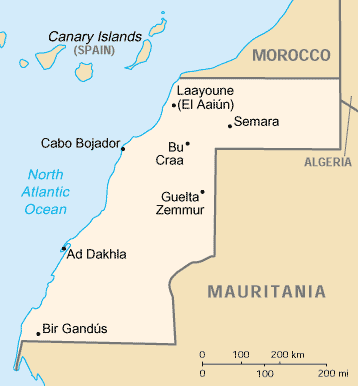
Phantom Countries: Western Sahara

And now we travel to a different kind of phantom country, one generally known as Western Sahara, though its official names is actually the Saharawi Arab Democratic Republic. My previous two phantoms, Taiwan and Somaliland, are examples of places that have many of the things one associates with independent states, but little or no recognition as such. Western Sahara's situation is the opposite. There is very little territory controlled by a self-declared Western Sahara, but as a country it has quite a lot of recognition. Quite a few African and Third World countries maintain diplomatic relations with the SADR, and the idea that there ought to be a Western Sahara is one that retains a lot of support (or lip service) beyond those who formally recognise the SADR. If you look at a world atlas, there is a good chance that Western Sahara will be shown as an independent country, even if it does not exist in any real sense.

So what is this Western Sahara? In the colonial period, it was an Atlantic coast possession of Spain, gaining its rather unimaginative name from its being at the western end of the Sahara desert. As the wind of change blew through Africa, an independence movement emerged in the region, calling itself POLISARIO. In 1975, Spain withdrew from the territory, but by prior agreement it was immediately invaded by Mauritania and Morocco, who carved it up between them. POLISARIO launched a guerrilla war against both of them, with the support of Algeria. Their struggle had the implicit support of the International Court of Justice, which had ruled that the people of the territory were entitled to self-determination.

Initially, POLISARIO's war went well. Mauritania found the going particularly hard. A change of regime there led to Mauritania withdrawing from Western Sahara in 1979 and recognising the rights of the Saharawi Arab Democratic Republic that POLISARIO had declared in 1976. Morocco, however, simply extended its zone to include as much of the Mauritanian territory as it could. Militarily, the Moroccans were able to turn the tables on POLISARIO by fortifying the parts of the country that had the towns and mineral resources, leaving the rebels only with empty desert. At this point the war stalemated, and a ceasefire was agreed in 1991.

The 1991 ceasefire was meant to be the prelude to a settlement of the dispute, but instead it has frozen the conflict. 1992 was meant to see a referendum on whether the territory would join Morocco or become independent; this vote has never taken place, largely because of disputes over who would get to vote in it. The continuing stagnation favours the Moroccan regime, as it has been able to entrench its rule over the territory. It is very hard to see why it is worth POLISARIO's while engaging with this farcical non-peace process, yet if they return to arms, they will most likely be cast as the bad guys who are against peace. The Moroccan regime has also played the Western powers astutely – during the Cold War, they could not be pressured over the Western Sahara, for fear of strengthening the communists, and now it is vital that Morocco control the territory to prevent an al-Qaida take-over there (or in Morocco itself).

One possible glimmer of hope for the plucky Western Saharans was the outbreak in 2005 of disturbances within the Moroccan controlled areas of the territory. This "Independence Intifada" suggests a possible third course of action, between rolling over and accepting Moroccan rule or relaunching the war. At the same time, the balance of forces against Western Sahara is so strong that it is hard to see anything good happening there, unless major changes occur within Morocco itself.

Pictures from Wikipedia

06 May, 2008

Continuing to Betray the Future

The BBC reports that the government of Turkmenistan has decided to move the golden statue of the late President Saparmurat Niyazov from the centre of the capital, Ashgabat. As you know, this was topped by golden statue of Nizayov that turned throughout the day so that it would always face the sun. The statue will now be located near a highway on the edge of the city. It is not known if it will continue to rotate.

The New York Times, meanwhile, reports that Nizayov-era bans on opera, ballet, and the circus have also been revoked: 'A Turkmen Dismantles Reminders of Old Ruler'

Picture from the BBC article.

Hat tip to my learned colleagues from ILX

04 May, 2008

2008: the year millions starve to death?

One thing I really need to write more about is the world food crisis. It is quite striking how this has exploded into the media over the last two months, and I expect it to become a bigger story as food prices continue to rise and increasing numbers of people across the world become unable to feed themselves and their families. I want to write more about this, not so much because any insights I have into the issue are likely to be that fascinating, but more because what I have written so far about it has been pretty facile. Biofuel is definitely not helping the situation, but it is rather simplistic to say that the turning over of relatively small tracts of land to ethanol production is the cause of recent steep rises in world food prices.

Pakistani Judges

The BBC has an interesting article on the recent reinstatement of senior judges in Pakistan: Saga of restoring Pakistani judges

As you know, when Pakistan's president, Pervez Musharraf, staged his autogolpe last year, he illegally sacked a load of senior judges, for fear that they might rule that his unconstitutional acts were unconstitutional. He replaced these judges with some lickspittle toady judges who could be relied upon to give convenient verdicts. Musharraf's autogolpe ultimately failed - although he remains in office as president, effective power now seems to lie with the coalition government of the Pakistan People's Party (PPP) and the Pakistan Muslim League Nawaz (PPP-N). This issue of reinstating the sacked judges has become a source of tension within the government. Nawaz Sharif, head of the PML-N, has taken a hard line, demanding that the sacked judges be reinstated and that the quisling judges who took their jobs be themselves sacked. The PPP (led by Asif Zardari, Benazir Bhutto's widower, and Prime Minister Yusuf Raza Gillani, meanwhile, has taken a more cautious line, arguing that the reinstatement of the judges should take place in the context of a general reform of the judiciary, and that the judges who took the sacked judges' jobs should merely revert to their former positions.

A compromise between the coalition partners seems to have been reached - the judges will be reinstated later this month, and the ones Musharraf promoted will take up their old jobs. However, there are still stormy waters ahead. The incumbent judges could try to keep their flash jobs by ruling against the reinstatement of their predecessors. There is also the theoretical possibility that Musharraf could invoke his constitutional powers to sack the government, in order to prevent the return of judges who might well rule that his continued holding of the presidency is unconstitutional; this is however unlikely, given his total lack of credibility and the government's recent electoral mandate.

One final exciting thing about all this is that the reinstatement of the judges could mean that everything that happened since they were sacked occurred in a legal void, with pretty much everything happening since Musharraf declared his state of emergency being up for legal challenge.

03 May, 2008

Betraying the Future

President Saparmurat Niyazov of Turkmenistan renamed the months of the year after members of his family (and other historical figures). January became Turkmenbashi (Father of the Turkmen), after a title he awarded himself.

Niyazov died in 2006. His successor, President Kurbanguly Berdymukhamedov, has just ordered the months to revert to their former names. It is not clear if there are any plans to remove or alter any of the country's golden statues to Niyazov.

01 May, 2008

Cameroon Diary

One of my former classmates is now in the town of Maga in Cameroon. He is working with the authorities there on a development plan for the locality. And he has a blog about what he is doing there: Tom in Africa

Phantom Countries: Somaliland

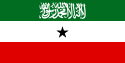
And so to Somaliland. This is a northern part of Somalia, and its attempt to achieve statehood is an example of see-you-around-suckers secession. As you know, the Somali state largely collapsed during the 1990s, with country's territory being taken over by feuding warlords and suchlike. The northern part of the country, however, managed to escape the general chaos that swept the rest of the country. The locals there managed to setup a separate administration and state-like apparatus, albeit one facing a lot of challenges. The leaders of this northern region then proposed to escape permanently from the rest of Somalia's ongoing nightmare by declaring their area independent, and naming it Somaliland.

Thus far no one has granted Somaliland formal recognition. This is not particularly surprising. The international community abhors secession. In Africa, in particular, there is a far that should any borders start to be re-drawn then the whole continent could slip into the abyss as ambitious leaders try to carve out little empires for themselves. But Somaliland has one ace up its sleeve that means it continuously hovers on the brink of formal acceptance in the family of nations. Its borders are the same as those of the pre-independence colony of British Somaliand. This was merged into Italian Somaliland to create the state we know and love as Somalia, but the Somaliland leaders can say that they are merely reversing this artificial union and bringing a previously existing entity back into being as an independent state. The Somalilanders are invoking the principle of uti possidetis, that post-colonial borders should by default follow pre-independence boundaries. This is good (for them), as it allows the prospect of their independence being recognised without setting a precedent that could lead to the disintegration of other countries.

That's about it for Somaliland. Various reports and stuff have recommended that it be allowed to join the family of nations, but for the moment the country remains unrecognised. If the rest of Somalia were to start showing signs of stabilisation then I imagine that the Somalilanders would be pressured to re-integrate with their former compatriots. But there is no prospect of that happening any time soon. The expectation has to be that Somaliland will sooner or later gain external recognition. In the meantime, this phantom country chugs along. Apparently it is quite nice to visit; its unrecognised status does not prevent a trickle of tourists visiting from Djibouti and Ethiopia to sample the hospitality of this strangely peaceful land.

Would you like to know more? Oh look, the International Crisis Group has a two year old report on Somaliland: Somaliland: Time for African Union Leadership

Somaliland flag from Wikipedia

The Lisbon Treaty and Irish Euroscepticism

I was out for dinner with some of my former spymates last Saturday. One of the people there is involved in a campaign against the Lisbon Treaty, and was talking about it with the rest of us. By her own admission, she was rather boring us. At the time I though, well, the Lisbon Treaty is boring, what do you expect? In retrospect, though, it struck me that if a group of former and current International Relations students are not interested in discussing the Lisbon Treaty, then who is?

From that, let me segue into a link to an article appearing on the website of the Dublin Review of Books: 'Battling the Beast of Brussels', by Tony Brown, brought to my attention in a blog post by Nicholas Whyte. Tony Brown is involved with the Institute of European Affairs, a think-tank that promotes the cause of European integration.

Even if you are not that engaged with the Lisbon Treaty, you may be aware that Ireland will shortly be having a referendum on it. Brown's article looks at the people who are campaigning in Ireland for a vote against the treaty. He points out that they are largely the same people and institutions that have campaigned against every previous EU treaty, and that on Lisbon they are making the same outlandish claims that they made in every previous case – that the treaty will lead to the creation of an EU super-army, or that it will lead to enforced abortions, or to the end of neutrality, or to everything being privatised, or to mass impoverishment, and so on. That this did not happen last time seems not to cause any embarrassment to those who said they would, nor does it prevent them being predicted again the next time an EU treaty comes up for ratification.

27 April, 2008

Phantom Countries: Taiwan

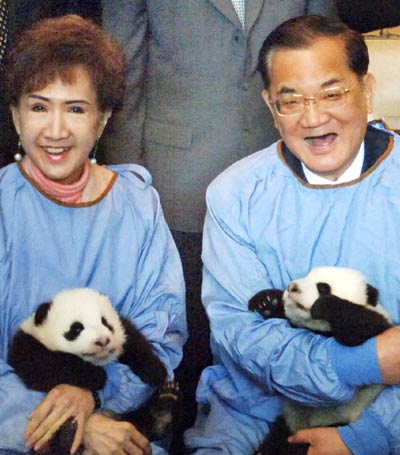
New Series! I thought I would take you on a trip round the world, visiting some funny locations housing unrecognised states or areas that some are trying to turn into new countries. This follows a pub conversation with some of my old spymates, where the unrecognised country of Somaliland was mentioned. I will return to Somaliland later, but first up we have Taiwan (or the Republic of China on Taiwan, which is I think its official title). Taiwan's origins come from the victory of the Chinese Communist Party in the Chinese civil war in the late 1940s. The defeated Kuo Min Tang forces retreated to the island of Taiwan, and set up their own administration there.

Taiwan has often had an anomalous relationship to the rest of China. In the 19th century, it was colonised by Japan, and only came back under Chinese control with the end of the second world war. In an earlier period, it was where the Ming dynasty hung on for a while after losing the rest of China to the Manchurian Qing. The rule of the KMT there under Chiang Kai-Shek continued this tradition, with the regime initially claiming that they were the legitimate government of all of China. More recently, the island's rulers have given up that legal fiction, claiming only to rule a geographically constrained Chinese republic. The rulers ot Taiwan have also been careful never to provoke war with communist China by declaring their island formally independent. At the same time, they do not in any sense acknowledge the overlordship of the Beijing government, and they have cultivated as much of the trappings of an independent state that they can.

Taiwan now is in a strange position. It is effectively an independent country, with its own government, state administration, diplomatic corps, army, flag, and so on. And in many respects, it has been a very successful country. Its economy has performed well over a long period of time, and the fruits of economic growth have been dished out in a relatively egalitarian manner. It has also managed an effective transition from KMT one party rule to a multi-party democratic system in which opposition candidates have been able to win elections and take office. For all that, very few other countries recognise its sovereignty, mainly because it is impossible to retain formal diplomatic relations which China and Taiwan simultanaeously. Its security is underwritten by the USA, but even the USA does not recognise it as a state. The countries that maintain diplomatic relations with it are mostly Central American states. I suspect that the USA leans on them to do this, as a way of giving Taiwanese diplomats someone to play with. Unfortunately for the island's rulers, the rising importance of China proper in world affairs has meant that many of these countries are thinking about transferring their diplomatic recognition to Beijing. It is quite possible, therefore, that Taiwan will have no formal diplomatic recognition in years to come.

My expectation is that Taiwan will nevertheless continue to exist as a de facto country. One could imagine a scenario in which Beijing decides to forcibly resolve the issue, at a time when the USA has given up on supporting its erstwhile unrecognised friend. However, my reading of the balance of military forces is that China would not be able to land an invasion force on the island, and that any attempt to do so would be a costly and humiliating failure. In any case, economic links between the island and mainland are now so strong that a war between them would be patent folly. The continuance of "Panda Diplomacy" between the island and mainland suggests that relations while continue to be relatively cordial.

One possible utopian future outcome would be that if China ever starts to seriously democratise, then Taiwan might be able to mount a reverse takeover of the mainland. Taiwan's experience of democratising while retaining social stability could prove useful to China, and the KMT's continued importance after the transition on Taiwan would be reassuring to people within the CCP who fear that democracy could lead to their extinction.

Taiwan flag from Wikipedia

Conference on Democracy in Africa

Given current events in Zimbabwe, there is a certain topicality to a conference taking place on 21st May next in the Royal Marine Hotel, in Dun Laoghaire. Organised by The African Voice, its title is When Will Democracy Work in Africa. You can read all about it here: Africa Conference. They seem only to have a PDF version of the conference programme, so here, pasted in, are the descriptions of the promised speakers:

"- Mr Phakiso Mochochoko, Senior Legal Advisor (Registry) at the International Criminal Court (ICC) the Hague, Holland on whether there can be lasting peace (democracy) without justice


"- Dr. Petros B. Ogbazghi (PhD)on social exclusion of Africans


"- Mr.Aki Stavrou, Director Integrating Ireland on conflict and peace

- Her Excellency Mannete Ramaili Ambassador-Kingdom of Lesotho on 'Women in Africa: where are they; where should they be?'


"- Maurice Manning, Irish Human Rights commission, will deliver closing remarks"

My old classmate Mark Little is MCing (word), and they are also promising a free lunch and an exhibit on tourism in Africa.

26 April, 2008

Filler

Substantive post coming soon, srsly. In the meantime, here is a blog post by my esteemed correspondent Randy McDonald about Bhutan: After Nepal .... He ponders whether the recent democratisation of Nepal, and the end of its monarchy, could have an impact in nearby Bhutan, a kingdom with a large population of ethnic Nepalese. This impact could perhaps be pressures for real democratisation, or invasion by India.

Whenever Nepal shows up in the news, in whatever context, I always think it's time I went back to local nom nom nom Nepalese restaurant Monty's of Kathmandhu. I am not unique in this kind of approach to world affairs.

12 April, 2008

Totally awesome developments

My thesis on semi-presidentialism in Palestine is now listed in the library catalogue of DCU. As a former librarian, this means a lot to me.

I wish I had given it a snappier title.

Common Knowledge on Ethiopia, Part 2: The Contemporary Situation

The Derg were overthrown in the early 1990s, by an alliance of Eritrean separatists and forces mainly recruited from Tigre. Ethiopia held elections, which were won by the EPRDF (Ethiopian People's Revolutionary Democratic Front, I think), a party led by the Tigrean movement that had defeated the Derg. Eritrea became independent, but at the time it seemed that it would remain forever friends with its large neighbour. Unfortunately, relations between the two countries soured, and a border dispute led to war. In African terms, this war was somewhat unique, in that it saw fighting conducted along a relatively static frontline and was fought mainly by soldiers against other soldiers, rather than against civilians. The war has left a lasting legacy of bitterness between the two countries' governments, and the frontier remains closed. More recently, Ethiopian forces have been deployed in Somalia against the Islamic Courts movement there; Eritrean support for the Islamists has turned this conflict into something of a proxy replay of the Eritrea-Ethiopia war.

Domestically, the rule of the EPRDF have drifted towards more authoritarian rule. Elections in 2005 ended in a shambles when the government announced they had won in a not entirely convincing manner. Protests against this were put down with lethal force, and the entire opposition leadership arrested for a while. Since then, EPRDF figures have talked about how it will take time to build democracy in Ethiopia (perhaps the several hundred years it took to do this in Europe); in any case, some suggest, maybe liberal democracy as seen in the West is not so appropriate for the country. Perhaps related to all this, perhaps not, some areas of the country have seen the re-emergence of ethnic-linguistic-separatist struggles, though these are still somewhat inconsequential.

That makes it sound like Ethiopia is in a lot of trouble at the moment, but that would be an exaggeration. The EPRDF may be creeping towards authoritarianism, but they are not insane maniacs like the Derg or totally rubbish like the later years of the Haile Selaise regime. There are still pressures within the country towards political openness, and the regime has not instituted the kind of full-on authoritarianism that its former allies in Eritrea have. The country remains relatively functional in a way not normally see in sub-Saharan Africa (though I may be in a better position to judge this if I actually go there).

Economically, the country remains heavily focussed on agriculture. Beyond food grown for subsistence or the internal market, coffee is the main cash crop. There is some domestic industry and a growing tourist sector. The country is at the moment experiencing rapid economic growth, but it is unfortunately also suffering from high inflation. Basic foodstuffs in particular are becoming too expensive for the urban poor, pushing them into aid dependency.

Common Knowledge on Ethiopia, Part 1: Historical Context

In this post and the next I will give a basic outline of Ethiopia's history, politics, international relations, and political economy. Some of what I am posting here is culled from paying attention to news media over the years, some from a lifetime of skimming interesting books, some from reading the Bradt guidebook to Ethiopia, and some from going to a lecture last week by Dr. Kassahun Berhanu, former professor of Political Science and International Relations in the University of Addis Ababa.

Ethiopia is an old country with a continuous history from antiquity to the present day. As a mountainous country, it developed in semi-isolation from the rest of Africa and the world generally, though it was never a completely closed country. The country was an early adopter of Christianity, with its national Church developing separately from the Church in Europe (or even the other sects in Egypt and the Middle East). As well as Christians, the country has animists, and Muslims, and it has (or had) a large Jewish population that had also developed in isolation from world Jewry. Ethiopia is also a patchwork of different ethnicities and languages.

Ethiopia's great claim to fame is that it was never colonised. In the late 19th century, the Italians sent an army to conquer the country, but the Ethiopians destroyed it at the Battle of Adowa. King Menelik II was the only African leader to end the Scramble for Africa period with a larger realm than he had had when it started.

In the 20th century, an ambitious nobleman of royal lineage seized the throne from Menelik's heirs. Haile Selaise was overthrown by the Italians in the 1930s, when they successfully invaded the country. He was reinstated when the country was liberated in 1941 by British forces operating in concert with the Ethiopian resistance. Italy's coastal colony of Eritrea was federated with Ethiopia. When Haile Selaise instituted a more unitary regime, the Eritreans launched a long war for independence.

For reasons that have never become clear, Haile Selaise was somehow hailed as a divinity by a strange new religion in Jamaica. Despite his apparently divine nature, his rule became increasingly discredited in Ethiopia, as he grew older and his regime seemed unable to respond to a succession of crises.

Haile Selaise was overthrown and murdered by radical army officers in the early 1970s. These fellows ended the monarchy and ruled as the Derg, a name that sounds wonderfully exotic and conjures up the image of a creepy cabal of cloaked figures meeting in darkened caves; sadly the name just means Committee. The Derg aligned Ethiopia to the USSR in the Cold War, and partly thanks to this alliance they were able to successfully fight a war against the US-backed Somalia. Domestically, they broke the power of the old feudal elite and instituted extensive land reforms that remain in place to this day. Apart from that, they instituted a mini-Stalinist reign of terror. The Eritreans stepped up their independence struggle, and were soon joined in arms against the Derg by a host of ethnic-regional movements.

Ethiopia exploded into the world's consciousness in the early 1980s when famine broke out in Tigre, caused by drought and local crop failures and exacerbated by government action against this separatist region. Simplistic news coverage of this tragic event, in which enormous numbers died, created a false perception of Ethiopia as some kind of permanently arid desert, a far cry from the Ethiopian plateau's status as perhaps the most fertile land in sub-Saharan Africa.

05 April, 2008

I know all about Ethiopia

Look forward to lots of well-informed posts on Ethiopian politics and society, as I am researching the country* preparatory to a possible visit there in July.

They seem to have a semi-presidential semi-democratic political system. Fascinating.

*i.e. reading the Bradt Ethiopia guidebook

The Real Cost of Biofuel

There were two interesting articles in today's Irish Times. One talked about how the price of foodstuffs has rocketed recently in much of Africa, pushing many people into dependence on food aid. Taking Ethiopia as an example country, the article talked about the urban poor are bearing the brunt of the rising cost of food. This is potentially problematic - aside from the impact on the urban poor themselves, it raises the prospect of social instability and rioting.

The odd thing about all this is that there does not seem to be a shortage of food as such - it is just becoming unaffordable. The article failed to inquire as to why this might be the case, but a separate article suggested a possible cause - biofuel. It doesn't take a genius to work out that if you turn land over to the production of biofuel then you are going to be producing less food. In effect, Ethiopians are going hungry so that people in the West can drive cars. UN secretary general Ban Ki Moon has hitherto been swept along by the biofuel hype, but now he is urging caution and warning of the dangers to the world's poor.

Here is a Guardian article on the subject (proably the same as the second of the two articles that appeared in the Irish Times)